Core ideaBad news from God is not a sentence of fate. His warnings call us to pray, to turn from evil and to follow His guidance, because He warns us not to destroy us but so that we will stand.
You are overjoyed to learn you are expecting a child. Then a dream unsettles you: the child in your womb has Down syndrome. Weeks later, a test suggests the same. Fear darkens the road ahead, and you do not know what to do.
Could this be God speaking through the dream? If so, could the God of Light be pronouncing darkness over you? Must you resign yourself to fate, or can you plead with Him for mercy and guidance?
Perhaps you pray:
God, You carefully formed this little one in my womb, and I thank You for this precious life. Have I done something to offend You? If possible, let this cup pass from me. Yet not my will, but Yours. I place my child in Your hands. Give me strength to change what I can and grace to accept what I cannot. You want what is good for me, and I trust in Your goodness.
A dream and a test may not be a word from God. But Scripture records people who did hear dreaded news from God Himself. What do we do when God’s news is not the good tidings we hoped for, but the news we dread?
Hezekiah heard such news: he would die. Nineveh was warned that it would be destroyed. Peter heard that he would deny the Master he vowed to give his life for. Jesus foretold that one of the Twelve would betray Him, and the betrayal came with a kiss.
Death, destruction, denial, betrayal. Does hearing such news from God mean that we can only say, “Let it be to me according to your word” (Luke 1:38)?
It can sound that way. If God has declared what will be, who are we to question His authority? Prayer can seem like unwillingness, and acceptance is the only faith we have left.
We know what Scripture says: “Heaven and earth will pass away, but my words will never pass away” (Matthew 24:35). Is every situation then set in concrete? His words include warnings and commands. The people in these accounts heard Him directly and still had something to do. We may read our own record as a sentence already passed, but they show us otherwise.
The messages were not an end in themselves. God wants none to perish, and He gave His Son, Jesus Christ, that we might have eternal life (John 3:16; 2 Peter 3:9). His unfailing love never ceases; His mercies are new every morning (Lamentations 3:22–23).
Bad news from God does not, by itself, tell us to surrender to fate. It brings us to our need for Him.
That need looks different depending on the news. Hezekiah’s illness is not presented as punishment for wrongdoing. Nineveh’s violence, Peter’s denial, and Judas’s betrayal carry moral responsibility. A person facing death may seek mercy or find peace through faithful acceptance. Someone confronted with wrongdoing cannot call continuing in sin submission to God’s will. God’s prediction of wrongdoing does not justify committing it.
So the key question isn’t whether the news is bad or the outcome unavoidable. It is whether we bring our desires to God, turn from the evil He condemns, and follow the guidance He provides.
Prayer Is Not Defiance
When King Hezekiah became gravely ill, the prophet Isaiah brought a message from the Lord: he was to put his house in order because he would die. Isaiah left. Hezekiah turned his face to the wall and wept bitterly. He later described those days as life cut off in its prime and his voice like the mourning of a dove (Isaiah 38:1–3, 10–14).
Isaiah had not yet left the middle court when God turned him back. The Lord had heard Hezekiah’s prayer and seen his tears. He would add fifteen years to his life (2 Kings 20:4–6).
Hezekiah could not grant himself another morning. He brought his desire to the One who could. He did not defy God by asking to live but appealed to Him for life.
His appeal matched his relationship with God. Scripture describes him as trusting the Lord and holding fast to Him (2 Kings 18:5–6). Faced with Assyria’s threats, he spread the enemy’s letter before the Lord and asked Him to save Jerusalem (2 Kings 19:14–19). In his illness, he again turned to God, and the announcement of his death did not stop him from praying.
Jesus, too, prayed earnestly in Gethsemane, asking that the cup might pass from Him. The cup did not pass. He submitted to the Father’s will above His own and accepted the suffering it represented (Matthew 26:39).
Jesus prayed three times, then rose and went to meet what was coming (Matthew 26:44–46). We too may plead repeatedly. When deep silence comes with peace, we may rest from asking. When there is no peace, we keep waiting on Him.
Hezekiah’s extra years should not measure anyone else’s faith. Accepting death with peace is not fatalism and grief is not rebellion. His case establishes something narrower and sufficient: the announcement did not make an appeal forbidden or pointless.
He could not command the outcome. He could still bring his request to God.
So can the mother who fears for her child. She may plead that the test is wrong or ask for courage if it is right. Prayer does not guarantee the result she hopes for, and a child with Down syndrome is no less a gift from God. Fear may darken her path, but it does not put out God’s light. Whatever the result, she need not face it alone or without Him.
They Changed Their Ways
But what if the news concerns not only what may happen to us, but what we have done or will do?
Jonah announced that Nineveh would be overthrown in forty days. The people believed God. They fasted and put on sackcloth, and even the animals were covered with it. Neither people nor herds nor flocks were allowed to eat or drink. The king set aside his royal robes and sat in the dust. He ordered everyone to call urgently on God and to turn from their evil ways and violence.
Jonah’s message held no promise of mercy, only a number: forty days. Like a mother waiting for her test results, the king could not know the outcome but continued to hope. “Who knows,” he said, whether God might yet turn from His fierce anger so they would not perish (Jonah 3:9). God saw they turned from their evil conduct and withheld the disaster He had announced (Jonah 3:4–10).
This is the principle God describes in Jeremiah 18:7–10. When He announces destruction against a nation, and it turns from its evil, He will relent. A promise of good likewise does not protect a nation that later turns to evil. Human conduct matters within the relationship He describes.
Nineveh believed the warning and changed its ways. Do not call it fate when God calls you to repent.
You Were Told to Pray
When Jesus told Peter he would deny Him three times, Peter insisted he would remain faithful even if it meant dying. Later, in Gethsemane, Jesus found him asleep and told him to watch and pray so that he would not fall into temptation. “The spirit was willing, but the flesh was weak” (Matthew 26:33–41).
Peter declared what he intended to do. Jesus told him what he needed to do.
Peter overestimated his spirit and underestimated his flesh’s weakness. Hours later, he lingered in a courtyard and swore he did not know the man. As he spoke, the rooster crowed. The Lord turned and looked at him. Peter remembered, went outside and wept bitterly (Matthew 26:74; Luke 22:60–62).
We need not assume his devotion was insincere. That is what makes the scene so hard to read. We too can sincerely make a promise beyond what our flesh can keep.
A foretold failure did not cancel the command to resist temptation. Peter was told what would happen but was still responsible for what he had been told to do.
Judas Still Chose the Silver
Judas brings us to the hardest objection: if Jesus’ betrayal was foretold in Scripture, didn’t someone have to carry it out? How, then, can we blame the betrayer?
Jesus places both truths before us. The Son of Man goes as written, yet woe is pronounced upon the man who betrays Him (Matthew 26:24). That does not resolve every question about divine sovereignty and human choice. It does establish the judgment we must preserve: the betrayal was foretold, and the betrayer remained accountable.
Consider what Scripture records Judas doing. John tells us that he took money from the disciples’ common purse. Matthew records that he approached the chief priests, asked what they would pay him to deliver Jesus, accepted thirty pieces of silver, and sought an opportunity to betray Him (John 12:4–6; Matthew 26:14–16).
Before Judas accepted money to betray Jesus, he was already taking money while following Him.
Jesus taught that our hearts follow our treasure and that we cannot serve both God and money (Matthew 6:19–24). James describes how desire entices a person, gives birth to sin, and, when sin is fully grown, brings death (James 1:14–15). A desire need not announce its eventual price when we first entertain it.
The account shows deliberate intention, not a man reluctantly carrying out prophecy. Scripture also does not record Judas using prophecy as his defence. That is the argument we are examining. We must not put it into his mouth. God’s purpose in Christ’s suffering did not justify Judas’s betrayal. He remained accountable for selling an innocent man for silver.
Failure Is a Reason to Return
Peter’s story did not end in the courtyard. Before the denial, Jesus told him that He had prayed for his faith, and instructed him, once he had turned back, to strengthen his brothers (Luke 22:31–32). After the resurrection, He questioned Peter about his love and entrusted him with caring for His sheep (John 21:15–19).
The Christ who knew Peter’s failure also spoke of his return.
This matters when shame begins to sound like a final verdict. We have promised before. We have disappointed people before. Why should this time be different?
Matthew records Judas’s remorse, his acknowledgement that he betrayed innocent blood, his return of the money, and his death (Matthew 27:3–5). The account does not make his death a cure for his sin. God appeals to turn from wrongdoing and live (Ezekiel 18:30–32).
Judas’s remorse was real, but remorse alone could not save him. Was his sin beyond mercy?
Hear Paul. He had approved the killing of Stephen, dragged believers from their homes, and tried to destroy the church. Years later, he wrote that Christ Jesus came into the world to save sinners, “of whom I am the worst.” Then he told us why he received mercy: so that Christ might display His patience in him as an example for all who would believe (Acts 8:1–3; Galatians 1:13; 1 Timothy 1:13–16).
If you tell yourself what you have done is too much for God, look at Paul. Christ’s mercy did not stop at the man who hunted His people. You have not found a sin that exhausts it.
Do not carry this alone. If guilt tells you others would be better off without you, do not be deceived. Jesus’ blood can cleanse the vilest sinner who truly repents. Judas’s story ended with the silver on the temple floor. Yours does not have to.
If you are thinking of ending your life, please tell someone today: a pastor, a trusted friend, or a local crisis line.
Mercy received does not end the work of returning. Another promise alone gives injured people little reason to feel confident. Returning may begin with a plain admission: “I chose this. You were hurt by it. I was wrong.”
That admission must reach the conduct itself. The deception must end. The intimidation must cease. The concealed relationship must no longer be protected by another lie. A pattern we have defended may require help we have refused: oversight, counsel, or removing an opportunity for further wrongdoing.
It must also reach the harm already done. When Jesus came to his house, Zacchaeus declared he would give half his possessions to the poor and repay anyone he had defrauded fourfold, and Jesus declared that salvation had come to that house (Luke 19:8–9). For us, repair may mean returning what we took, correcting a false accusation before those who heard it, or bearing the cost of a loss we caused.
Repair places the injured person’s needs ahead of our wish to feel forgiven quickly. They may need distance. Trust may return slowly, or remain broken. Repentance does not entitle us to dictate their recovery.
Do not use yesterday’s failure to justify today’s surrender.
Why God Warns
God foretold it. Does that excuse what you did? It does not. Why, then, does God warn us at all?
God is gracious and merciful. He did not spare His own Son and will graciously give us all things (Romans 8:32). He tempts no one to evil (James 1:13). In this, we must have confidence.
When God warns that we will fall, He is like a father telling his child, “If you do not stand properly, you will fall.” He does not warn because He wants the child to fall, but so that the child will stand.
God is faithful. He will not let us be tempted beyond what we can bear, and with the temptation will provide a way out (1 Corinthians 10:13). Jesus offered Judas a way out by letting him know He knew what he was about to do, yet Judas went on (Matthew 26:25). He offered Peter a way out by warning him of the weakness of his flesh and telling him to watch and pray. He offered Paul a way out by stopping him on the road to Damascus (Acts 9:3–6).
Forewarning is not to destroy but to avert us from falling into darkness.
You do not need to defy heaven to turn around. You need to answer the God who calls you back.
Related Essays
The Prayer That Does Not Avail Much — why earnest prayer cannot replace repentance or overrule God’s will, from David’s child to Hezekiah’s recovery.
You Know God Forgives. Have You Forgotten He Judges? — mercy is never permission to remain in sin, yet the God who judges also gives a new heart.
Why Judah, Not Joseph? — God does not only preserve the righteous; He also restores the repentant.
Related Ideas
God Has Spoken, But He Still Listens — God’s warnings are not sentences of fate; He speaks so that we will pray, turn and stand.
Repentance Is Not Second-Best — when truth is faced and the direction of life changes, God can rebuild what sin damaged.
Our Need Gives Us Reason to Ask, Not Authority to Decide — bring your desire honestly to God, and leave the answer to His will.
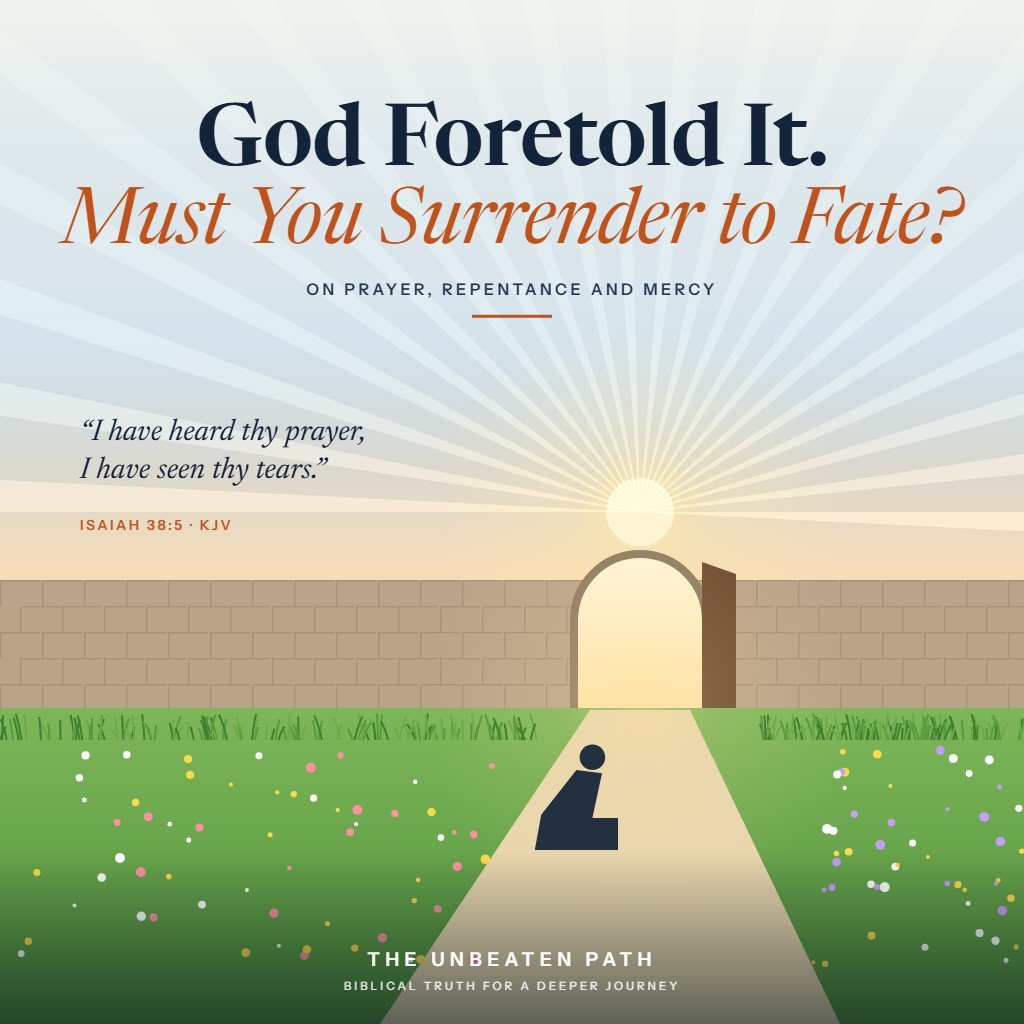
“I have heard thy prayer, I have seen thy tears: behold, I will add unto thy days fifteen years.”
Isaiah 38:5 · KJV
Questions to carry with you
Take one question into your prayer time, or work through them together in a small group or Bible study.
- The essay opens with a mother whose dream and test bring fear for her unborn child. When dreaded news comes, do you tend to resign yourself, or bring it to God in prayer?
- Hezekiah wept and prayed after God’s announcement (Isaiah 38:1–3; 2 Kings 20:4–6), and Jesus prayed three times in Gethsemane before rising to meet what was coming (Matthew 26:39–46). How can we plead honestly with God and still say, “Not my will, but Yours”?
- Nineveh turned from its violence with no promise of mercy, only “Who knows?” (Jonah 3:9). Where might God be calling you to repent rather than call your situation fate?
- Peter sincerely promised more than his flesh could keep (Matthew 26:33–41). In an area where you know you are weak, what would “watch and pray” look like this week?
- Zacchaeus repaid those he had defrauded (Luke 19:8–9). If you have hurt someone, what would returning look like in admission, changed conduct and repair?
Where this essay leads
People in this essay
The same Scripture, explored elsewhere
- Luke 22:31also in You Know God Forgives. Have You Forgotten He Judges?, You May Have Forgotten What You Sowed—God Has Not, The Serpent Is Not an Uninvited Guest in the Garden of Eden: Understanding God’s Divine Plan Through Temptation
- John 21:15also in You Know God Forgives. Have You Forgotten He Judges?, You May Have Forgotten What You Sowed—God Has Not, The Voice That Shapes the Soul
- John 3:16also in The Love That Will Not Leave Us in the Dark, What You Cannot Take With You
- Matthew 26:14also in You May Have Forgotten What You Sowed—God Has Not, You Set Your Heart; God Shapes Your Mind.