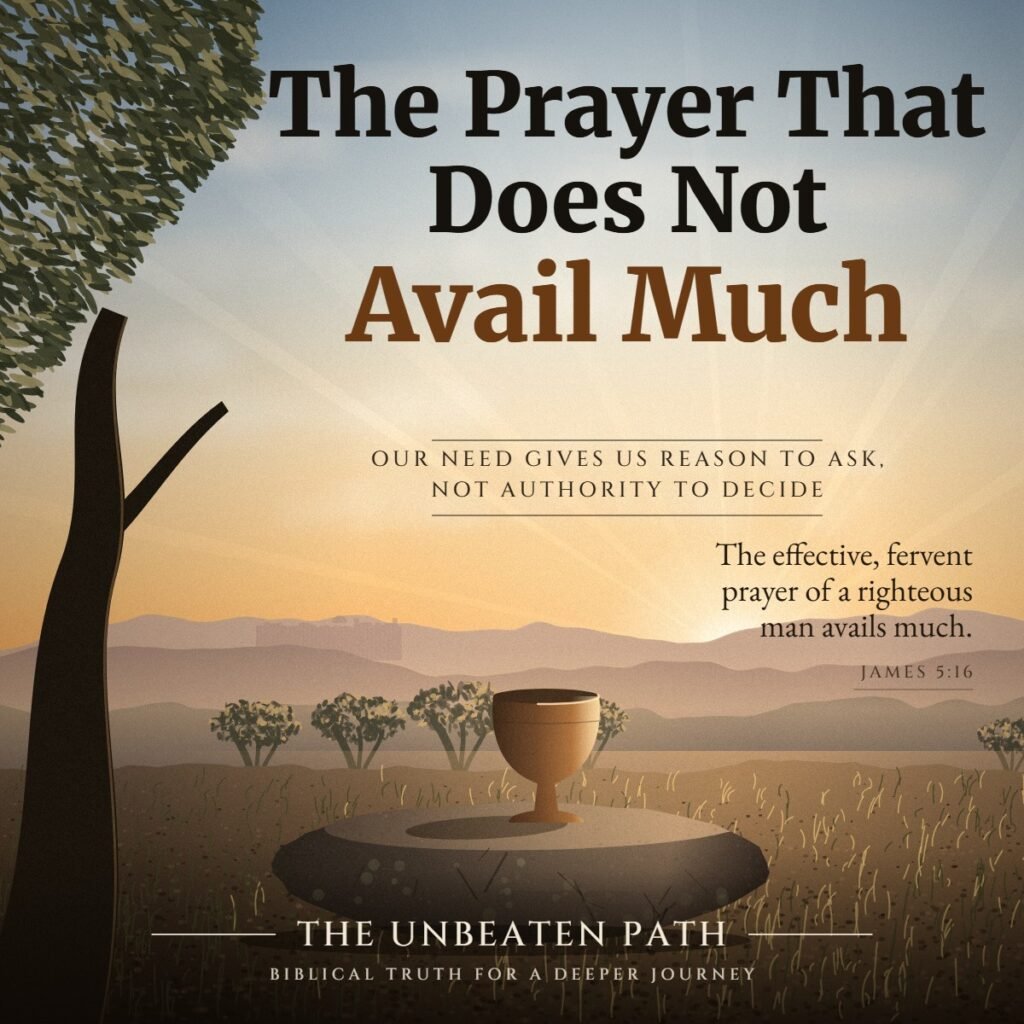
Need is a real reason to pray.
It is not a reason for God to obey.
We ask because we are sick and want to be healed. We ask because something is broken and we want it restored. We ask because a consequence is coming and we want to be spared.
Scripture never tells us to hide those desires from God. It invites us to bring them.
But it also refuses to let our need become the final authority over His answer.
Our need gives us reason to ask. It does not give us authority to decide the answer.
Asking is not the same as deciding
When a request matters deeply to us, we can begin to treat the strength of our desire as proof that it must be right.
We know what the answer would spare us. We know what it would make possible. We know how much it would mean.
All of that may be true. None of it establishes God’s purpose.
David fasted and lay on the ground for his child. His grief was real and his pleading was earnest. Yet Nathan had already announced what would happen, and on the seventh day the child died. David’s need was undeniable. It did not overturn what God had declared. (2 Samuel 12:14–23)
Even the perfect prayer was submitted
The clearest picture of this truth is not a sinner but the Son.
In Gethsemane, Jesus asked that, if possible, the cup might pass from Him. There was no hidden sin in that prayer, no lack of faith, no divided heart.
He also prayed, “Not as I will, but as You will.” (Matthew 26:39)
The cup did not pass. And Hebrews tells us He was heard. (Hebrews 5:7–9)
If the prayer of the sinless Son was offered within submission to the Father, then our prayers cannot be offered on any other terms.
The prayer Jesus taught us to pray begins with God’s will before it reaches our daily bread.
God’s will belongs inside the promise
We sometimes speak of God’s will as though it were an excuse introduced when prayer seems to fail.
John places it at the centre of the promise itself. Our confidence is that God hears us when we ask according to His will. (1 John 5:14–15)
Jesus ties His promise to answer prayer in His name to a purpose: that the Father may be glorified in the Son. (John 14:13)
The promise was never a guarantee that our preferred outcome would be granted. It is an assurance that we are heard by a Father whose purposes are larger than our request.
Submission is not resignation
Submitting a request to God does not mean we stop wanting it.
Paul asked three times for his thorn to be removed. He did not pretend the thorn was pleasant. God answered him: His grace was sufficient, and His power was made perfect in weakness. The thorn remained, but Paul was not left empty. He received strength for the very condition he had asked to escape. (2 Corinthians 12:7–10)
Submission keeps praying honestly.
Resignation stops expecting anything from God at all.
The first trusts Him with the answer. The second has quietly decided that He will not give one.
What submission asks of us
Submitting our requests to God’s will begins with honesty about ourselves.
If we are asking Him to bless what He has told us to abandon, the problem is not the strength of our prayer. It is the sin we are protecting. God calls us to turn, not simply to plead louder. (Isaiah 1:15–17)
If we have been forgiven but a consequence remains, we must not conclude that forgiveness has failed. Mercy can be real while the harvest of what was sown still arrives. (Galatians 6:7–8)
If neither of these applies, we must not manufacture guilt from disappointment. A request can remain ungranted in the life of someone walking faithfully with God.
And if God has made a promise that has not yet been fulfilled, we keep waiting. Delay is not refusal.
The heart that can say both
Mature prayer can hold two things at once.
It can say with all honesty, “This is what I want.”
And it can say with equal sincerity, “Your will be done.”
The first without the second turns prayer into an attempt to command God. The second without the first turns prayer into a formula with no heart in it.
Together they form the kind of prayer Jesus prayed: earnest, honest, and surrendered.
We bring Him our request.
We submit it to His will.
We seek His glory in the answer.
Questions for Reflection
- Is there a request I have begun to treat as something God owes me?
- Do I pray “Your will be done” sincerely, or only after I have stopped expecting an answer?
- Have I confused submission with giving up on God?
- Is there a sin I am protecting while asking God to bless me?
- Can I want something deeply and still leave the answer in God’s hands?
Related Essays
The Prayer That Does Not Avail Much — why earnest prayer cannot replace repentance, cancel every consequence, or overrule God’s will.
Trust God Beyond What You Can Understand — trusting God sometimes means obeying the next step before we understand the whole road.
Will We Still Love God When He Takes Back What He Gave? — Job’s heart kept turning towards God even when his requests were not granted.
Related Ideas
You Do Not Need the Whole Road to Take the Next Faithful Step — God often gives enough light for obedience before He gives full understanding.
The Gifts Can Leave While the Heart Remains — mature faith still wants the Giver when the gift is withheld.
The Delay Is Not the End — the season between asking and receiving belongs to God.
Connected Ideas
Prayer · God’s Will · Submission · Gethsemane · Unanswered Prayer · Grace in Weakness · Repentance · Waiting · Trust · Glory of God