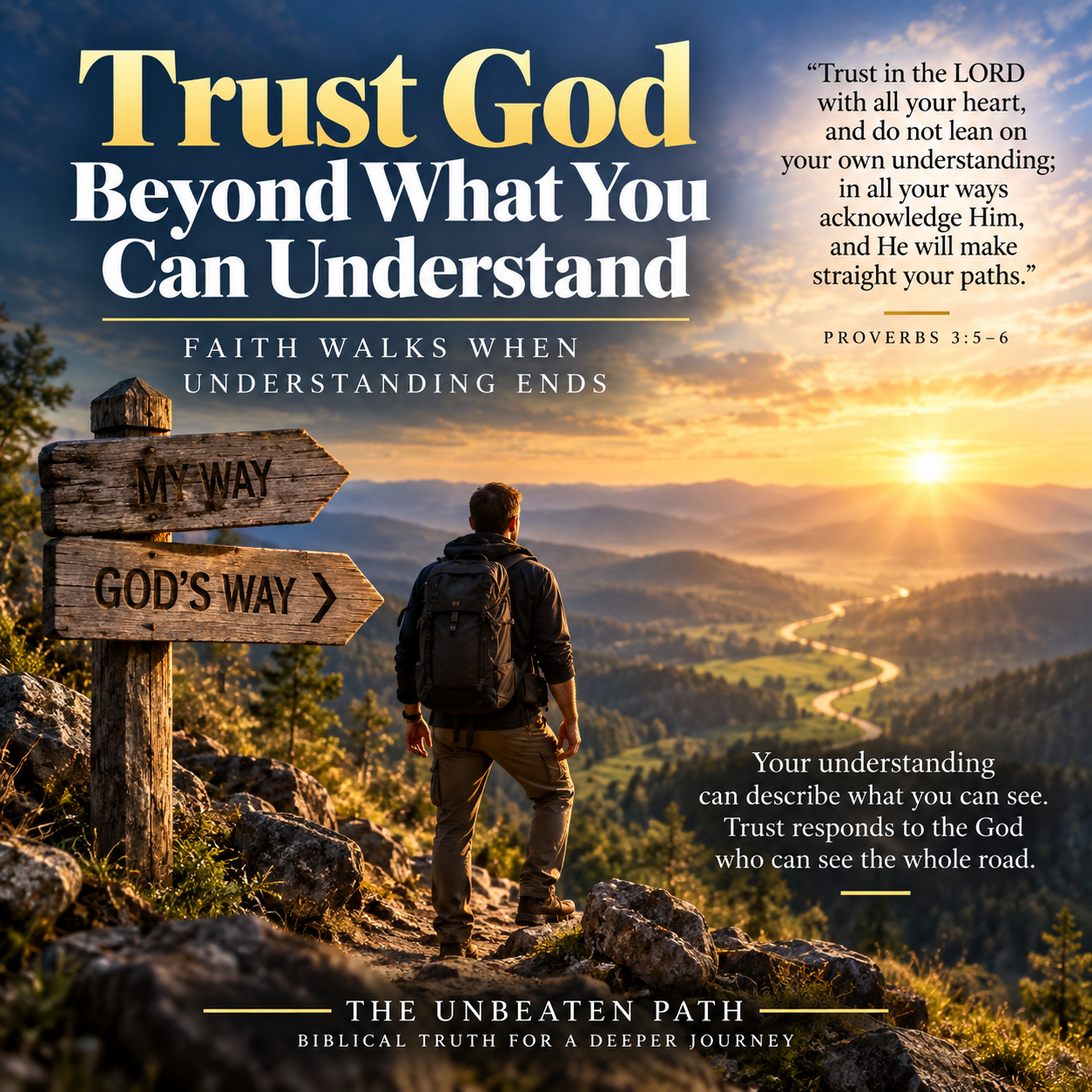
We naturally want to understand before we trust.
We want the explanation before the obedience.
We want to see where the road leads before we take the first step.
We want God to show us how everything will work before we place ourselves fully in His hands.
Proverbs 3:5–6 reverses that order.
Trust in the LORD with all your heart, and do not lean on your own understanding.
This does not mean that understanding is worthless.
It means understanding was never meant to become God.
Human reason is a gift.
But it is a limited gift.
And faith begins when reason recognizes the limits of what it can see.
The Problem Is Not Understanding
Christians are not commanded to stop thinking.
Scripture repeatedly calls us toward wisdom, discernment, careful judgment, and truth.
So Proverbs is not creating a conflict between faith and intelligence.
The danger lies in the word lean.
To lean upon something is to place weight upon it.
It becomes what holds you up.
Our understanding becomes spiritually dangerous when we begin asking it to carry a weight it cannot bear.
The danger is not having understanding. The danger is leaning on it as though it were God.
Your Understanding Is Always Partial
Every human decision is made with incomplete information.
You do not know everything another person is thinking.
You do not know every consequence of today’s choice.
You do not know what will happen tomorrow.
You do not know which apparent setback may eventually become protection.
You do not know which apparent opportunity may eventually become a trap.
You do not even fully know your own heart.
Yet we often make judgments as though the small portion we can see represents the whole.
God does not suffer from that limitation.
That difference is the foundation of trust.
Trust Begins With Who God Is
Trust is not positive thinking.
It is not telling ourselves that everything will happen exactly as we hope.
It is not assuming that every difficult circumstance will quickly become comfortable.
Biblical trust is confidence in God Himself.
That means the question beneath faith is not simply:
“Do I understand what God is doing?”
It is:
“Do I trust who God is when I do not understand what He is doing?”
If trust depends entirely upon explanation, then explanation—not God—has become the foundation of our peace.
Why We Want Understanding First
Understanding gives us a sense of control.
If I know what will happen, I can prepare.
If I know why something happened, I can fit it into a story.
If I know where a road leads, I can decide whether I want to take it.
But God sometimes calls us into places where certainty is unavailable.
Then trust becomes costly.
We must move without possessing the whole map.
We must obey without controlling the outcome.
We must surrender without receiving every explanation.
That is precisely why faith reveals the heart.
Trust With All Your Heart
Proverbs does not say, “Trust the LORD with the part of your heart that agrees with Him.”
It says all your heart.
That includes the part that is afraid.
The part that wants guarantees.
The part that has been disappointed before.
The part that thinks another road looks safer.
The part that wants to retain one final area of control.
Wholehearted trust does not mean fear disappears.
It means fear is no longer given the final vote.
Sometimes Understanding Comes After Obedience
We often assume the proper order is:
- Understand completely.
- Become certain.
- Remove the risk.
- Then obey.
But many acts of faith follow a different order:
- Hear what is true.
- Trust the One who speaks.
- Obey what has become clear.
- Understand more as the road unfolds.
There are things we understand only from inside obedience.
The road looks different once we begin walking it.
Faith therefore does not always wait for complete understanding.
Sometimes obedience becomes the doorway through which deeper understanding comes.
Acknowledge Him in All Your Ways
Proverbs continues:
In all your ways acknowledge Him.
Not merely in religious decisions.
All your ways.
Your work.
Your money.
Your relationships.
Your ambitions.
Your private thoughts.
Your disappointments.
Your plans for the future.
To acknowledge God means more than mentioning Him.
It means refusing to divide life into areas where God may rule and areas where we remain sovereign.
Trust becomes practical when God is allowed into the decisions we most want to control ourselves.
We Often Ask God to Approve a Road We Already Chose
There is a subtle difference between seeking God’s direction and asking God to bless our direction.
We can decide what we want first.
Then pray.
Then search for reasons God should agree.
Then call that guidance.
But acknowledging God means our plans themselves remain open to His correction.
The question is not:
“God, will You make my plan work?”
but:
“God, is this the road You want me to walk?”
God’s Direction May Contradict Your Immediate Logic
There are moments when obedience appears inefficient.
Forgiving may feel weaker than retaliation.
Generosity may feel less secure than holding everything tightly.
Telling the truth may appear more costly than remaining silent.
Waiting may look foolish when everyone else is rushing ahead.
Surrender may look like loss.
But our immediate calculation is not always capable of measuring the full consequence of obedience.
God sees beyond the moment we are trying to survive.
Straight Paths Do Not Mean Easy Paths
The promise continues:
He will make straight your paths.
We should be careful how we understand this.
A straight path is not necessarily a painless path.
God’s direction does not promise the absence of difficulty.
Sometimes the right road still passes through loss.
Sometimes obedience still costs us.
Sometimes God’s path contains waiting, uncertainty, opposition, or suffering.
Straight does not mean comfortable.
It means directed.
The promise is not that every road will feel easy.
The promise is that the life acknowledging God is not abandoned to meaningless wandering.
Faith Is Not a Guarantee That Your Interpretation Is Correct
There is another danger.
We may stop leaning on our understanding only to begin leaning on our feelings.
“I feel God told me.”
But confidence itself does not make an interpretation true.
Trusting God requires humility.
We should remain willing to discover that we misunderstood a circumstance, misread a motive, or confused desire with direction.
True trust is not stubborn certainty in ourselves.
It is increasing dependence upon God.
The Need to Understand Can Become a Form of Control
Sometimes our demand for answers sounds spiritual.
“God, explain this to me.”
There is nothing wrong with asking.
But beneath the request may be another condition:
“I will trust You once Your explanation satisfies me.”
Then understanding has quietly become the price God must pay for our trust.
But God does not always explain Himself on our timetable.
Sometimes He asks us to know enough about Him to walk without knowing everything about the road.
Trust Is Tested Where Understanding Ends
It is easy to trust when God’s direction perfectly matches our expectations.
When the answer arrives.
When the door opens.
When obedience immediately produces visible reward.
But the deeper test comes when the road stops making sense.
When prayer seems unanswered.
When the faithful choice costs more than expected.
When the person who did wrong appears to prosper.
When the path God seemed to open becomes difficult.
Then trust moves from theory into reality.
You Do Not Need the Whole Road
One reason we become anxious about guidance is that we want God to show us the entire future.
But often we are given enough light for the next faithful step.
We want ten years.
God may give today.
We want certainty about the destination.
God may give clarity about the next act of obedience.
The demand to know everything can keep us from doing what we already know.
You do not need to understand the whole road in order to obey God at the next step.
Trust Does Not Eliminate Planning
Trusting God does not mean becoming careless.
We can research.
We can seek counsel.
We can compare options.
We can calculate risk.
We can prepare carefully.
The difference is that none of these tools becomes sovereign.
Planning remains beneath trust.
Reason remains beneath truth.
Strategy remains beneath obedience.
And every plan remains open to God’s correction.
When God Changes the Road
Sometimes we trust God for a particular outcome rather than trusting God Himself.
We say we are surrendering, but secretly we have already written the ending.
Then when circumstances change, we assume God has failed.
But perhaps the road changed because our understanding was never the whole story.
Trust leaves room for God to redirect us.
It can release a plan without releasing God.
It can surrender an expectation without surrendering faith.
It can say:
“I do not understand this road, but I still want the God who leads me.”
The Principle
Faith does not require you to understand everything before you obey.
Use your mind.
Seek wisdom.
Ask questions.
Examine circumstances.
But do not confuse the limits of your understanding with the limits of God’s sight.
Your understanding can describe what you can presently see.
Trust responds to the God who sees the whole road.
And sometimes the narrow way begins with a step you cannot yet fully explain.
Questions for Reflection
- Where am I demanding complete understanding before I am willing to obey?
- Am I using wisdom as a tool, or leaning upon my own reasoning as my final authority?
- Is there an area of life where I have already decided what God must do before I will trust Him?
- What next step of faithfulness is already clear even though the entire road is not?
- Where might fear of uncertainty actually be a desire for control?
- If God changes the outcome I expect, will I still trust the One leading me?
Related Essays
Trial Is Not Proof of Rejection — difficult circumstances do not automatically mean that God’s direction has failed or that He has abandoned His people.
The Temptation — temptation often makes a competing road appear more reasonable than obedience to God.
You Can Predict Your Future! — the direction repeatedly chosen eventually forms character and produces fruit.
Will We Still Love God When He Takes Back What He Gave? — Job shows what trust can look like when explanation fails and the gifts of God disappear.
Related Ideas
You Do Not Need the Whole Road to Take the Next Faithful Step — God often gives enough light for present obedience before He reveals enough of the road for complete understanding.
Your Direction Predicts Your Destination — understanding the entire future is unnecessary for choosing the next faithful direction.
The Battle Is Often Won Before the Moment — trust formed before crisis makes obedience more available when circumstances become confusing.
Connected Ideas
Trust · Understanding · Wisdom · Faith · Obedience · Guidance · Control · Surrender · Discernment · Uncertainty · Direction · Dependence