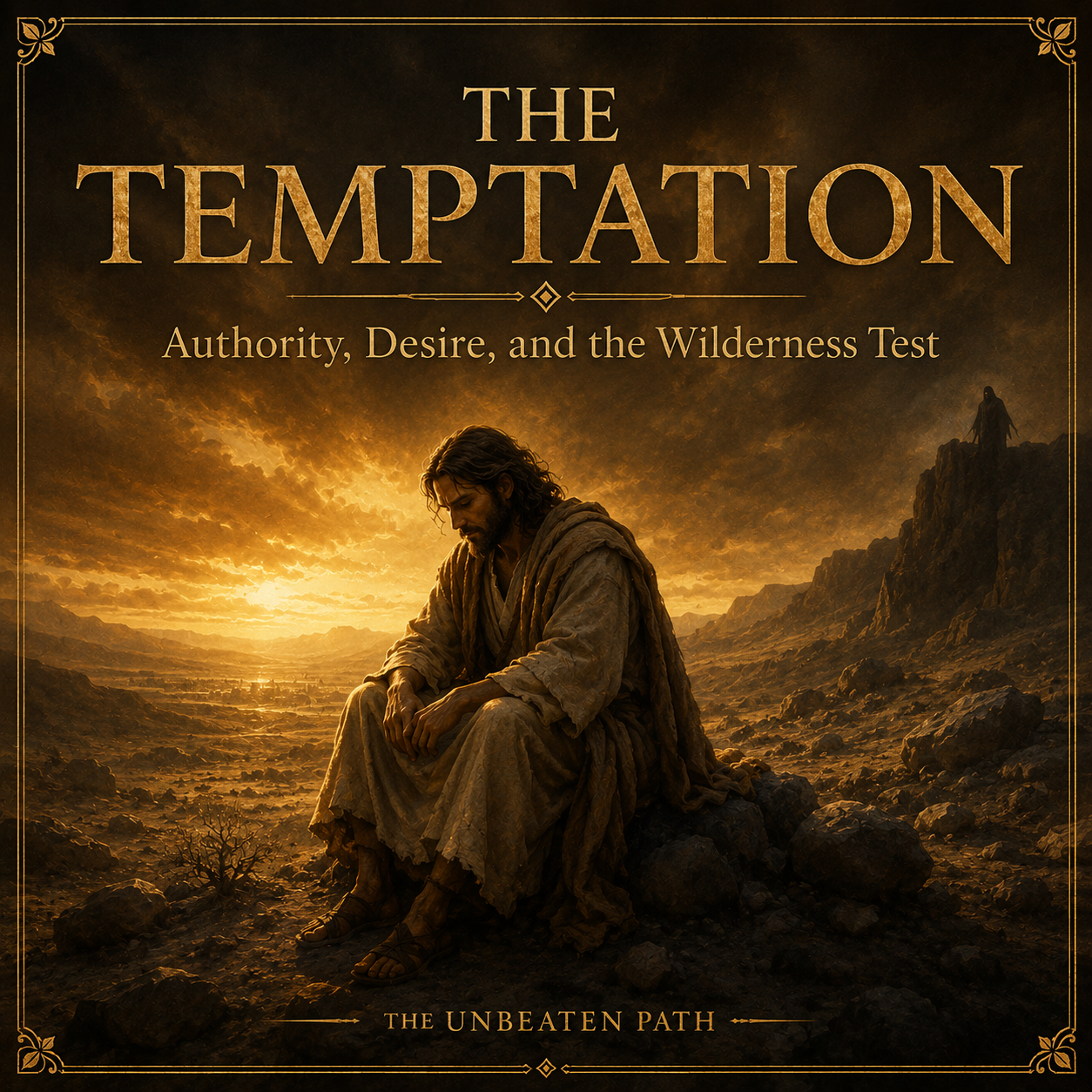
“Then Jesus was led by the Spirit into the wilderness to be tempted by the devil.” — Matthew 4:1
Temptation is one of the most misunderstood parts of the Christian life.
We often imagine that temptation means something has gone wrong, that we have become unusually weak, or that God has somehow moved far away. Yet Scripture gives us a very different picture.
Jesus Himself was led into the wilderness and tempted.
The presence of temptation therefore does not automatically mean the absence of God. The more important question is what temptation reveals about the heart, the mind, and the authority we are willing to obey.
Temptation Rarely Looks Like Destruction
If temptation appeared in its final form, it would often be easier to reject.
No one is usually tempted by the ruin itself.
We are tempted by what appears to come before the ruin: relief, pleasure, advantage, recognition, control, security, revenge, comfort, or an easier path.
The bait is visible. The hook is not.
This is why Ecclesiastes 9:12 compares human beings to fish caught in a cruel net and birds caught in a snare. The danger often arrives unexpectedly. The creature sees what attracts it, not what will hold it.
Temptation works in a similar way. It presents the immediate gain while concealing the deeper cost.
The Wilderness Exposes What Comfort Can Hide
Jesus entered the wilderness after His baptism, after the Father’s affirmation, and before the public unfolding of His ministry.
The wilderness stripped away ordinary comforts.
There was hunger.
There was isolation.
There was no crowd to impress and no earthly support to lean upon.
In that setting, temptation pressed directly upon identity, appetite, trust, power, and obedience.
That is often what trial does. It removes the noise that allows hidden loyalties to remain unseen.
Comfort can make faith appear stronger than it is. Pressure reveals what we actually depend upon.
The First Temptation: Use Power to Serve Appetite
The devil first challenges Jesus to turn stones into bread.
Hunger itself was not sinful. Bread was not evil. The temptation was deeper.
Would Jesus use His power independently of the Father’s will in order to satisfy an immediate need?
This is a recurring pattern in temptation: something legitimate is used to justify an illegitimate path.
We can want something good and still pursue it wrongly.
Food is good. Rest is good. Success can be good. Marriage is good. Provision is good. Recognition can be useful. But any good desire can become spiritually dangerous when it begins to overrule obedience.
Jesus refused to let hunger become His master.
He answered with God’s Word.
The Second Temptation: Force God to Prove Himself
The devil then takes Jesus to the temple and urges Him to throw Himself down.
This temptation appears spiritual because Scripture itself is quoted.
That is important.
Not every religious-sounding argument is faithful.
Scripture can be quoted while its purpose is distorted.
The temptation was to turn trust into presumption: to manufacture a crisis and demand that God prove His faithfulness through rescue.
Faith trusts God without manipulating Him.
Presumption creates the danger and then demands a miracle.
Jesus refuses to test the Father.
The Third Temptation: Gain the Kingdom Without the Cross
The final temptation offers Jesus the kingdoms of the world in exchange for worship.
The offer is not merely power.
It is a shortcut.
It offers destination without obedience, glory without suffering, rule without sacrifice.
Many temptations take this form.
The goal may even appear good, but the proposed path bypasses God.
We want the result without the formation.
We want success without faithfulness.
We want authority without surrender.
We want blessing without the narrow road that teaches us how to carry it.
Jesus refuses the shortcut because worship belongs to God alone.
Temptation Is a Battle Over Authority
Beneath all three wilderness temptations stands one question:
Who will define what Jesus should do?
Will hunger define the decision?
Will the devil’s interpretation of Scripture define the decision?
Will the promise of immediate power define the decision?
Or will the Father’s Word remain the governing authority?
This is why temptation is not merely a battle against bad behaviour.
It is a contest over lordship.
The Word Must Be Present Before the Crisis
Jesus answered temptation with Scripture because the truth was already present within Him.
This principle is reflected in Joshua 1:8: meditate on God’s Word day and night, carefully doing what it says.
The command is not to begin thinking about truth only when danger arrives.
The Word is to become a continual environment for the mind.
Why?
Because the moment of temptation is a poor time to begin deciding what we believe.
If God’s goodness, authority, and truth remain unsettled until desire becomes intense, we have already entered the battle unprepared.
The strongest resistance is often formed before the temptation appears.
What We Rehearse Becomes Available Under Pressure
Pressure does not usually give us time for lengthy theological reflection.
When fear, anger, desire, or opportunity suddenly rises, we tend to reach for what has already been rehearsed within us.
If resentment has been rehearsed, retaliation comes easily.
If lust has been rehearsed, compromise comes easily.
If fear has been rehearsed, retreat comes easily.
If Scripture has been rehearsed, truth becomes available when the lie arrives.
This is why meditation matters. We are not merely collecting verses. We are training the mind to recognize reality according to God.
Temptation Studies Timing
Ecclesiastes warns that a snare can fall suddenly.
Temptation often comes when we are tired, lonely, angry, discouraged, successful, wounded, bored, or overconfident.
The exact opening differs from person to person.
For some, vulnerability increases in suffering.
For others, it increases in prosperity.
Some become careless when exhausted.
Others become careless after victory.
Knowing this is part of vigilance.
We do not need to fear every moment, but we should know when our judgment is most likely to be weakened.
The Enemy Does Not Need a Huge Door
Temptation often begins with a small permission.
One thought we refuse to challenge.
One resentment we decide to keep.
One compromise we tell ourselves will happen only once.
One desire we secretly protect from God’s authority.
One shortcut that appears too useful to refuse.
The danger is not that one small act instantly determines everything. The danger is that repeated permission forms direction.
What is tolerated can become familiar.
What becomes familiar can become normal.
What becomes normal can eventually become a master.
Temptation Often Uses Truth Mixed with Distortion
The devil’s use of Scripture in the wilderness teaches another important lesson.
Deception is often strongest when it contains enough truth to sound trustworthy.
A half-truth can be more dangerous than an obvious lie because it does not immediately trigger resistance.
“God wants you to be happy.”
“You deserve better.”
“Surely God understands.”
“This opportunity may never come again.”
Each statement may contain something that sounds reasonable. But the question is what conclusion it is being used to justify.
Discernment does not ask only whether a statement contains truth.
It asks whether the truth is being used faithfully.
The Battle Is Often Won Before the Moment
We usually think victory means saying no at the final moment.
Sometimes it does.
But many victories are decided earlier.
The decision to remain in Scripture.
The decision to confess weakness rather than hide it.
The decision to avoid an environment that repeatedly weakens us.
The decision to settle God’s goodness before disappointment arrives.
The decision to obey before emotion agrees.
These quiet decisions reduce the power of temptation later.
Preparation is therefore part of resistance.
Jesus Did Not Debate the Tempter Forever
There is also wisdom in the brevity of Jesus’ response.
He did not enter endless negotiation.
There comes a point when continued discussion with temptation is itself dangerous.
If God has spoken clearly, we do not always need another argument.
We need obedience.
Many compromises occur because we keep reopening a question God has already answered.
Temptation gains strength through prolonged negotiation.
Truth closes the conversation.
Temptation Reveals What We Worship
The final wilderness temptation makes worship explicit, but worship is present beneath every temptation.
What will we treat as ultimate?
Appetite?
Safety?
Success?
Recognition?
Power?
Or God?
Temptation reveals what we are willing to disobey God in order to obtain or preserve.
That thing has begun to compete for the heart’s worship.
The Way of Escape May Look Like Loss
One reason temptation is difficult is that obedience can feel costly in the moment.
To refuse may mean losing an opportunity.
To tell the truth may mean embarrassment.
To forgive may mean surrendering the pleasure of revenge.
To remain sexually faithful may mean carrying unmet desire.
To follow God’s timing may mean waiting while others appear to move ahead.
Temptation magnifies the immediate cost of obedience and minimizes the eventual cost of disobedience.
Faith reverses that perspective.
It believes that losing something in order to remain with God is not the ultimate loss.
Remain Ready
Ecclesiastes reminds us that the snare can come suddenly.
Joshua reminds us to keep God’s Word continually before us.
Matthew shows us Jesus facing temptation without surrendering His identity, trust, obedience, or worship.
Together they give us a practical picture of readiness.
Do not wait for the crisis to decide what is true.
Do not wait for desire to become overwhelming before deciding whom you will obey.
Do not wait for the snare to close before learning where the bait is placed.
Know God’s Word.
Know your vulnerabilities.
Know the voice of the tempter.
And settle the question of authority before the moment of pressure arrives.
Temptation is real.
But so is the possibility of obedience.
Temptation Can Come Through Success as Easily as Suffering
We often become alert when life is painful and careless when life is going well.
But success creates its own temptations.
Prosperity can tempt us to believe we are self-sufficient. Recognition can make us hunger for applause. Influence can persuade us that ordinary obedience no longer applies to us. Achievement can slowly replace gratitude with entitlement.
The wilderness tempts through lack. Success can tempt through abundance.
Both ask the same question: will God remain the center when circumstances change?
The believer must therefore remain watchful not only when desperate, but also when comfortable.
Temptation and Testing Are Not the Same Thing
Scripture can speak of the same difficult moment from two different directions.
A trial can expose and strengthen faith. Temptation seeks to turn that same pressure into disobedience.
God does not entice us toward evil, but He may permit circumstances in which our allegiance becomes visible.
The enemy then tries to exploit the pressure.
Hunger itself was not evil in the wilderness. The temptation was to answer hunger apart from the Father’s will.
Waiting itself is not evil. The temptation may be to force the timing.
Ambition itself is not always evil. The temptation may be to compromise worship in order to obtain the position.
Understanding this distinction helps us stop asking only, “How do I escape this pressure?” and begin asking, “How do I remain faithful within it?”
Know the Pattern That Repeats in Your Own Life
Temptation is rarely completely random.
Most of us have patterns.
We know the situations in which anger rises quickly.
We know the kind of praise that makes pride hungry.
We know the loneliness that makes certain compromises appear comforting.
We know the fatigue that weakens discipline.
We know the fear that makes us reach for control.
Wisdom does not pretend these patterns do not exist.
It names them.
Once a pattern is recognized, practical boundaries can be established before the vulnerable moment arrives.
This is not weakness. It is humility.
Do Not Fight Every Battle Alone
Temptation often becomes stronger in secrecy.
What remains hidden can grow without correction.
A believer who is ashamed of weakness may withdraw precisely when wise fellowship is most needed.
Yet confession, accountability, prayer, and honest friendship can interrupt the isolation in which temptation thrives.
We do not need to announce every struggle to everyone. But we should not build a spiritual life in which no trusted person knows where we are weak.
Pride says, “I can manage this alone.”
Wisdom says, “I know enough about myself to ask for help before the snare closes.”
The Enemy Often Returns to an Old Question
Some temptations disappear quickly. Others return again and again.
Repeated temptation does not mean obedience is useless.
It means vigilance may need to become a long discipline.
A door that has been closed once may need to remain closed tomorrow.
A truth that answered fear yesterday may need to be remembered again next week.
Faithfulness is not always one dramatic victory. Sometimes it is a thousand quiet refusals to leave the path God has already shown us.
Preparation Is Not Legalism
Some people resist spiritual disciplines because they fear becoming mechanical.
But preparation is not the same as trusting in rules.
A guardrail does not save a driver by itself, but it recognizes that a dangerous edge exists.
In the same way, habits of prayer, Scripture, rest, accountability, and wise boundaries do not replace grace. They help us remain attentive to grace.
The goal is not to create a life so controlled that temptation becomes impossible.
The goal is to create patterns that make obedience more available when pressure comes.
The Strongest Answer Is a Settled Heart
Jesus’ victory in the wilderness was not merely the ability to quote the correct verse.
His heart was settled in the Father’s will.
Scripture expressed that settled allegiance.
This is the deeper goal of Christian formation.
We want truth to move from the page into the heart until obedience becomes more than a forced decision.
We want to know God well enough that the shortcut loses some of its appeal.
We want His goodness to be sufficiently settled that the serpent’s question sounds familiar rather than persuasive.
We want worship to be sufficiently ordered that power cannot buy our allegiance.
This does not make us beyond temptation.
It makes us better prepared to recognize what temptation is asking us to surrender.
Related Ideas
The Battle Is Often Won Before the Moment — temptation may arrive suddenly, but obedience is usually strengthened beforehand through Scripture, settled convictions, wise boundaries, repeated surrender, and small acts of faithfulness.
The Enemy Attacks Trust Before Behavior — outward compromise often begins after trust, interpretation, desire, or fear has already been redirected.
Temptation Begins by Questioning God’s Goodness — temptation becomes persuasive when God’s boundaries begin to look like deprivation rather than wisdom.
The Voice You Obey Becomes the Master You Serve — repeated obedience gives increasing authority to the voice we continually choose to follow.
Connected Ideas
Temptation · Wilderness · Authority · Obedience · Desire · Scripture · Meditation · Discernment · Snare · Vigilance · Worship · Shortcuts · Preparation · Resistance