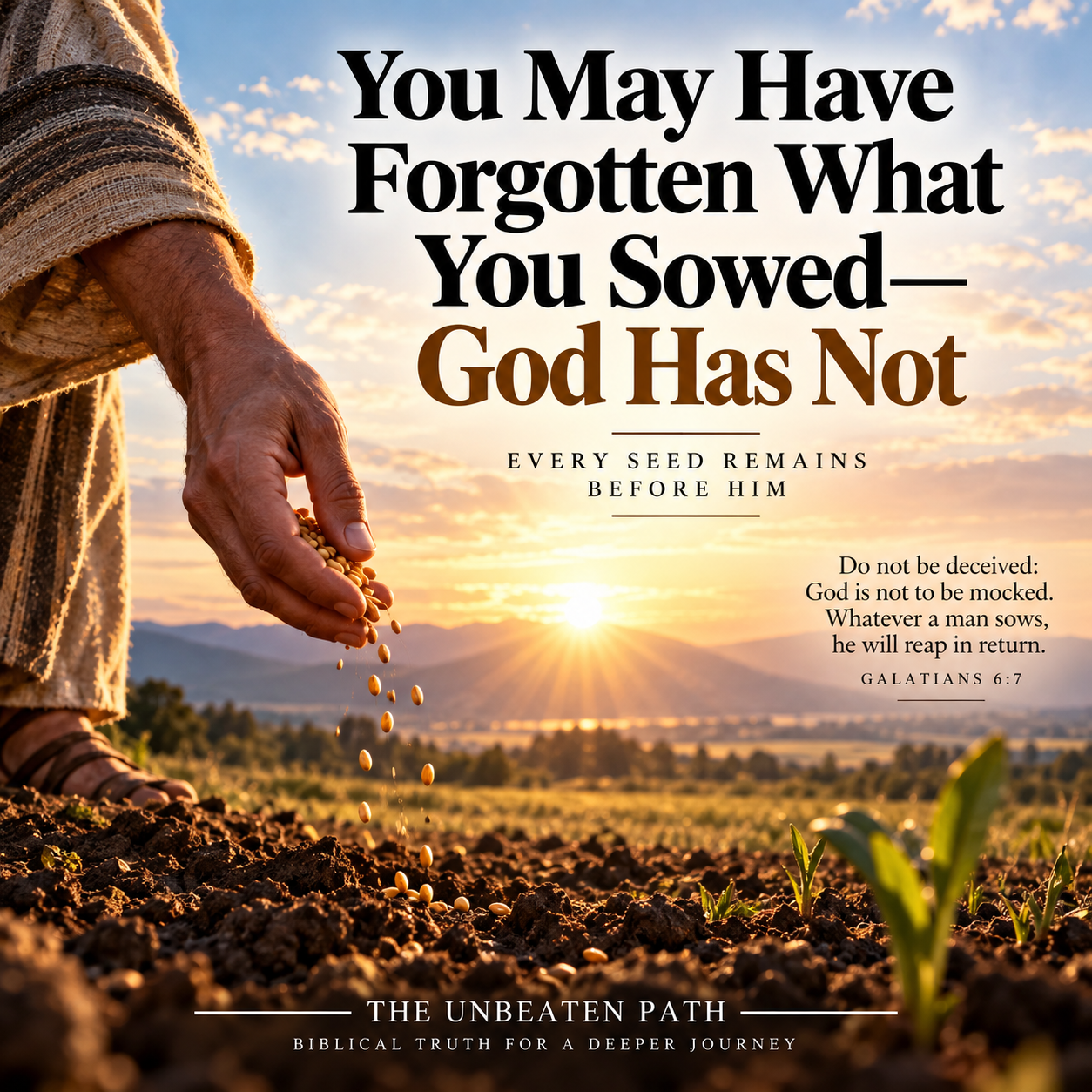
Do not be deceived: God is not to be mocked. Whatever a man sows, he will reap in return.
Galatians 6:7
The Seed Did Not Disappear
You may no longer remember the anger you cultivated, the truth you concealed, the person you wounded, or the good you withheld when it was within your power to act. Time has carried the moment away. The people involved may have moved on. Because no consequence appeared, you assumed the matter had ended.
But time does not destroy a seed.
It only carries it closer to harvest.
Scripture declares an order that cannot be overturned: Whatever a man sows, he will reap in return. The seed may remain beneath the ground for years. Nothing on the surface may reveal what is growing below. But the silence of the field does not mean the seed has died.
Man may forget what he has sown.
God does not.
This is why Paul begins with a warning: “Do not be deceived.” The greatest danger is not that man can deceive God, but that he can deceive himself. He mistakes delayed consequence for escaped consequence. He interprets God’s patience as God’s indifference. He continues sowing because the field has not yet answered.
But God is not mocked.
Neither time nor secrecy removes a deed from His government. Evil is not overlooked because it was committed long ago. Good is not forgotten because no one saw it. Each seed remains before God until He brings it to its appointed harvest.
The Bible records this equation working through human lives.
A Universal Law Under a Sovereign God
Every civilisation has observed that what a man sends into the world eventually returns to him. Hinduism calls it karma. The Chinese call it 报应. English speaks of retribution, or of chickens coming home to roost.
Different cultures have seen the pattern.
But Scripture reveals who governs it.
Sowing and reaping is not an independent force operating above God. It is not an impersonal universe balancing its own accounts. The harvest returns because God sees, remembers and judges.
The law may operate universally like gravity, but it is not impersonal.
The harvest does not return because the universe remembers.
It returns because God does.
This law governs both evil and good. Retribution usually describes the return of evil, but Galatians speaks of two fields and two harvests:
The one who sows to please his flesh, from the flesh will reap destruction; but the one who sows to please the Spirit, from the Spirit will reap eternal life.
Sowing to the flesh is not confined to obviously sinful acts. It means that the self remains the purpose of what is done.
A man may give in order to be praised.
He may serve in order to gain influence.
He may help another person to secure a future return.
He may appear sacrificial while remaining the intended beneficiary of everything he does.
The flesh can sow into another person while still intending to reap everything for itself.
To sow to the Spirit is to live according to the two greatest commandments: to love God with all our heart, soul, mind and strength, and to love our neighbour as ourselves.
The decisive question is not merely: What did I do?
It is also: For whom was it done?
The flesh makes the self the field, the sower and the intended harvest.
The Spirit is willing to plant a seed whose fruit another person may live to enjoy.
Adam and Abraham: Two Seeds, Two Directions
Adam was given life, provision and fellowship with God. Yet he took from the tree God had forbidden. The serpent promised that he would become like God, knowing good and evil. Adam reached for the right to determine life apart from the One who gave it.
He sowed independence from God. He reaped separation from God.
The man who sought elevation was brought down. The man who took what was forbidden lost access to what had been freely given. He reached for greater life and brought death into the world.
The seed appeared to offer more. Its harvest left him with less.
What man takes outside God’s will eventually takes something from man.
Abraham moved in the opposite direction. He left his country without knowing where God would lead him. He lived as a foreigner in the land God had promised. He waited for a son when his own body and Sarah’s womb appeared incapable of producing one. Later, he placed that son upon the altar because God had spoken.
Again and again, Abraham sowed faith into ground that appeared unable to support it.
The harvest did not come quickly. Much of it did not arrive within his lifetime. He died having seen only the beginning of what God had promised. Yet generations lived inside the harvest of his obedience.
Adam distrusted God despite possessing everything. Abraham trusted God while possessing nothing but a promise.
One man reached outside God and brought death to his descendants. The other surrendered everything to God and became a blessing to nations.
A man may finish his earthly life before his seed finishes bearing fruit.
Cain: Resentment Reaped Mastery
Cain’s harvest did not begin when he murdered Abel. It began when he allowed anger to remain within him.
God warned him before the murder: Sin was crouching at his door. It desired him, but he had to master it. Cain was still standing before the seed. He could humble himself and obey God, or continue cultivating resentment against his brother.
Cain chose resentment.
Resentment produced hatred.
Hatred produced murder.
Murder produced separation and restless wandering.
Cain did not merely reap punishment for one violent act. He became mastered by what he had refused to master.
What he permitted within his heart eventually determined the world he had to live in.
Jacob: Deception Reaped Deception
Jacob deceived his father in order to receive the blessing intended for Esau. He approached Isaac wearing his brother’s clothes and the skins of young goats, presenting himself as someone he was not.
Later, Laban deceived Jacob by placing Leah where Jacob expected Rachel. The man who had used disguise to deceive his father was himself deceived because darkness concealed one sister from another.
Years later, Jacob’s sons dipped Joseph’s robe in the blood of a goat and presented it to their father. Once again, clothing and a goat were used to deceive.
Jacob sowed deception through his father's weakness. He reaped deception through his uncle and his sons.
The incidents were not identical, but the seed returned according to its nature. Jacob may have forgotten the garment he wore before Isaac, but deception had not disappeared from his field.
The seed we sow may return through hands we never expected.
Pharaoh: Destruction Reaped Destruction
Pharaoh commanded that the sons of the Hebrews be thrown into the Nile. He used water as an instrument of death against a people he feared.
Years later, when Israel departed from Egypt, Pharaoh pursued them into the divided sea. The water through which Israel escaped closed over his army.
Egypt had sown the destruction of Israel’s sons through water. Egypt reaped the destruction of its own power through water.
But Pharaoh’s harvest was also growing within him. Each time he resisted God, resistance became more deeply established. Every refusal prepared him for another refusal until he pursued Israel into the place of his own destruction.
The judgment that overtook him externally had first been cultivated internally.
A man who repeatedly hardens himself against God may eventually become unable to recognise the moment when he should turn back.
Israel and Rahab: The Near Rejected; the Stranger Entered
When Israel reached the border of Canaan, twelve spies saw the same land, the same fruit and the same fortified cities. Joshua and Caleb believed that God could give Israel the land. The other spies cultivated fear among the people.
Israel declared that they would die in the wilderness.
They reaped the future their unbelief had chosen.
The generation brought to the border of promise refused to enter. Their children received the land their parents had been unwilling to trust God for.
Rahab stood on the other side.
She lived in Jericho, a city appointed for destruction. By birth, nationality and residence, she belonged to what was about to fall. Yet she had heard what the God of Israel had done. She believed, sheltered the spies and placed the scarlet cord in her window.
When Jericho fell, Rahab’s household remained. Her harvest was greater than survival. She was brought into Israel and eventually entered the genealogy of Christ.
Israel had seen God divide the sea, yet sowed unbelief and remained outside. Rahab had only heard what God had done, yet sowed faith and was brought inside.
Those nearest to the promise did not enter through proximity. The stranger entered through faith.
A person’s past may explain the field in which he stands. It does not prevent faith from planting a different future within it.
Joseph and Saul: One Waited; the Other Grasped
Joseph’s faithfulness appeared, for many years, to produce the wrong harvest.
He served faithfully in Potiphar’s house and was falsely accused. He resisted temptation and was sent to prison. He interpreted the cupbearer’s dream and was forgotten.
Obedience did not immediately open the prison door.
But the absence of visible reward did not mean that nothing was growing. In the house and in the prison, Joseph was learning to serve, govern and remain faithful under conditions he could not control. The years that appeared wasted were preparing him to carry authority over Egypt.
Joseph sowed faithfulness when faithfulness seemed to bring him no advantage. He reaped the capacity to preserve nations—including the brothers who had sold him.
Saul responded differently.
He continually attempted to preserve his throne, his reputation and his right to rule. When God commanded him to destroy Amalek completely, Saul spared what appeared valuable and blamed the people. When Samuel confronted him, Saul remained concerned that Samuel honour him before the elders. Later, when David’s favour increased, Saul devoted himself to destroying the man God had chosen.
Everything Saul did to preserve his kingship hastened its loss.
He protected his reputation and lost God’s approval.
He defended his throne and lost his kingdom.
He pursued David and drove himself towards destruction.
Joseph did not grasp for authority, and God raised him. Saul would not release authority, and God removed it.
The one who waited became capable of carrying power. The one who grasped became possessed by the fear of losing it.
What man refuses to release to God may become the very thing that destroys him.
Solomon and Rehoboam: A Divided Heart Became a Divided Kingdom
Solomon began by asking God for wisdom to govern His people. God gave him wisdom, riches and honour beyond what he had requested.
But Solomon later loved many foreign women, which turned his heart toward other gods. He did not wholly follow the LORD. He built places of worship for the gods of his wives and allowed divided devotion to take root within him.
After Solomon’s death, the kingdom was divided.
What first occurred invisibly within the king eventually appeared visibly within the kingdom.
Rehoboam completed what Solomon had begun. When he became king, the people asked him to lighten the heavy burden his father had placed upon them. The elders advised him to serve the people and answer them kindly. Rehoboam rejected their counsel and followed the advice of the young men who had grown up with him.
He threatened to make the people’s burden heavier. Rehoboam used severity to prove his strength. He believed harsher rule would establish greater authority.
Instead, ten tribes rejected the house of David.
Solomon sowed division within the heart. Rehoboam harvested division within the kingdom.
One generation may sow what the next generation is forced to reap.
Ahab and Jezebel: The Vineyard Was Not the Harvest
Ahab desired Naboth’s vineyard, but Naboth refused to surrender the inheritance of his fathers. Jezebel arranged for false witnesses to accuse Naboth, and he was stoned to death.
Ahab then entered the vineyard and took possession of it.
The vineyard appeared to be the harvest.
But it was not the harvest.
It was still part of the seed.
Through Elijah, God declared judgment upon Ahab’s house. The blood they had shed was not forgotten. Ahab’s house was destroyed, and Jezebel, who had arranged Naboth’s death, later met a violent death of her own.
They obtained what they wanted. But what they obtained carried judgment within it.
An immediate gain must not be mistaken for a final harvest.
Sometimes what appears to be success is merely evil given time to ripen.
Haman: The Gallows Returned to Its Builder
Haman’s hatred of Mordecai grew into a plan to destroy all the Jews throughout the Persian Empire. At the urging of his wife and friends, he constructed a gallows for Mordecai.
But the plot was exposed before the king. The instrument Haman had prepared for another became the instrument of his own death.
Haman was hanged upon the gallows he had built.
The structure did not change.
Only the person upon it did.
Haman constructed his harvest with his own hands.
Nebuchadnezzar and Daniel: One Exalted Himself; the Other Exalted God
Nebuchadnezzar looked over Babylon and declared that he had built the great city by his own power and for his own glory. While the words were still in his mouth, judgment came upon him.
The king who exalted himself above men was driven away from men. The ruler who gloried in his reason lived like an animal until he acknowledged that heaven rules.
Daniel stood before the same empires but sowed a different seed.
Kings changed. Governments rose and fell. Laws were written against him. Yet Daniel continued to kneel before God as he had done before.
His faithfulness brought him into the lions’ den. But the den was not proof that faithfulness had failed. It became the place where its fruit was revealed. God preserved Daniel, and the king who had been unable to reverse his own decree was compelled to acknowledge the authority of Daniel’s God.
Nebuchadnezzar possessed a kingdom but glorified himself and was brought down. Daniel lived under another man’s kingdom but glorified God and remained standing.
Kings possessed thrones. Daniel possessed continuity with God.
Political power repeatedly changed hands. The harvest of faithfulness remained.
Judas: Proximity Did Not Change the Seed
Judas’s betrayal did not begin with thirty pieces of silver.
Before he agreed to hand Jesus over, he had already been stealing from the money entrusted to him. He followed Jesus outwardly while secretly cultivating another master within himself.
He heard Christ’s teaching.
He witnessed His miracles.
He lived among the disciples.
Yet proximity to Christ did not make the seed within Judas righteous.
The private theft became public betrayal. The money he desired became abhorrent to him. He returned the silver, but he could not return Jesus to the place before the betrayal.
Judas reaped not from the faith of the men beside him, but from what he himself had cultivated.
No one reaps from proximity to another person’s obedience.
Each man reaps from the master he obeys.
God Does Not Average the Field
We prefer to imagine that life is judged by its average.
We place our evil on one side and our goodness on the other. We hope later obedience will compensate for earlier disobedience, that generosity will balance selfishness, or that years of service will purchase permission for one concealed sin.
But a field does not calculate averages.
Wheat planted today does not uproot the thorns planted yesterday. Both may grow in the same ground.
Future goodness does not transform past evil into good. Past evil does not transform future obedience into evil. Each seed retains its own nature, and God answers each according to its kind.
The lives of Moses, David, Peter and Paul make this unmistakable. These were not men who stood entirely outside God. They were His servants. Their faithfulness was honoured, but their failures were not renamed because of their calling.
Moses: Faithfulness Was Honoured; Disobedience Was Judged
Moses served God through forty difficult years in the wilderness. He stood before Pharaoh, led Israel out of Egypt, received the Law and repeatedly interceded for a rebellious people.
God honoured his faithfulness.
But at Meribah, when the people demanded water, Moses acted in anger and failed to uphold God’s holiness before them. For this, he was not permitted to lead Israel into Canaan.
Forty years of faithfulness did not make that act of disobedience righteous.
Moses was still God’s servant. God spoke with him face to face. God Himself buried him, and Moses later appeared with Christ at the Transfiguration.
His disobedience did not erase his faithfulness. His faithfulness did not erase his disobedience.
Each was answered according to its own kind.
Past obedience does not provide credit with which present disobedience may be purchased. Neither does one failure make a lifetime of faithfulness invisible before God.
Good is not overlooked. Evil is not excused.
David: Forgiveness Did Not Make the Seed Harmless
David saw Bathsheba, took another man’s wife and arranged for Uriah to die by the sword. The acts were committed through secrecy, distance and royal authority. David remained in Jerusalem while Uriah died in battle.
For a time, it appeared that the matter had been buried.
But God had seen the seed.
Through Nathan, God declared that the sword would not depart from David’s house. David had taken another man’s wife secretly; calamity would rise from within his own household, and his own women would be taken publicly.
The judgment corresponded to the seed.
David was forgiven. Nathan told him, “The LORD has taken away your sin.” Yet forgiveness did not make the seed harmless. The child died. Sexual violation entered David’s household. Amnon was murdered. Absalom rebelled. The sword David had used through another man returned within his own family.
God removed David’s guilt without pretending that his evil had never occurred.
But David also sowed repentance. He humbled himself before God and confessed, “Against You, You only, have I sinned.” From that repentance came Psalm 51—a prayer through which generations of sinners have found words to return to God.
David reaped from his evil. He also reaped from his repentance.
One harvest did not cancel the other.
Mercy saved the sower without declaring the seed harmless.
Peter: Self-Confidence Collapsed; Dependence Endured
Peter declared that even if everyone else abandoned Christ, he never would. He said he was ready to go with Jesus to prison and to death.
His devotion was sincere, but his confidence rested upon a false understanding of himself.
Within hours, Peter denied Christ three times.
The man who believed himself stronger than the other disciples could not withstand the questions of a servant girl. He sowed confidence in himself and reaped the collapse of himself.
But Peter’s failure was not the final seed of his life.
After the resurrection, Christ restored him and commanded him to feed His sheep. Peter learned to depend upon the strength of God rather than the strength he had imagined within himself.
The man who had once boasted that he would die for Christ eventually became willing to suffer for Him—but no longer through confidence in his own power.
As a follower of Jesus, Peter was called to take up the cross. The suffering did not prove that his later obedience had failed. It proved that the direction of his life had changed.
Previously, Peter preserved himself and denied Christ. Later, he loved Christ more than life.
Peter reaped from self-confidence. He also reaped from repentance, dependence and obedience.
The first seed exposed him. The second transformed him.
Paul: The Persecutor Became the Persecuted
Before meeting Christ, Paul entered houses, dragged away men and women and committed them to prison. He approved Stephen’s death and attempted to destroy the Church.
He made believers suffer for the name of Christ.
When Christ appeared to him on the road to Damascus, Paul received mercy. But mercy did not turn his former persecution into righteousness. Christ told Ananias, “I will show him how much he must suffer for My name.”
The correspondence is unmistakable.
The persecutor became the persecuted.
The man who had imprisoned believers was repeatedly imprisoned. The man who had approved violence against them was beaten, stoned and pursued. The man who had tried to silence the gospel eventually suffered because he would not stop proclaiming it.
But Paul also sowed a different seed after meeting Christ.
The hands that had dragged believers into prison later wrote letters from prison to strengthen them. The zeal once used to destroy the Church was placed into the service of building it.
Paul sowed the gospel across cities and nations. He reaped churches, spiritual children and an enduring testimony to Christ. His letters continued feeding the Church long after the hand that wrote them had died.
His later obedience did not make Stephen’s blood insignificant. His former evil did not make his later obedience fruitless.
Each seed produced its own harvest.
God did not average Paul’s life. He answered every seed.
Not All Suffering Is the Harvest of Evil
The law of sowing and reaping is universal. But man must not reverse the equation carelessly.
Seed leads to harvest.
It does not follow that every suffering allows us to identify the sufferer’s seed.
This was the error of Job’s friends. They believed that God was just. They saw that Job was suffering. They therefore concluded that Job must have cultivated secret wickedness.
Their principle appeared sound. Their conclusion was false.
They knew the equation but inserted information God had not given them.
Job had not sown the evil they attributed to him. His suffering was not the exposure of hidden wickedness. It was a test permitted by God because God had identified something exceptional within him: “There is no one on earth like him.”
Job’s suffering was not the harvest of a test he had failed.
His suffering was the test.
The same distinction appears in Joseph and reaches its summit in Jesus.
Job, Joseph and Jesus: The Training of Summit Climbers
Job, Joseph and Jesus experienced suffering that did not arise from evil they had cultivated.
They form a distinct group.
They are summit climbers.
A person walking on level ground does not require the training of one who must survive at extreme altitude. An ordinary assignment does not demand the preparation required for an exceptional mission. The greater the weight a person is chosen to carry, the deeper the work that may first be required within him.
Job was trained to love God without visible blessing.
Everything that appeared to prove God’s goodness was removed. His wealth disappeared. His children died. His health collapsed. His reputation was attacked. Yet Job refused to let suffering separate him from God.
His trial revealed a love that did not depend upon favourable treatment.
Joseph was trained to carry authority without using it for revenge.
He was betrayed by his brothers, sold into slavery, falsely accused, imprisoned and forgotten. None of these sufferings was the harvest of wickedness within him. They prepared him to stand above the men who had harmed him without becoming like them.
Before Joseph could govern Egypt, God trained him to govern himself.
Jesus was without sin, yet He suffered more than all.
He was rejected, falsely accused, mocked, struck and crucified. His suffering was not punishment for evil He had sown. He came for this purpose. Though He was the Son, He learned obedience through what He suffered and completed the work given to Him.
Job, Joseph and Jesus did not suffer because they had failed the test.
Their suffering was the test.
They were not chickens pecking at what lay immediately before them. They were eagles being prepared for heights where ordinary strength could not sustain them.
Not every disciple is assigned the same mountain.
But every follower of Christ must take up the cross.
Some suffering is the harvest of evil.
Some is inflicted by the evil another person has sown.
Some comes because obedience places a person in conflict with darkness.
Some prepares a servant for a mission greater than himself.
The outward pain may appear similar.
Only God knows the complete field beneath it.
The Equation Runs Forward, Not Backward
Haman suffered upon the gallows because Scripture reveals the seed he planted.
David’s household suffered under the sword because God explicitly connected the judgment to David’s deeds.
Israel died in the wilderness after declaring that it would die there.
These harvests are revealed.
But Abel did not die because he had sown murder. He died because Cain had.
Joseph was not imprisoned because he had sown sexual immorality. He was imprisoned because he refused it.
The man born blind was not blind because he or his parents had committed the sin the disciples imagined. Jesus said that the works of God would be displayed in him.
Job’s friends looked at his suffering and invented a seed.
God rebuked them.
We may know with certainty that every man will reap what he sows. We do not therefore possess the authority to explain every suffering we observe.
The equation runs forward, not backwards.
God knows the seed behind every harvest.
Man often does not.
To say this does not weaken God’s judgment. It places judgment back into the hands of the One who knows everything buried beneath the ground.
We can trace the seed when Scripture reveals it.
We must not invent the seed when God has concealed it.
Human Strength Cannot Command the Harvest
The race is not to the swift, nor the battle to the strong; neither is bread to the wise, nor wealth to the intelligent, nor favour to the skilful. For time and chance happen to all.
Speed, strength, wisdom, intelligence and skill all have value. But none possesses sovereignty.
The fastest runner cannot command the race. The strongest soldier cannot command the battle. The wisest man cannot command provision. The most skilful person cannot command favour.
In the same way, hard work cannot force a desired harvest from God.
Unless the LORD builds the house, its builders labour in vain; unless the LORD protects the city, its watchmen stand guard in vain.
The builders must still build. The watchmen must still watch. The farmer must still sow.
But none of them controls the result.
Man chooses what he places into the ground. God determines the season, measure and form of its return.
Ability cannot guarantee the harvest. Labour cannot create the harvest.
But neither can a man refuse to sow and blame God for the emptiness of his field.
The Delay Is Not the End
There is always a period between sowing and reaping.
During that interval, the righteous may wonder whether doing good matters. The wicked may conclude that judgment will never come. Both look at the same silent field and interpret it differently.
Paul therefore continues:
Let us not grow weary in doing good, for in due season we will reap, if we do not give up.
The season belongs to God.
Some harvests emerge quickly. Others wait for years. Some return through another person. Some enter the lives of later generations. Some will be fully revealed only when every man stands before God.
The wicked may prosper while judgment remains beneath the soil.
The faithful may suffer while reward remains unseen.
Present appearance is not final evidence.
The field is still growing.
Every Word Has an Account
Jesus said that men will give an account on the day of judgment for every careless word they have spoken. By their words they will be acquitted, and by their words they will be condemned.
If even a careless word remains before God for accounting, what more the actions that have damaged lives, concealed truth, shed blood or turned others away from Him?
Nothing is too small for God to see.
This is terrifying when the seed is evil.
But the same exactness that remembers every careless word also remembers every act of faithfulness. Jesus said that even a cup of cold water given in His name would not lose its reward.
The prayer no one heard is not lost.
The sacrifice no one recognised is not lost.
The truth spoken at personal cost is not lost.
The years spent serving without honour are not lost.
The kindness forgotten by its recipient is not forgotten by God.
His impartiality works in both directions.
Evil is not overlooked.
Good is not forgotten.
God does not need to make His judgment acceptable to man. He holds sovereignty over heaven and earth. His goodness is not proved by overlooking evil, but by judging without corruption. His mercy does not require Him to become indifferent to what men have done.
He does not favour the powerful.
He does not excuse the useful.
He does not disregard the hidden.
He does not forget the faithful.
God is not mocked because no seed escapes His government.
What Is Already in Your Ground?
Adam, Cain, Jacob, Pharaoh, Israel, Saul, Solomon, Rehoboam, Ahab, Jezebel, Haman, Judas and Paul lived in different centuries and occupied different positions.
Some were kings. Some were servants. Some knew God intimately. Some opposed Him.
But none stood outside the equation.
Their authority did not exempt them.
Their calling did not exempt them.
Their past faithfulness did not exempt them.
Their later usefulness did not exempt them.
Abraham, Joseph, Rahab, Daniel, Peter and Paul reveal the other side. Faith planted in uncertainty was remembered. Faithfulness cultivated in obscurity was remembered. Courage exercised under danger was remembered. Obedience maintained through suffering was remembered.
Moses, David, Peter and Paul reveal both sides within the same life.
Goodness planted later did not make earlier evil barren.
Earlier evil did not make later goodness fruitless.
God judged every seed according to its own kind.
The same is true of us.
We may have forgotten what we said. We may have forgotten whom we injured. We may have forgotten the conviction we ignored. We may have forgotten the good we could have done but withheld.
We may also have forgotten the prayer we prayed, the person we strengthened, the sacrifice we made, or the obedience that appeared to produce nothing.
God has not forgotten either.
The seed did not cease to exist because it left our memory. The ground may conceal it for a season, but it remains under God’s government.
And in its appointed time, it will answer to Him.
Another Seed Is in Your Hand
You cannot return to yesterday and remove what you planted.
But today, another seed is in your hand.
Before you release it, remember the field.
Remember Cain’s resentment.
Remember Jacob’s deception.
Remember Saul’s grasping.
Remember David’s secrecy.
Remember Haman’s gallows.
Remember Judas’s silver.
But also remember Abraham’s faith.
Remember Joseph’s faithfulness.
Remember Rahab’s courage.
Remember Daniel’s prayers.
Remember Peter’s return.
Remember Paul’s obedience.
The flesh will ask what the seed can produce for you.
The Spirit will ask how it may express your love for God and your neighbour.
The choice may appear small. The moment may pass quickly. Tomorrow, you may no longer remember it.
But time does not destroy a seed.
It only carries it closer to harvest.
You may forget the moment.
You may forget what you sowed.
God will not.
Related Idea
The Delay Is Not the End — a silent field is not an empty field. Delayed consequence does not mean evil has escaped judgment, and delayed reward does not mean faithfulness has been forgotten.
Scripture index
Galatians 6:7–9; Genesis 3; Genesis 4:6–16; Genesis 12:1–4; Genesis 22:1–18; Genesis 27; Genesis 29:15–30; Genesis 37; Genesis 39–41; Genesis 50:15–21; Exodus 1:22; Exodus 14:26–31; Numbers 13–14; Numbers 20:7–12; Joshua 2; Joshua 6:22–25; 1 Samuel 15; 1 Samuel 18–31; 1 Kings 11:1–13; 1 Kings 12:1–20; 1 Kings 21; 2 Kings 9:30–37; Esther 5:9–14; Esther 7:1–10; Daniel 4:28–37; Daniel 6; Job 1–2; Job 42; Psalm 51; Psalm 127:1; Ecclesiastes 9:11; Matthew 10:42; Matthew 12:36–37; Matthew 17:1–3; Matthew 26:14–16; Matthew 27:3–5; Luke 22:31–34; Luke 22:54–62; John 9:1–3; John 12:4–6; John 21:15–19; Acts 8:1–3; Acts 9:1–19; 2 Corinthians 11:23–28; Hebrews 5:8