Core ideaSuccess can cost us more than we intended to give. No achievement, relationship, desire or security is worth placing above obedience to God.
Success seldom comes without sacrifice.
You may have spent years working toward what you now possess, enduring disappointments, making difficult decisions and giving up things you valued. Perhaps you wanted to provide a better life for your family, build something extraordinary, make a difference in the world or accomplish what others believed impossible.
Whatever your ambition, you persevered because you believed the outcome would justify the sacrifice.
Your achievements deserve recognition.
But success is not always about acquiring more. Sometimes it is about holding on to what we already have.
We want to preserve the relationships we cherish, fulfil the desires of our hearts, protect those we love and secure a future free from uncertainty.
These are deeply human desires. Many are good in themselves.
But does something become right simply because we have a good reason for wanting it?
A father may accumulate wealth to secure his children’s future, only to discover he sacrificed the relationship he hoped to strengthen. He may have acted out of love, yet lost something money cannot restore.
He intended to give his children a better life. Yet the price of achieving it may have deprived them of something they needed more.
The danger is not always that we knowingly sacrifice what is good for what is evil.
Sometimes we sacrifice what matters most to preserve something we believe we cannot afford to lose.
Jesus asked:
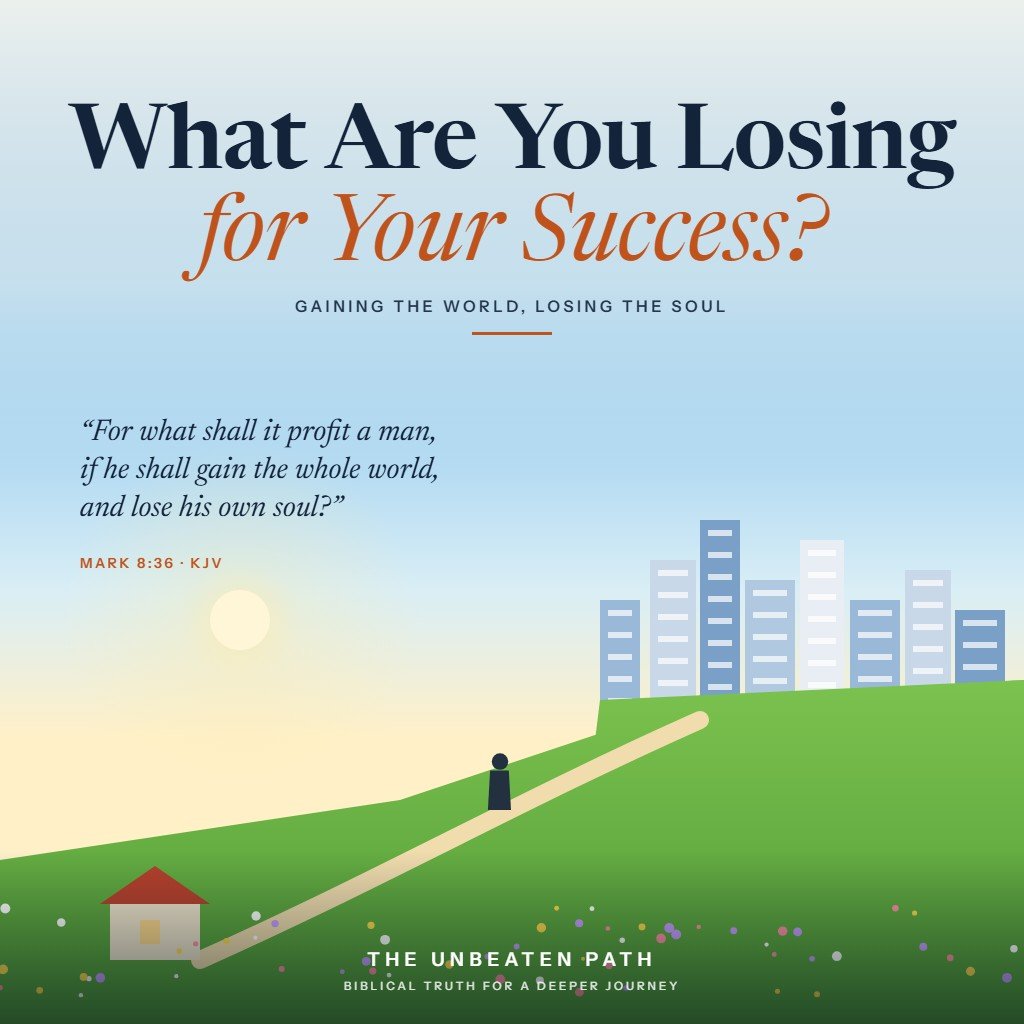
For what shall it profit a man, if he shall gain the whole world, and lose his own soul?
Mark 8:36 (KJV)
His question challenges more than our ambitions. It challenges the value we place upon everything we pursue, possess and protect.
What if the things we are determined to gain—or unwilling to surrender—are taking us away from God?
We may get everything we want and still lose what God intended us to have.
Losing God for More
What sustains life can become harmful when we lose sight of its purpose.
Food nourishes the body. Yet consuming more than we need can damage the very body it was meant to sustain.
Our pursuit of success can follow the same pattern.
We work to provide for our families, fulfil our responsibilities and create opportunities. Scripture recognises our responsibility to provide for those entrusted to our care (1 Timothy 5:8).
But a pursuit that begins with responsibility can become an appetite that responsibility no longer satisfies.
Enough becomes a little more. A little more becomes another achievement. And every achievement becomes the reason we cannot afford to stop.
What began as a means of providing for life becomes the purpose around which life is organised.
Paul warned:
For the love of money is the root of all evil: which while some coveted after, they have erred from the faith, and pierced themselves through with many sorrows.
1 Timothy 6:10 (KJV)
Paul warns against the love of money, not money itself. He warns that covetousness can lead people away from faith and bring them sorrow.
Wealth can support a family, relieve suffering and enable good works. But when acquiring or preserving it becomes more important than obeying God, something has changed.
Money has ceased to serve us. We have begun to serve it.
Paul offers a different measure:
But godliness with contentment is great gain.
1 Timothy 6:6 (KJV)
Contentment does not mean refusing to improve our circumstances. It means refusing to make our peace, identity or faithfulness dependent upon acquiring more.
Hebrews 13:5 connects freedom from covetousness with God’s promise never to forsake His people.
Our security is not ultimately established by how much we accumulate. It rests in the One who remains when possessions cannot.
The danger is not that we become successful. It is that success becomes so important that we will disobey God to preserve it.
We may gain more than we need while surrendering what we need most.
Losing Devotion for Affection
Sometimes what draws us away from God is not greed, but love.
Solomon had received extraordinary blessings. God granted him wisdom, riches and honour (1 Kings 3:5–13). His kingdom prospered, his reputation spread, and he built the temple.
Yet the king who had been blessed so abundantly allowed his heart to turn away from the God who blessed him.
Scripture identifies the cause:
But king Solomon loved many strange women.
1 Kings 11:1 (KJV)
God had warned Israel’s kings against multiplying wives lest their hearts turn away (Deuteronomy 17:17).
Solomon nevertheless held fast to these relationships.
When he grew old, his wives turned his heart after other gods, and he was no longer wholly devoted to the Lord (1 Kings 11:4).
Why would a man of such wisdom disregard a command whose danger had already been explained?
Scripture does not disclose every thought behind Solomon’s choices. But it tells us what he loved, what God had forbidden and what eventually happened to his heart.
Solomon did not lack knowledge of God. He failed to let that knowledge govern what he loved.
That is what makes his account so searching.
We may know what God requires and still struggle to obey when obedience threatens a relationship we cherish.
We may excuse what is wrong because the person involved matters deeply to us. We may convince ourselves that preserving the relationship is an act of love, even when doing so requires us to compromise what we know is right.
But love does not become righteous merely because it is sincere.
Solomon’s disobedience brought God’s judgment upon his kingdom. The division would occur after his lifetime (1 Kings 11:11–13).
He retained the relationships he desired, but his heart was turned away from wholehearted devotion to God.
He preserved his affection at the expense of his faithfulness.
His wisdom did not prevent it. His achievements did not excuse it. His continued wealth and power did not mean God approved.
We may still possess everything the world admires while losing the devotion God requires.
Losing Righteousness for Desire
Solomon’s failure reveals how affection can compromise obedience.
David’s failure reveals what happens when power is used to satisfy desire.
David was already king when he took Bathsheba, Uriah’s wife.
When she became pregnant, he attempted to conceal what he had done. When his efforts failed, he arranged for Uriah to be killed in battle (2 Samuel 11).
David possessed the authority to give commands. He used that authority to obtain what he wanted and conceal his wrongdoing.
But Scripture delivers its judgment:
But the thing that David had done displeased the LORD.
2 Samuel 11:27 (KJV)
David’s power could compel others to act. It could not make his actions righteous.
He could arrange Uriah’s death. He could not make that death just.
He could retain his throne. He could not prevent God from seeing what he had done.
David could command a kingdom, but he could not command God to approve of his sin.
His wrongdoing also harmed people whose lives were not his to sacrifice. Uriah was killed. Bathsheba was subjected to David’s abuse of royal power. Their suffering cannot be reduced to a lesson about the king’s personal consequences.
When Nathan confronted David, he confessed his sin. God forgave him, but the consequences remained (2 Samuel 12:7–14).
The lesson is not that powerful people are necessarily corrupt.
Power can make disobedience easier to carry out and harder for others to challenge.
Success may remove obstacles that once restrained us. It does not remove the boundaries God has established.
The ability to obtain what we desire is not permission to take it.
And the fact that we can conceal wrongdoing from others does not mean that it is concealed from God.
Losing the Promised Land for Certainty
Not every wrong decision begins with the desire for pleasure, wealth or power.
Sometimes it begins with the desire to feel safe.
The Israelites had succeeded in escaping Egypt. God delivered them from slavery through extraordinary signs, brought them through the Red Sea and sustained them in the wilderness.
But freedom from Pharaoh was not the completion of God’s purpose. He intended to bring them into Canaan.
Deuteronomy 8:2–3 explains that the wilderness was a place of testing, where Israel was to learn dependence upon God’s word.
They had witnessed what God could do.
The question was whether they would trust Him with what He had promised to do.
That question divided the twelve spies.
All twelve saw the same land, the same fortified cities and the same formidable inhabitants.
Ten concluded that Israel could not overcome them. Joshua and Caleb urged the people to enter because the Lord was with them (Numbers 13:30–33; 14:6–9).
The ten measured the danger against Israel’s strength. Joshua and Caleb measured it against God’s promise.
The giants were the same size. Their faith was not.
Why did the Israelites believe the ten?
Because the danger was visible, immediate and terrifying.
They feared that their wives and children would perish if they entered Canaan (Numbers 14:3).
Their concern was understandable. They were being asked to advance toward enemies who appeared capable of destroying everything they loved.
But a reasonable concern does not necessarily justify the decision we make because of it.
The people wanted assurance that their families would survive.
God had already given them His promise and demonstrated His power. Yet they wanted certainty they could see before they would proceed.
They had seen enough to know God’s power, but still demanded certainty before trusting His promise.
Their fear became the authority governing their decision.
Rather than trust the God who had delivered them from Egypt, they proposed returning to the land of their former slavery.
God confronted their unbelief:
How long will it be ere they believe me, for all the signs which I have shewed among them?
Numbers 14:11 (KJV)
Their refusal brought judgment. God declared that the rebellious generation would die in the wilderness, while their children would enter Canaan (Numbers 14:29–31).
Hebrews 3:19 gives the verdict:
So we see that they could not enter in because of unbelief.
Hebrews 3:19 (KJV)
They escaped Egypt, but they forfeited their share in the inheritance God had promised.
They sought safety by refusing to follow God, only to lose the future He had promised them.
Their failure was not that they felt fear. Joshua and Caleb faced the same danger.
Their failure was allowing fear to overrule faith.
Sometimes we are so determined to protect what we already have that we refuse to follow God into what we cannot yet see.
We may choose the familiar over the faithful, the predictable over the obedient, and the apparent security of the present over a future that requires trust.
The Israelites had achieved something extraordinary. They were no longer slaves.
But they stopped short of the destination God had set before them.
We can escape what once held us captive and still fail to follow God into what He has prepared.
Their tragedy was not that they had achieved nothing.
They let their need for certainty keep them from obeying the God who had already proved faithful.
Losing the Call for Possessions
The cost of success is not always what we surrender to obtain it.
Sometimes it is what we refuse to surrender once we have it.
A wealthy young man approached Jesus seeking eternal life.
He had observed the commandments he mentioned since his youth. Yet Jesus called him to sell what he possessed, give to the poor and follow Him.
Mark 10:22 records his response:
And he was sad at that saying, and went away grieved: for he had great possessions.
Mark 10:22 (KJV)
He came seeking eternal life.
But when following Jesus required him to part with his wealth, he walked away.
Scripture does not tell us his final destiny. It tells us the choice he made at that moment.
He wanted what Jesus offered, but not at the cost Jesus required.
His sorrow is significant.
He did not walk away because he considered Jesus’ invitation worthless. He walked away grieved because accepting it required him to surrender something he valued greatly.
Many of us can recognise that struggle.
We may want to follow God while hoping that obedience will never threaten the relationships, possessions, ambitions or security we have worked so hard to establish.
We may be willing to give God what remains after our priorities have been satisfied.
But what happens when He asks for something we have already decided we cannot surrender?
Jesus taught:
No man can serve two masters.
Matthew 6:24 (KJV)
The rich young ruler’s possessions were not merely evidence of his success. In that encounter, they became the obstacle he would not relinquish to follow Jesus.
What we refuse to surrender may reveal what we serve.
The question is not whether we possess much or little.
It is whether anything we possess has become more important to us than obedience to God.
Turning Back Before Losing More
When we discover that our pursuit has taken us away from God, we face another decision.
Do we defend the direction we have taken, or do we turn?
Changing course can be difficult when we have invested years of effort, made sacrifices, and convinced ourselves our choices were justified.
We may fear that admitting we were wrong will make everything we have sacrificed seem wasted.
But the distance already travelled cannot make a wrong direction right.
The longer we have walked away from God, the greater our need to turn—not the stronger our reason to continue.
Scripture calls us to repentance.
Ezekiel 18:21–23 teaches that God takes no pleasure in the death of the wicked, but desires that they turn from their ways and live.
Repentance is more than regretting the consequences of a decision.
It requires acknowledging the wrong and returning to obedience.
David confessed his sin when Nathan confronted him. God forgave him, although the consequences of his wrongdoing remained.
The Israelites, after hearing God’s judgment, acknowledged their sin and attempted to enter Canaan despite Moses’ warning. Their advance ended in defeat (Numbers 14:39–45).
Their regret did not undo their earlier refusal. Nor did their new determination make disobedience into obedience.
They refused to advance when God commanded them to go. Then they advanced when God commanded them not to.
Their actions changed, but they still did not submit to God.
This is the difference between regret and repentance.
Repentance is not merely regretting the wrong decision. It is returning to obedience.
We may not be able to recover lost years, reverse every consequence or repair every relationship.
But those losses do not justify continuing in the same direction.
Where we have harmed others, repentance should lead us to acknowledge the harm and seek to make it right where possible.
Where we have allowed ambition, affection, desire or fear to govern us, repentance requires us to restore obedience to its rightful place.
The past may still carry consequences.
It need not continue to determine our choices.
We cannot undo every wrong turn. But we can refuse to take another.
Losing Eternity for Success
Success is often measured by what we have gained.
Wealth. Recognition. Influence. Security. A flourishing family. A legacy that may outlive us.
These things may be meaningful. They may reflect honest effort, genuine love and worthy intentions.
But none can determine whether we have been faithful to God.
Solomon had wisdom, wealth and honour, yet allowed his affections to turn his heart away.
David possessed a kingdom, yet used his authority to commit acts God condemned.
The Israelites gained freedom, yet their desire for visible certainty kept the rebellious generation from entering the promised land.
The wealthy young man possessed great riches, yet walked away when Jesus called him to follow.
Their circumstances were different. Their failures were not identical.
But each account confronts us with the same question:
What are we willing to place above obedience to God?
We may pursue more because we believe it will bring fulfilment.
We may protect a relationship because we cannot bear to lose it.
We may satisfy a desire because we possess the power to do so.
We may demand certainty because we are afraid of what obedience might cost.
We may cling to possessions because we cannot imagine life without them.
Yet none of these desires can make disobedience right.
What we value does not become more valuable than God simply because we are afraid to lose it.
Jesus asked:
For what shall it profit a man, if he shall gain the whole world, and lose his own soul?
Mark 8:36 (KJV)
His question reaches beyond the sacrifices we make during our lifetime.
It asks what remains when everything we have gained can no longer help us.
We entered this world with nothing. We will take none of our possessions with us.
Wealth cannot purchase eternal life. Power cannot overrule God’s judgment. Recognition cannot make disobedience righteous.
And no achievement can compensate for the loss of our souls.
Jesus taught:
But seek ye first the kingdom of God, and his righteousness; and all these things shall be added unto you.
Matthew 6:33 (KJV)
In context, Jesus was addressing anxiety over life’s necessities, not promising unlimited material prosperity.
His command establishes the priority by which our other pursuits must be governed.
Seek God first.
Not after we have acquired enough.
Not after we have secured every relationship.
Not after every desire has been satisfied.
Not after every uncertainty has disappeared.
First.
Because the question is not merely how much success will cost us.
It is whether what we are gaining—or refusing to surrender—is drawing us towards God or taking us away from Him.
A father may gain the wealth he wanted for his children and lose the relationship he hoped to enrich.
We may gain the life we wanted and discover that we have neglected the life God called us to live.
And we may spend so much of our lives protecting what we cannot keep that we neglect what matters for eternity.
No achievement can make the wrong direction right. No worldly success can compensate for losing our souls.
Before asking how much more we can gain, we should examine what we are already losing.
What are you losing for your success?
Related Essays
Rich Toward God: Wealth, Faithfulness, and the True Measure of Success — Luke 12 and the difference between being rich and being rich toward God.
What You Cannot Take With You — Ecclesiastes 5:15 and the illusion that possessions can secure a life.
When the Shield Falls, the Sword Enters the House — the fuller story of David’s drift and its consequences.
What Will You Do When God Asks for Your Isaac? — surrendering what is most precious without letting the gift take the Giver’s place.
Where this essay leads
People in this essay
The same Scripture, explored elsewhere
- 1 Kings 11:1also in You May Have Forgotten What You Sowed—God Has Not, You Set Your Heart; God Shapes Your Mind.
- 1 Kings 3:5also in You Set Your Heart; God Shapes Your Mind.
- 2 Samuel 12:7also in The Prayer That Does Not Avail Much
- Matthew 6:33also in What You Cannot Take With You