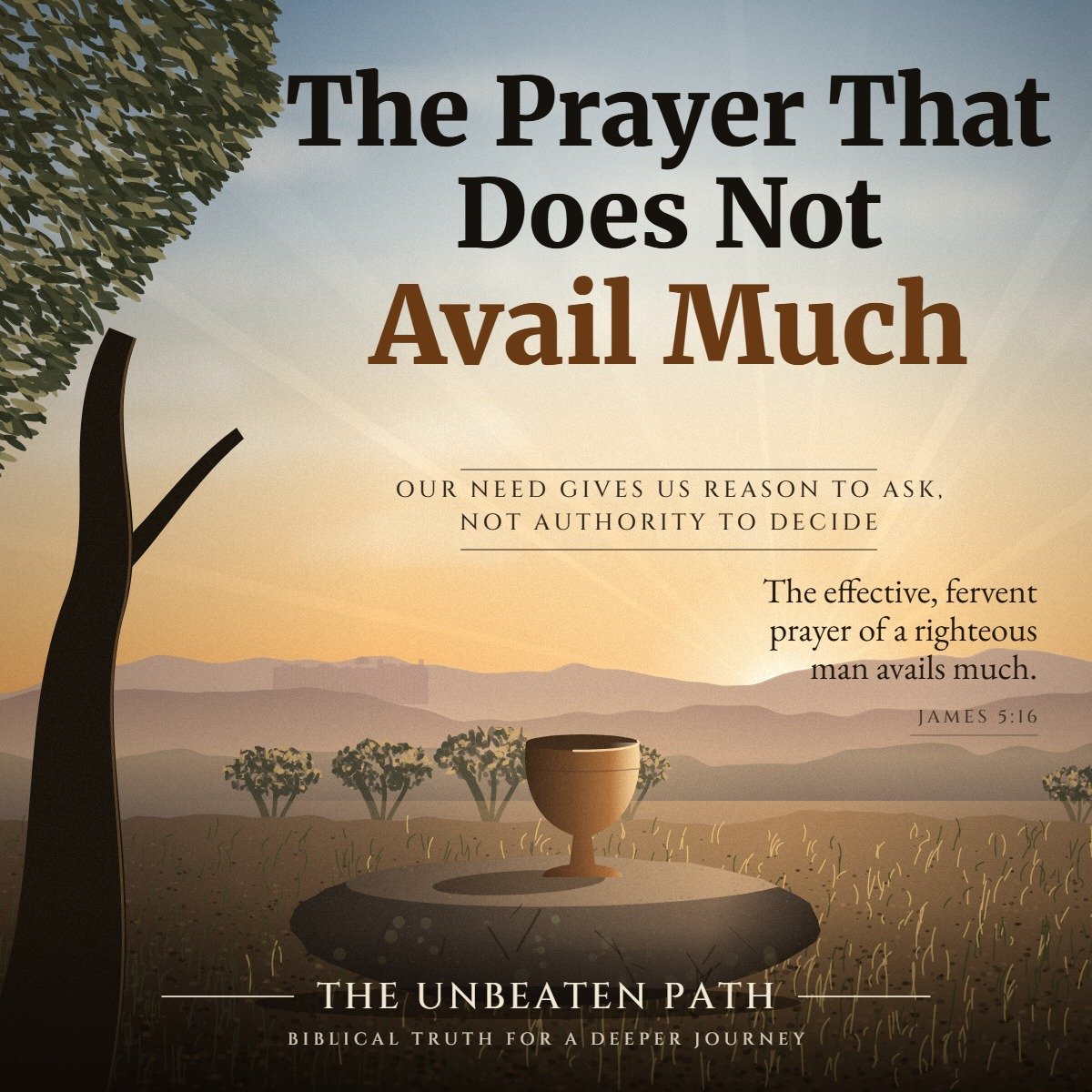
Core ideaEarnest prayer cannot replace repentance, cancel every consequence of sin, or overrule God’s will. When a request is not granted, Scripture calls us to examine our conduct, our petition, and what God has revealed, and to bring our desires with a heart willing to forsake sin and a will submitted to His.
We can pray with all our hearts and still not receive what we ask for.
The illness we plead to have healed. The relationship we beg to have restored. The consequence we hope to escape. We return to God with the same request, sometimes with tears, sometimes with fasting, believing that He is able to do what we cannot.
Yet the condition remains. Or the outcome arrives, and it is the very thing we prayed would not happen.
We begin to examine our praying. Were we sincere enough? Did we believe enough? Should we have persisted longer? These questions matter, but they leave another question unasked: what are we asking God to approve?
We have reasons for wanting the answer. We know what it would spare us, restore to us, or make possible. But our reasons for asking do not, by themselves, establish God’s purpose in granting.
David pleaded with God for his child. He fasted and lay on the ground all night. On the seventh day, the child died. His earnestness was unmistakable. The survival he sought was not granted. (2 Samuel 12:15–23)
Yet James tells us that the prayer of a righteous man avails much. Elijah prayed, and the rain stopped. He prayed again, and it returned. What distinguishes a prayer that prevails from one that does not obtain its request? (James 5:16–18)
Earnestness cannot replace repentance. Forgiveness does not cancel every consequence. Prayer cannot overrule God’s will. Before concluding that God has failed to hear, we must examine our conduct, our petition, and what His Word reveals about His response.
Pleading cannot replace repentance
Hands lifted towards God are still accountable for the blood upon them.
Through Isaiah, God confronted worshippers who offered many prayers while continuing in wrongdoing. He declared that He would hide His eyes and refuse to listen. He then commanded them to cease evil, learn good, seek justice, and defend the oppressed. The obstacle was conduct they would not abandon. More prayer did not remove it. (Isaiah 1:15–17)
Isaiah later makes the reason explicit: God’s arm is not too short to save, nor His ear too dull to hear. Their iniquities have separated them from Him. The refusal is deliberate. They seek His intervention while persisting in what He condemns. (Isaiah 59:1–4)
We recognise the contradiction more readily in them than in ourselves. We ask God to restore peace while preserving the cruelty that destroys it. We ask Him to bless our work while protecting the dishonesty that profits us. We plead for a relationship to be healed while refusing to acknowledge the wound we inflicted.
The desire for relief may be sincere. The repentance may still be absent.
God’s promise to Solomon addresses precisely this distinction. His people must humble themselves, pray, seek His face, and turn from their wicked ways. Prayer belongs with the turning. In the same passage, He warns that abandoning His commands will bring judgment upon the people and the temple bearing His name. Their religious identity will not protect their disobedience. (2 Chronicles 7:13–22)
Are we asking God to change our circumstances while refusing to change our ways?
God calls us to turn from sin, not simply turn up the pleading.
The invitation remains open to the sinner who turns. But what if the person has confessed and God has already forgiven him?
Forgiveness is not immunity
David was forgiven before he pleaded for his child. Yet the child died.
When David confessed, Nathan announced that the Lord had put away his sin and that David would not die. Nathan nevertheless declared that the child would die. Nathan announced forgiveness and the remaining judgment together. (2 Samuel 12:13–14)
David’s earlier faithfulness could not make his wrongdoing righteous. The man who had faced Goliath in God’s name had taken Uriah’s wife and arranged Uriah’s death. Nathan expressly connected the sword David had used against Uriah with the sword that would remain within David’s household. (2 Samuel 12:7–12)
God had shown mercy by sparing David’s life. David then sought further mercy: the survival of his child. He pleaded because he hoped God might be gracious. He had no promise that this announced consequence would be withdrawn.
The child died. The requested mercy was not granted.
Nathan had already declared forgiveness. The child’s death did not undo that declaration. David was forgiven, but he was not released from every consequence of what he had done.
Scripture warns that God is not mocked: what a person sows, that person will reap. Time between the deed and its harvest does not make the deed harmless. In David’s family, the later violence and betrayal gave terrible substance to Nathan’s warning. His wrongdoing had consequences beyond himself. (Galatians 6:7–8; 2 Samuel 13–18)
We cannot measure forgiveness solely by how much pain disappears from the offender’s life. The person we wounded may still carry the injury. The trust we broke may still require rebuilding. Confession does not undo the deed.
Consider the criminal beside Jesus. He acknowledged that his sentence was deserved, recognised Jesus’ innocence, and asked to be remembered in His kingdom. Jesus promised him paradise. His words revealed a repentant heart, and Jesus received his appeal. (Luke 23:39–43)
His request was granted. He had asked for remembrance in the kingdom, not removal from the cross. He remained under the earthly sentence even as Jesus assured him of paradise.
A guilty past does not shut out the repentant heart. Acceptance by God does not guarantee escape from consequences.
Answered prayer does not excuse sin
Hezekiah received the relief David sought: a life was spared after an announcement of death. Told to prepare for his end, he turned towards the wall, appealed to his faithful walk before God, and wept bitterly. God declared that He had heard his prayer, seen his tears, and would add fifteen years to his life. (2 Kings 20:1–6)
David’s child died. Hezekiah recovered. An appeal for mercy after an announcement of death was not necessarily futile.
But did receiving that mercy establish God’s approval of everything Hezekiah would subsequently do?
Hezekiah failed to respond appropriately to the benefit he had received. His heart became proud, and wrath came upon him and upon Judah and Jerusalem. When he humbled himself, that wrath did not come upon them during his lifetime. (2 Chronicles 32:24–26)
God’s earlier favour did not make Hezekiah’s later pride acceptable. The man who received mercy remained accountable for how he lived after receiving it.
We must therefore examine our conduct after receiving an answer as honestly as we examine it while seeking one. What have we done with the health restored, the opportunity given, the danger escaped? Has mercy deepened our gratitude, or have we turned the gift into a monument to ourselves?
Yesterday’s answered prayer cannot serve as today’s permission to disobey.
Prayer cannot overrule God’s will
If wrongdoing explains every withheld request, how do we explain Jesus?
In Gethsemane, He prayed that, if possible, the cup might pass from Him. He also submitted Himself to the Father’s will. The cup did not pass. He went to the cross. We cannot attribute that outcome to personal sin, deficient faith, or an unrepentant heart. (Matthew 26:39–44)
John grounds our confidence in this condition: God hears us when we ask according to His will. His will belongs within the promise itself. It is not an explanation introduced only after our expectations fail. (1 John 5:14–15)
Jesus offered His request for relief within His submission to the Father. The prayer included both His desire that the cup might pass and His commitment to the Father’s will. We cannot judge its outcome while leaving out that submission.
Hebrews speaks of His prayers and tears, states that He was heard, and describes His learning obedience through suffering. Scripture links being heard with enduring suffering. (Hebrews 5:7–9)
The cup remained. That does not mean the Father failed to hear.
Paul asked three times for his thorn to depart. He identifies its purpose as keeping him from becoming conceited because of the greatness of his revelations. The Lord answered with sufficient grace and power perfected in weakness. (2 Corinthians 12:7–10)
God spoke; Paul was not ignored. The thorn remained; the requested removal was not granted. Paul received strength for the condition he had sought to escape.
David faced judgment for wrongdoing. Paul describes a thorn that restrained conceit and displayed Christ’s power in weakness. All punishment involves pain, but not all pain is punishment. The burden that remains does not, by itself, identify the reason it remains.
A prayer may be heard without the requested burden being removed. Where God’s purpose requires endurance, earnestness and righteousness do not give us authority to overrule it.
Delay does not establish refusal
Before concluding that a petition has not prevailed, we must ask whether its outcome has arrived.
Jesus taught His disciples to keep praying and not lose heart. Abraham was one hundred when Isaac was born. The account emphasises that God fulfilled His promise at the appointed time. The years of waiting had not annulled His word. (Luke 18:1–8; Genesis 21:1–5)
Abraham’s confidence, however, rested upon an actual promise. Waiting for a desire does not, by itself, turn that desire into something God has promised.
While David’s child lived, he fasted and wept. When the child died, he rose, washed, entered the house of the Lord, and worshipped. He recognised that the outcome of his plea for the child’s survival had been settled. (2 Samuel 12:20–23)
We must neither declare refusal at the first setback nor deny what has happened because we pleaded for something else. Examine what God has promised, what remains unresolved, and what has already occurred.
Faith can wait without surrendering hope. It can also accept an outcome without surrendering God.
An unmet request does not prove rejection
When our prayers do not obtain what we ask, the outcome calls for examination. It does not explain itself.
David’s plea did not remove an announced consequence, even though he had been forgiven. Paul’s plea did not remove the thorn, even though the Lord answered him. The worshippers Isaiah confronted were refused a hearing because they persisted in evil. We must preserve these distinctions as we examine our own unanswered petitions.
Begin with what God has already made clear. Are we asking Him to bless what He commands us to abandon? Are we seeking forgiveness while protecting the sin? Are we treating mercy as permission to escape every consequence? Where His Word exposes our wrongdoing, our next step is repentance.
But when no such explanation is established, we must not manufacture guilt from disappointment. Jesus’ cup and Paul’s thorn show that a faithful person’s request for relief can remain ungranted. A burden that remains is not, by itself, evidence of an unrepentant heart.
Then examine the petition. We know why we want it granted. Have we considered how it relates to God’s will? We may see an escape from pain where He has declared a purpose to be fulfilled through endurance. We may ask for circumstances to change while He supplies the grace to meet them. And where the outcome remains unresolved, we must distinguish waiting from refusal.
Our need gives us reason to ask. It does not give us authority to decide the answer.
John grounds our confidence in asking according to God’s will. Jesus connects His promise to answer prayer in His name with the Father’s being glorified in the Son. The promise has a purpose larger than the petitioner’s preferred outcome. (1 John 5:14–15; John 14:13)
We can therefore bring our desires honestly and earnestly before Him. Wanting healing, restoration, or relief is not itself a fault. But we must bring those desires with a heart willing to forsake sin and a will submitted to His. Where the reason for a withheld request remains unknown, we should keep searching His Word without claiming a verdict the evidence does not establish.
The prayer that does not avail much may expose a sin we refuse to leave, a consequence that remains, or a request that does not accord with God’s purpose. Understanding the difference changes what we should do next. More pleading cannot replace the repentance He requires, and greater earnestness cannot make our preference His will.
We began by asking why God had not given us what we wanted. We must also ask whether what we want accords with what He has revealed.
We bring Him our request. We submit it to His will. We seek His glory in the answer.
Questions for Reflection
- Is there a request I keep bringing to God while holding on to something He has told me to abandon?
- Have I treated forgiveness as though it should remove every consequence of what I have done?
- What have I done with the mercy God has already shown me: the health restored, the danger escaped, the opportunity given?
- Am I asking according to God’s will, or asking Him to approve a will I have already settled?
- Have I manufactured guilt from disappointment, assuming every unmet request must expose a hidden sin?
- Am I still waiting on something God has actually promised, or on something I have only desired?
Related Essays
Will We Still Love God When He Takes Back What He Gave? — Job, like David, shows that a faithful heart can keep turning towards God when the request is not granted.
When the Shield Falls, the Sword Enters the House — the fuller story of David’s drift and the consequences Nathan announced to his household.
You May Have Forgotten What You Sowed—God Has Not — Galatians 6 explains why forgiveness and harvest can arrive together.
Trust God Beyond What You Can Understand — submitting a petition to God’s will requires trusting Him beyond what we can see.
Related Ideas
Our Need Gives Us Reason to Ask, Not Authority to Decide — prayer brings our desire honestly before God while leaving the answer to His will and His glory.
Repentance Is Not Second-Best — turning from sin is the response God requires, and no amount of pleading can stand in its place.
Trial Is Not Proof of Rejection — a burden that remains does not, by itself, mean that God has turned away.
The Delay Is Not the End — the time between sowing and reaping does not mean a matter has been forgotten or settled.
Connected Ideas
Prayer · Unanswered Prayer · Repentance · Forgiveness · Consequences · Sowing and Reaping · God’s Will · Submission · Endurance · Grace in Weakness · Waiting · Humility