Core ideaJoseph shows righteousness preserved; Judah shows righteousness rebuilt. Joseph remained faithful through temptation, injustice, and power, while Judah began compromised, participated in Joseph's betrayal, failed Tamar, and acted from self-protection. Yet when truth confronted Judah, he stopped defending himself, confessed his wrong, and later proved his repentance by offering himself in Benjamin's place. Judah's place in the messianic line therefore reveals a central truth of redemption: God does not only preserve the faithful; He restores the repentant.
Repentance vs. Perfection
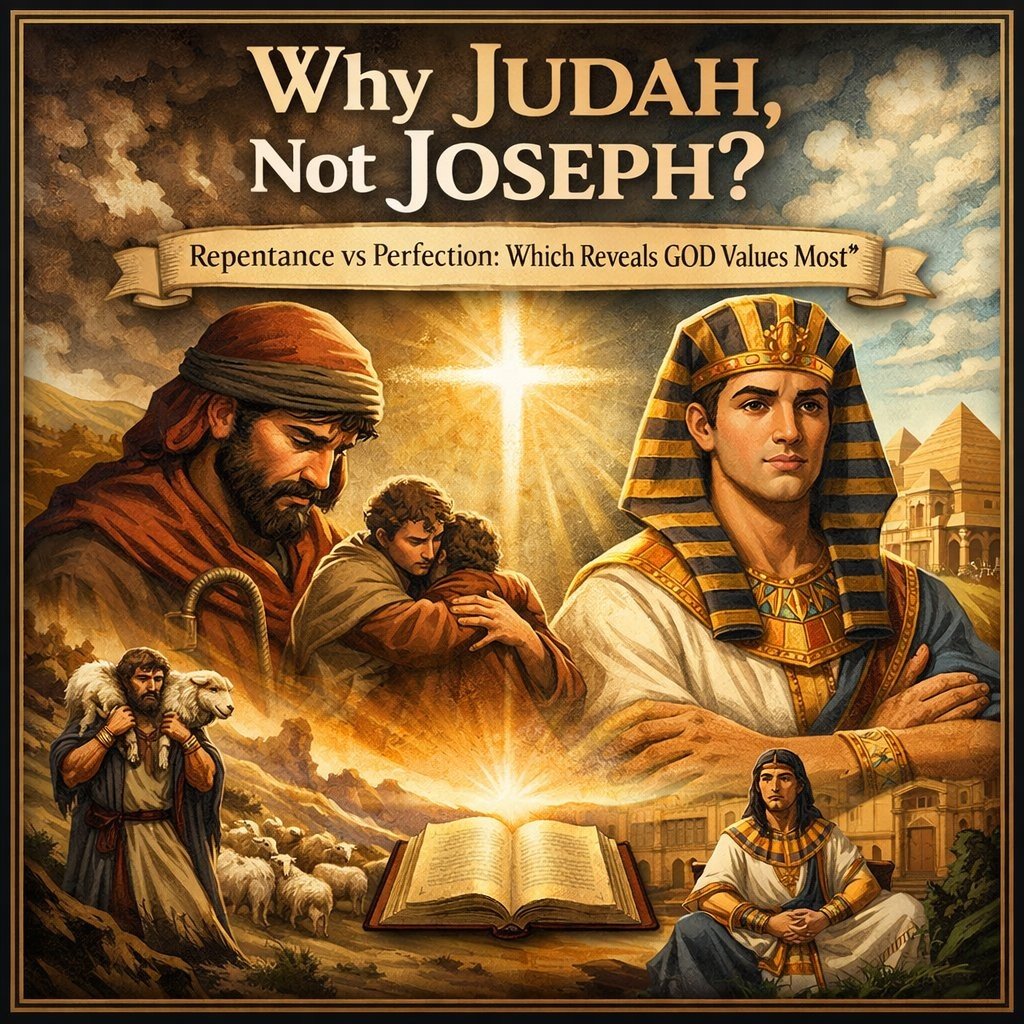
Repentance vs Perfection: Which Reveals GOD Values Most?
“If a man has a hundred sheep and one of them goes astray, will he not leave the ninety-nine on the hills and go out to search for the one that is lost? And if he finds it, truly I tell you, he rejoices more over that one sheep than over the ninety-nine that did not go astray.”
Matthew 18:12-13
Why Judah, Not Joseph?
God often teaches through patterns rather than slogans. He hides meaning in stories, reversals, and surprising choices – so that those who seek will find. That is why the question “Why Judah, not Joseph?” is not a trivial detail in Genesis. Out of Jacob’s twelve sons, the messianic line runs through Judah, not through Joseph. At first glance, this seems preposterous. Joseph is the admired son: he receives dreams, resists temptation, endures injustice without corruption, and later uses power to preserve life. Judah is the uncomfortable son: compromised, implicated in betrayal, and morally exposed. If we were choosing by human standards – discipline, consistency, and clean reputation – Joseph seems like the obvious candidate.
But Scripture repeatedly contradicts human standards of “the best.” The Bible does not suggest that God chooses at random. When God preserves Noah, calls Abraham, and appoints David, the divine choices were purposeful – aligned with God’s will. That does not mean the chosen are flawless; it means God’s choices carry a message. The choice is a testimony of what God is doing in the world: not rewarding the strongest performer, but advancing redemption through people who will be corrected, shaped, and transformed. If that is God’s pattern, then Judah’s place in the messianic line should not be treated as a matter of chance. It calls for a deeper question: what kind of “qualification” does God value? This essay argues that Judah is chosen not because Joseph lacks greatness, but because Judah’s life reveals something central to redemption – repentance that turns a person around and redirection back to GOD.
The Family That Formed Judah and Joseph
To understand Judah and Joseph, it helps to begin with the emotional structure of Jacob’s household. Jacob loved Rachel, the mother of Joseph, more than Leah, the mother of Judah. This imbalance shaped the children’s world. In families where affection is visibly ranked, favouritism rarely stays private. It becomes a system that teaches comparison – who is more loved? Comparison often turns into jealousy; jealousy hardens into resentment; resentment makes it easier to treat a sibling as a rival rather than as a brother.
Genesis presents that Joseph’s brothers were moving along that path. The point is not to excuse them. It is to recognise that the family environment provided fertile ground for rivalry to become cruelty.
Judah grows within the experience of being “less chosen.” Joseph grows within the experience of being openly favoured. These positions carry different psychological risks. Those who feel less chosen may become defensive, pragmatic, and hungry for control. Those who are favoured may become naive about the resentment they provoke. Yet Genesis does not excuse either man to their psychology settings. It shows how each responds to pressure – because their characters are revealed not by their circumstances, but by what they do with them.
Judah Begins in Compromise
Judah enters the story not as a hero but as a participant in moral collapse. When the brothers turn on Joseph, they are not only angry; they are prepared to destroy him. Judah does not stop the injustice. Instead, he redirects it into a profitable betrayal: he proposes selling Joseph. This may prevent immediate murder, but it still treats Joseph as disposable. Judah’s early role, therefore, reveals a particular kind of compromise: the ability to turn cruelty into practicality and evil into an arrangement that feels manageable.
This is why Judah can be described as self-protective, hard-hearted, and compromised at the beginning. His conscience is not absent, but it is easily overridden by self-interest. He is capable of choosing what seems “less evil” while still participating in injustice. And that is precisely why his later transformation will matter: the story sets him up not as a naturally noble man, but as someone who genuinely needs repentance.
After Joseph is sold, Genesis follows Judah into a personal storyline that exposes his private moral disorder. The narrative portrays Judah’s separation from his father’s family as the beginning of a downward spiral: his household decisions grow increasingly disordered, and his responsibility toward others becomes increasingly compromised.
Tamar Forces Judah to Face the Truth
Judah marries and has three sons: Er, Onan, and Shelah. Er marries Tamar, but Er dies under God’s judgment. Then the responsibility falls to Onan to preserve his brother’s line by providing Tamar with an heir. Onan refuses responsibility while still taking advantage of Tamar, and he too dies under God’s judgment. Now Judah has only one remaining son, Shelah. Fearful of losing him, Judah sends Tamar back to her father’s house with a promise: when Shelah is older, she will be given to him. Yet when Shelah grows up, Judah does not fulfil his promise. Tamar is left vulnerable as a childless widow – a position that, in that world, meant insecurity, dependence, and a threatened future.
Tamar’s determination to have a child is therefore not merely a personal desire. It is bound up with justice, survival, and the continuation of her husband’s line. Judah’s deeper sin is not only sexual failure later on; it is the neglect of responsibility and the withholding of what he had effectively pledged. Tamar then disguises herself, sleeps with Judah, and becomes pregnant. When Judah hears of her pregnancy, he moves quickly to condemn her. His instinct is judgment, not truth-seeking – revealing the double standard of a man protecting his reputation.
But Tamar produces Judah’s seal, cord, and staff – proof that Judah is the father. Judah cannot escape the truth. And then he says the sentence that marks the beginning of repentance: “She is more righteous than I, since I did not give her to my son Shelah.” Judah is not declaring Tamar morally flawless. He is admitting that, in this situation, she acted more rightly than he did. His confession is significant not because it is emotional, but because it is honest. He does not defend himself. He does not shift blame. He names the truth about his failure to do what was right.
This is repentance in its first clear shape: the courage to tell the truth about oneself without self-protection.
Repentance Begins With Honest Confession
Years later, Judah’s repentance becomes visible not merely in words but in action. When famine drives the brothers to Egypt, Joseph – now in authority – tests them through a situation involving Benjamin. Benjamin is accused and must remain a slave. This moment reveals whether Judah’s confession was temporary or transformative.
The Proof of Repentance Comes Later
Here, the story’s moral geometry reverses. The Judah who once participated in removing a brother now steps forward to protect a brother. He offers himself in Benjamin’s place. Judah’s offer is explicit: he asks to remain as the slave instead of Benjamin – “please let your servant remain instead of the boy… and let the boy go back” (Gen 44:33-34). Repentance is no longer a single admission. It becomes a rewritten direction of life: Judah moves from self-preservation to self-giving, from treating a brother as disposable to treating a brother as worth suffering for.
Joseph’s greatness is real and must not be diminished. He displays integrity in circumstances that would easily corrupt a person: betrayal, slavery, false accusation, imprisonment, and finally authority. He refuses temptation, endures injustice without losing moral clarity, and uses power to preserve life rather than take revenge. Joseph is a model of faithfulness preserved.
Joseph: Righteousness Preserved
Yet Scripture is not merely cataloguing virtues; it is revealing redemption. Joseph shows righteousness that remains steady. Judah shows righteousness that is rebuilt through repentance. Joseph governs wisely and saves many lives. Judah intercedes and offers himself in place of another. Joseph’s story teaches endurance; Judah’s, return. And the messianic line – leading to Jesus – carries a message about the kind of salvation God brings: not only sustaining the faithful, but restoring the fallen.
Judah: Righteousness Rebuilt
This is also echoed in Jacob’s final blessing, where Judah is marked out for leadership and kingship. Jacob’s words place royal weight on Judah – “Judah, your brothers shall praise you… the sceptre shall not depart from Judah” (Gen 49:8-10) – so Judah’s line is presented as the locus of kingship long before Israel ever has a king. The messianic line does not come from the most “flawless biography,” but from the line shaped for rule – and from a man within that line whose repentance becomes unmistakable.
The Sceptre Comes Through Judah
Conclusion: Joseph remains an extraordinary example of faithfulness. His story shows what it takes to maintain integrity when life is unfair and to wield power without becoming bitter. But Judah’s story reveals the shape of redemption with particular clarity, because Judah is closer to what Scripture says is true of all of us: we fall short. The Bible does not flatter us with the illusion that we can earn God’s approval by keeping a spotless record. It names the deeper truth – that all have sinned – and then it points us to what God does with people who are willing to return.
What Redemption Reveals
That is why repentance sits at the centre of this question. The point is not that falling is acceptable or that sin is minor. The point is that God does not treat the fall as the final chapter. Judah begins as self-protective, hard-hearted, and compromised. Yet when truth confronts him, he stops defending himself. He admits wrong without excuse. And over time, he becomes a different kind of man – one who can carry responsibility for another, even at great cost. Judah shows repentance in its full weight: not just regret, but a changed direction; not only confession, but a rewritten pattern of life.
The shepherd’s joy in the parable is not in the sheep’s wandering, but in the sheep’s recovery. In the same way, God’s delight is not in human failure, but in the miracle of return. Repentance makes grace visible. It shows that God’s work is not simply to applaud the strong, but to restore the broken; not only to preserve the steady, but to remake the compromised into something new. If Joseph’s life is a picture of righteousness preserved, Judah’s life is a picture of righteousness rebuilt.
So the conclusion is not merely “you have fallen.” Scripture already answers that for all of us. The deeper question is: will you repent? Will you tell the truth, accept responsibility, and turn back? Through Judah, Scripture offers a quiet but radical hope: God’s reward is not reserved only for those who never stumble. God honours the one who returns. He does not ignore sin, but He also does not treat our fallenness as the final verdict when we are willing to repent. In God’s eyes, repentance is not second-best. It is the path by which broken people are restored—and the place where redemption shines most clearly.
Related Ideas
Repentance Is Not Second-Best — Judah’s life shows that repentance is more than regret. When truth is faced, self-defence ends, responsibility is accepted, and the direction of life genuinely changes, God can rebuild what sin damaged.
Surrender — repentance begins when self-defence ends and a person becomes willing to tell the truth before God.
Faithfulness Before Success — Joseph shows the beauty of righteousness preserved, while Judah shows that God can also rebuild a compromised life through genuine repentance.
What Rules the Heart Shapes the Mind — Judah’s early self-protection distorted his choices; transformation became possible when truth broke through his self-justification.
Connected Ideas
Judah · Joseph · Tamar · Benjamin · Repentance · Restoration · Redemption · Confession · Responsibility · Self-Protection · Self-Giving · Faithfulness · Kingship · Messianic Line · Grace
Originally published on X on 2026-03-02. This website edition preserves the original essay while adding structural headings and knowledge links.