An Outsider Brought Into the Story of Redemption
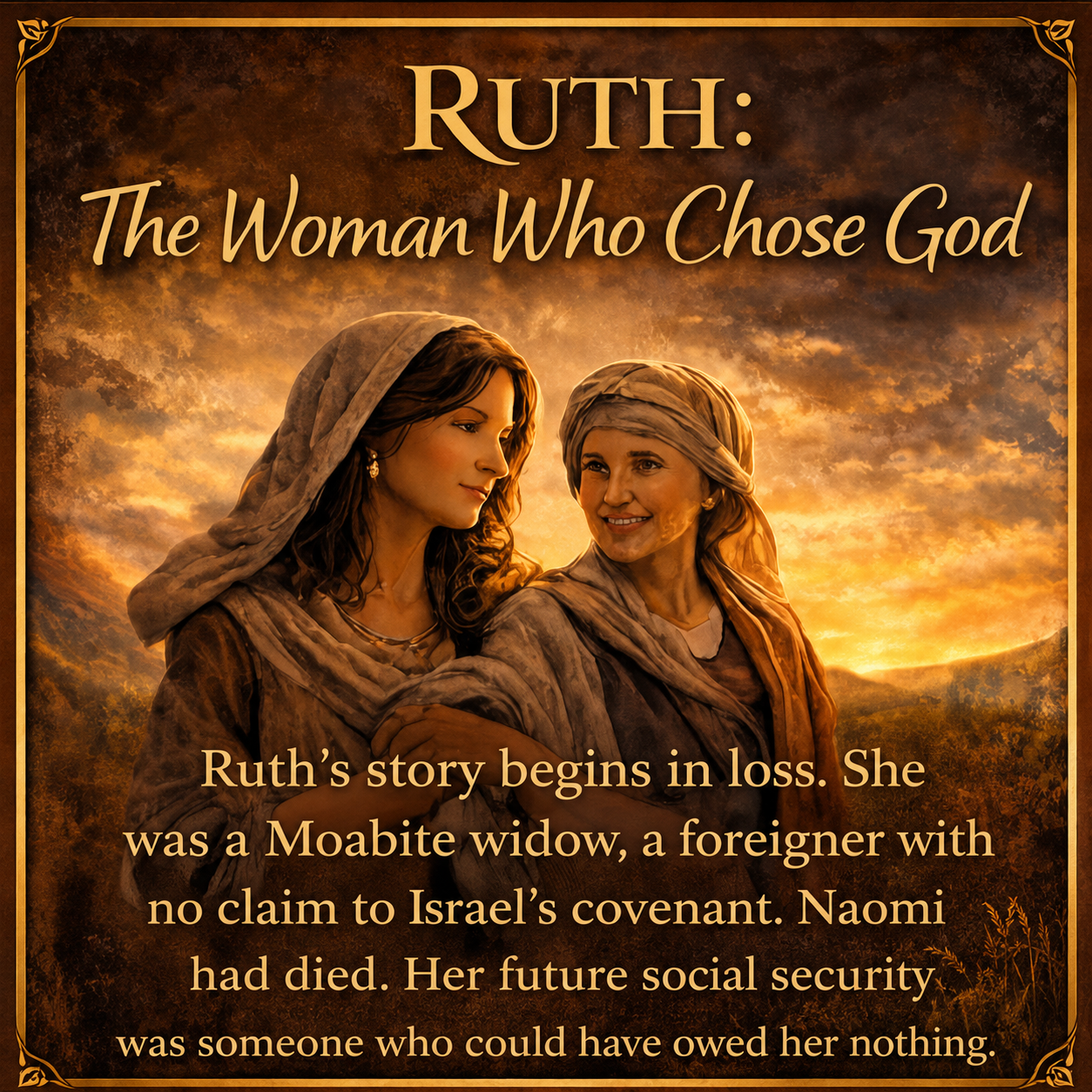
Ruth is one of the most beautiful figures in Scripture because she begins as an outsider and ends at the very center of God’s redemptive story. She was not born into Israel. She was a Moabite, a foreigner, a widow, and by all outward measures, someone unlikely to have a place in the covenant line. Yet her name stands in the genealogy of David and ultimately of Jesus. That alone tells us that Ruth’s life is not merely a touching family story. It is a revelation of how God brings His promises forward through humility, loyalty, and courageous faith.
Ruth Begins in Loss
At the start of the book, Ruth’s life is wrapped in loss. Naomi, her mother-in-law, has left Bethlehem during famine and gone to Moab with her husband and two sons. There, Naomi’s husband dies. Then her two sons die also, leaving Naomi and her two daughters-in-law widowed. Ruth enters the biblical stage not in strength, but in grief. She has no husband, no security, no visible future. She could have remained in Moab, returned to her own people, and tried to rebuild life on familiar ground. In fact, Naomi urges her to do exactly that.
The Decision That Defined Her
But Ruth makes the decision that defines her forever. She says to Naomi:
“Where you go I will go, and where you stay I will stay.
Your people will be my people and your God my God.”
That is one of the strongest confessions in the Old Testament. Ruth was not merely choosing Naomi. She was choosing Naomi’s God. She was turning away from her old identity and stepping by faith into a people that were not naturally her own. Ruth did not join the covenant line through blood, status, or entitlement. She entered through faith.
Covenant Faithfulness Over Personal Convenience
That, in my view, is the one strongest thing Ruth did right:
She chose covenant faithfulness over personal convenience
Ruth could have chosen safety.
She chose faithfulness.
She could have chosen familiarity.
She chose the God of Israel.
She could have chosen self-preservation.
She chose love, loyalty, and trust.
Her Greatness Was Not Loud
This is what makes Ruth extraordinary. Her greatness is not loud. She does not confront like Tamar. She does not rule like Esther. She does not sing like Miriam. Ruth simply stays. She remains loyal when leaving would have been easier. And in the Bible, that kind of steadfastness is immensely powerful.
When Ruth arrives in Bethlehem with Naomi, she is still poor and vulnerable. She goes to glean in the fields, following behind harvesters to gather leftover grain. This is humble work. Yet even here we see Ruth’s character. She does not wait passively for rescue. She works. She honors Naomi. She walks with dignity in low circumstances. Her faith is not abstract. It becomes visible through devotion, labor, and quiet obedience.
Faithfulness Became Her Beauty
Then comes Boaz. He notices Ruth, not first because of beauty or social standing, but because of her reputation for loyalty and kindness. Boaz has heard how Ruth left her father, mother, and homeland to care for Naomi and come under the wings of the God of Israel. This is crucial. Ruth’s inner character becomes her introduction. Her faithfulness becomes her beauty.
Boaz and the Appeal for Redemption
Later, at Naomi’s instruction, Ruth goes to the threshing floor and appeals, in effect, for Boaz to act as kinsman-redeemer. Like Tamar’s story, this moment can make readers uneasy because it is bold and socially delicate. But Ruth’s action is not manipulative. It is an act of covenant appeal. She is asking that redemption, protection, and family continuity be honored rightly. Boaz responds with integrity, and Ruth is eventually redeemed and married into the family.
Ruth and Tamar: Two Women in the Messianic Line
Here the comparison with Tamar becomes very rich.
Tamar and Ruth are alike in several important ways:
Tamar preserved the covenant line through bold confrontation.
Ruth entered and preserved the covenant line through faithful loyalty.
Tamar exposed Judah’s failure.
Ruth drew out Boaz’s righteousness.
Tamar’s story carries tension and judgment.
Ruth’s story carries gentleness and restoration.
Yet both women were widows.
Both were vulnerable.
Both acted decisively.
Both became mothers in the messianic line.
From Emptiness to Fullness
That is why Matthew later names both Tamar and Ruth in the genealogy of Jesus. God wanted their names remembered. He wanted readers to see that His redemptive plan moved forward not only through patriarchs and kings, but also through women who acted with courageous faith in difficult circumstances.
Ruth’s story also contains the same pattern of reversal we saw in Tamar. She begins as a foreign widow with no claim. She ends as the great-grandmother of David. She begins in emptiness. She ends in fullness. Naomi says she returned empty, but by the end, through Ruth, her arms hold hope again. Ruth becomes a living sign that God can bring harvest out of famine and future out of bereavement.
Ruth Points Us Toward the Gospel
And this points us toward the Gospel.
Ruth is a foreigner who is brought near.
The Gospel brings outsiders near.
Ruth is redeemed by a worthy redeemer.
The Gospel proclaims Christ as our Redeemer.
Ruth comes under covenant mercy she did not naturally possess.
The Gospel offers grace to those who have no natural claim.
She Clung to God When She Had Every Reason to Turn Back
In that sense, Ruth is not only an ancestor of Christ. She is also a picture of the people Christ came to save: the outsider welcomed, the empty filled, the widow sheltered, the stranger brought home.
So if we ask, “What one strong thing did Ruth do right?” the answer is this:
She clung to God when she had every earthly reason to turn back.
That is why Ruth still speaks to us.
Faith Refuses to Retreat
In our lives, we often stand at crossroads where convenience pulls one way and covenant pulls another. Comfort says, “Go back.” Faith says, “Stay with God.” Ruth teaches us that destiny often begins with a quiet refusal to turn away. The line of promise may advance, not only through dramatic victories, but through simple, costly faithfulness.
Tamar teaches us to refuse injustice.
Ruth teaches us to refuse retreat.
Tamar says, “Do not let truth die.”
Ruth says, “Do not let faith die.”
And because Ruth chose loyalty over ease, and God over familiarity, her name stands forever in the story of redemption.
#ChristianVictory #Faithfulness #Righteousness
Related Ideas
Faith Sometimes Means Refusing to Turn Back — Ruth shows that faith is not merely believing the right things, but remaining committed when the path becomes costly. She had every practical reason to return to Moab, yet she chose covenant loyalty, the God of Israel, and a future she could not yet see.
Quiet Faithfulness Is Greatness Before God — Ruth’s greatness was not loud; it was revealed through costly loyalty, humble work, and steadfast obedience when turning back would have been easier.
Faithfulness Before Success — Ruth did not know where her decision would lead. She chose faithfulness before she could see the harvest, the marriage, David, or her place in the messianic line.
Surrender — Ruth released familiarity, security, homeland, and self-preservation in order to identify herself with Naomi’s people and Naomi’s God.
Connected Ideas
Ruth · Naomi · Boaz · Covenant Faithfulness · Loyalty · Trust · Outsider · Kinsman-Redeemer · Redemption · Grace · Providence · Quiet Obedience · Perseverance · Messianic Line
Originally published on X on 2026-03-15. This website edition preserves the original essay while adding structural headings and knowledge links.
Scripture index
Ruth 1:1–18; Ruth 2:2–12; Ruth 3:1–13; Ruth 4:9–17; Matthew 1:5–6