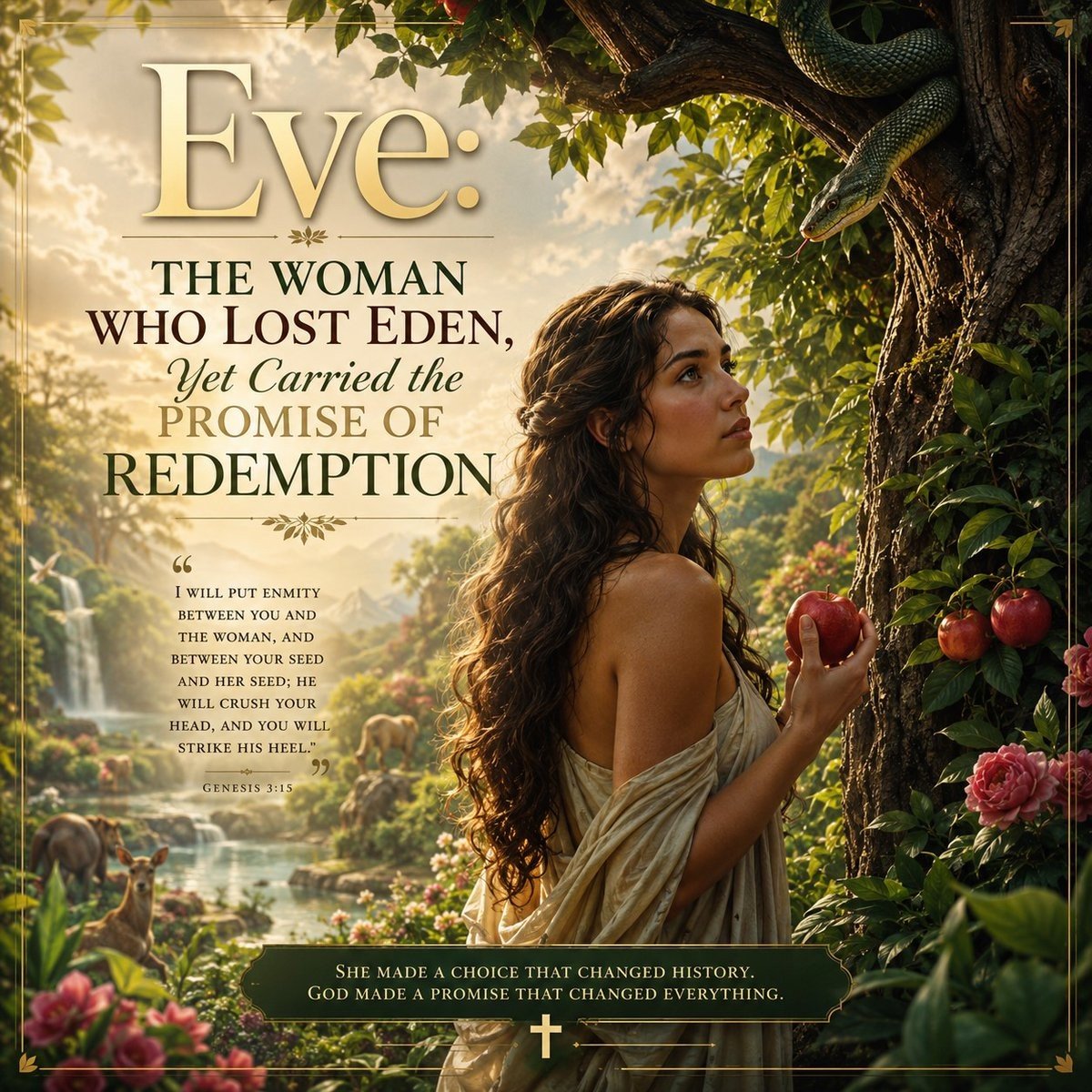
Eve as a Mirror of the Human Soul
The story of Eve, the first woman of mankind, is not merely an ancient account about the beginning of human history. It is a mirror of the human soul. In her story, we see innocence, beauty, dignity, desire, deception, failure, judgment, mercy, and hope. Eve stands at the beginning of the Bible not only as the mother of all living, but also as a warning and a witness. Through her, we learn how sin entered the human experience. Yet through her also came the first promise that sin would not have the final word.
Created in Dignity Before the Fall
Eve was created in a world without death, sickness, violence, fear, or shame. She opened her eyes in Eden, the garden of God. Everything around her was good. The trees were beautiful. The rivers flowed. The animals lived in harmony. There was no corruption in creation, no anxiety in the heart, no separation between humanity and God. Yet in this perfect world, God declared that one thing was “not good”: man was alone.
This tells us something profound. Before sin entered the world, loneliness was already identified as something incomplete. God said, “It is not good that the man should be alone.” So Eve was created as a companion, partner, helper, and counterpart to Adam. She was not an afterthought. She was not a mistake. She was not made to be inferior. She was made with divine intention, dignity, and purpose.
The word “helper” has often been misunderstood. In human pride, some have treated it as a lower position. But in Scripture, God Himself is often called the helper of His people. To be a helper is not to be weak. It is to be one who supplies what is needed, one who strengthens, supports, completes, and stands alongside. Eve was created because Adam needed companionship and partnership. She was God’s answer to human aloneness.
From this, we learn that womanhood began not in shame, competition, or subordination, but in glory. Eve was fashioned by God’s hand and brought to Adam as a gift. She was bone of his bone and flesh of his flesh. She shared his humanity. She shared his calling. She shared his responsibility before God. The story of Eve begins with dignity before it ever moves into failure.
Even Paradise Cannot Protect an Unguarded Heart
Yet Eve’s life also teaches us a sober truth: even paradise cannot protect an unguarded heart.
Many people believe that if their environment were better, they would become better people. If they had more money, less pressure, better relationships, stronger opportunities, or fewer difficulties, they imagine that their hearts would be pure and stable. But Eve lived in the best environment any human being has ever known. She had no childhood wounds, no poverty, no social injustice, no sickness, no family trauma, and no corrupt society around her. Still, she fell.
This reveals that the deepest problem of humanity is not merely outside us. It is within the human heart. Temptation does not need a broken environment to succeed. It only needs an unguarded desire. Eden had no pollution, but the human heart was still capable of turning away from God.
Temptation Begins by Questioning God
The serpent entered the story not with violence, but with a question. He did not begin by attacking Eve’s body. He attacked her understanding of God’s word. “Did God actually say…?” That was the first recorded temptation. The serpent’s strategy was subtle. He wanted Eve to question whether God’s command was true, good, and trustworthy.
This is still the pattern of temptation today. The enemy rarely begins by making evil look evil. He begins by making God look unfair. He whispers, “God is holding something back from you. God does not want you to be happy. God is limiting your freedom. You can decide for yourself. You can be your own authority.”
The serpent twisted God’s command. God had generously given Adam and Eve permission to eat from every tree except one. The garden was full of abundance. But the serpent shifted Eve’s attention from what God had given to what God had forbidden. This is one of the oldest tricks of temptation. It makes us forget blessings and obsess over restrictions. It makes the one forbidden thing appear more attractive than a thousand permitted gifts.
She Saw, She Desired, She Took
Eve looked at the fruit. She saw that it was good for food, pleasant to the eyes, and desirable to make one wise. Then she took it and ate. Afterward, she gave some to Adam, and he ate also. This movement is important: she saw, she desired, she took, and she gave.
Sin often begins in the imagination before it becomes an action. The fruit entered Eve’s eyes before it entered her mouth. What she continued to look at, she began to desire. What she desired, she eventually took. What she took wrongly, she then shared with another.
This is a serious lesson for all of us. What we allow our eyes to dwell on can shape our desires. What we allow our minds to entertain can become a decision. Sin is rarely born suddenly. It is often conceived quietly. It grows through attention, imagination, rationalization, and desire. By the time the hand reaches out, the heart has often already moved.
The Temptation to Define Good and Evil for Ourselves
Eve wanted wisdom, but she wanted it apart from obedience to God. The fruit promised knowledge. It promised that her eyes would be opened. It promised that she would be like God, knowing good and evil. This was not merely a temptation of appetite. It was a temptation of authority. Eve was tempted to step out from under God’s definition of good and evil and define reality for herself.
This remains one of humanity’s deepest struggles. We do not merely want pleasure. We want control. We want to decide what is right. We want to be the final judge of our own lives. We want God’s gifts without God’s authority. We want wisdom without surrender. We want freedom without obedience.
But knowledge without obedience does not produce life. It produces pride, confusion, and death. Eve’s eyes were indeed opened, but not in the glorious way she expected. She did not become divine. She became ashamed. She did not gain freedom. She experienced fear. She did not rise into greatness. She hid among the trees.
That is the tragedy of sin. It promises enlargement but produces shrinking. It promises confidence but brings shame. It promises independence but creates bondage. It says, “Take this and you will become more,” but afterward the soul becomes less than it was before.
Fig Leaves Cannot Heal the Soul
After Adam and Eve sinned, they realized they were naked. For the first time, shame entered human consciousness. They sewed fig leaves together to cover themselves. This was humanity’s first attempt at self-salvation. They tried to cover their own shame with the work of their own hands.
We are still doing this today. People cover shame with achievements, money, reputation, beauty, religion, busyness, success, excuses, and image management. We try to appear whole when we are broken inside. We hide behind titles, possessions, social status, and carefully crafted appearances. But fig leaves cannot heal the soul. They can only cover the surface.
God Still Comes Looking
Then God came walking in the garden and called, “Where are you?” This question was not asked because God lacked information. God knew where they were. The question was meant to awaken Adam and Eve to where sin had taken them. They were no longer standing openly before God. They were hiding.
This is one of the most tender and serious moments in Scripture. After humanity sinned, God came looking. He did not abandon them to darkness. He did not leave them hiding forever. He called them out. Judgment was coming, but so was mercy.
Blame Does Not Remove Responsibility
When confronted, Adam blamed Eve. Eve blamed the serpent. The pattern of blame began immediately after the fall. Sin damages not only our relationship with God, but also our relationship with one another. Instead of confession, there was accusation. Instead of responsibility, there was self-protection.
Eve said, “The serpent deceived me, and I ate.” This was true, but it was not a complete excuse. She was deceived, but she was still responsible. The serpent tempted her, but he did not force her. Deception explains the fall, but it does not remove accountability.
This is an important lesson for our own lives. We may be influenced by people, culture, pain, weakness, temptation, or deception, but we are still responsible before God for our choices. Spiritual maturity begins when we stop hiding, stop blaming, and start confessing the truth.
Judgment Came, but So Did Promise
God pronounced judgment. Pain would enter childbirth. Relationships would be strained. Work would become difficult. The ground would be cursed. Death would enter the human story. Eden would be lost.
Yet in the middle of judgment, God gave a promise. He said that the seed of the woman would crush the serpent’s head. This is one of the most powerful statements in the Bible. The woman who was deceived would also be connected to the promise of deliverance. Through the line of the woman, the serpent would one day be defeated.
Christians have long understood this as the first announcement of the gospel. Long before Bethlehem, long before the cross, long before the empty tomb, God declared in Eden that evil would not win forever. The serpent would wound, but he would also be crushed. Sin would bring death, but God would bring redemption.
This means Eve’s story does not end in failure. It points forward to hope. She lost Eden, but through her line would come the Savior. The enemy used deception to bring death through the woman, but God promised victory through the woman’s seed. This is the mercy of God: He does not merely punish sin; He begins the work of redemption.
Failure Did Not Become Eve’s Final Identity
Adam later named his wife Eve, because she would become the mother of all living. That name is remarkable. After sin, after shame, after judgment, she was still associated with life. Her failure was real, but it was not the end of her identity. She was not only the woman who fell. She was also the woman through whom human life continued.
This gives hope to every person who has failed. God does not deny sin. He does not pretend rebellion is harmless. But neither does He allow failure to have the final word when His mercy intervenes. Eve teaches us that a person can fall terribly and still be part of God’s unfolding purpose.
What We Learn from Eve
What then can we learn from Eve?
We learn that human beings were created for relationship with God and with one another. We learn that dignity comes from being made by God, not from performance or status. We learn that temptation often begins by questioning God’s word and doubting God’s goodness. We learn that desire must be guarded, because what captures the eye can capture the heart. We learn that wisdom apart from God becomes rebellion. We learn that sin promises freedom but produces shame, fear, hiding, and blame. We learn that responsibility cannot be avoided by accusation. Most importantly, we learn that God’s mercy is greater than human failure.
Eve’s story is not only about the first woman. It is about all of us. We too have listened to the serpent’s whisper. We too have desired forbidden fruit. We too have tried to cover our shame with fig leaves. We too have hidden from God among the trees of our own excuses.
The God of Eden Still Calls
But the God of Eden still calls, “Where are you?”
This question is not only a question of judgment. It is also a question of grace. God calls us out of hiding so that we may return to Him. He exposes our sin not to destroy us, but to bring us to truth. He removes our false coverings so that He may clothe us with mercy.
From the Fall to the Promise of Redemption
Eve lost paradise, but she did not erase God’s promise. Her story begins with creation, descends into the fall, and rises again with the hope of redemption. She reminds us that sin is deadly, deception is subtle, and the human heart must be guarded. But she also reminds us that God seeks the fallen, covers the ashamed, and promises victory over the serpent.
In Eve, we see the tragedy of mankind. But in God’s promise after Eve’s fall, we see the beginning of mankind’s hope.
#Eve
#GardenOfEden
#Genesis
#Genesis315
#BibleStory
#WomenOfTheBible
#ChristianFaith
Related Ideas
Temptation Begins by Questioning God’s Goodness — Temptation often begins before the act itself, when God’s word is made doubtful, His goodness is questioned, and His boundary begins to look like deprivation rather than protection.
What Rules the Heart Shapes the Mind — Eve’s fall shows how desire can reshape judgment until what God forbids begins to appear reasonable and desirable.
The Voice We Obey — the serpent’s first strategy was to challenge God’s word and invite Eve to trust another voice.
Surrender — Eve’s temptation was not only about appetite, but about authority: whether God would define good and evil, or whether she would claim that authority for herself.
Connected Ideas
Eve · Eden · Temptation · Deception · Desire · Authority · Shame · Hiding · Blame · Responsibility · Judgment · Mercy · Redemption · Genesis 3:15
Originally published on X on 2026-06-05. This website edition preserves the original essay while adding structural headings and knowledge links.
Scripture index
Genesis 2:18–25; Genesis 3:1–24; Genesis 3:1; Genesis 3:6; Genesis 3:9; Genesis 3:13; Genesis 3:15; Genesis 3:20