Many people say they believe in God.
But that statement raises a more important question:
Who is the God they believe in?
Is He the God Scripture reveals?
Or is He a God constructed from our fears, expectations, disappointments, traditions, and desires?
Christian faith is not merely confidence that some higher power exists.
It is trust in Someone.
And trust depends upon knowing the character of the One being trusted.
You cannot deeply trust a God you have never sought to know.
Believing That God Exists Is Only the Beginning
There is a difference between believing that God exists and knowing who God is.
A person may believe in a Creator yet know almost nothing about His character.
He may imagine God as distant.
Or unpredictable.
Or angry.
Or indulgent.
Or existing mainly to make human plans succeed.
But none of these assumptions becomes true merely because we believe it strongly.
If God is truly God, then He must define Himself.
We do not create His identity.
We receive what He reveals.
God Introduces Himself
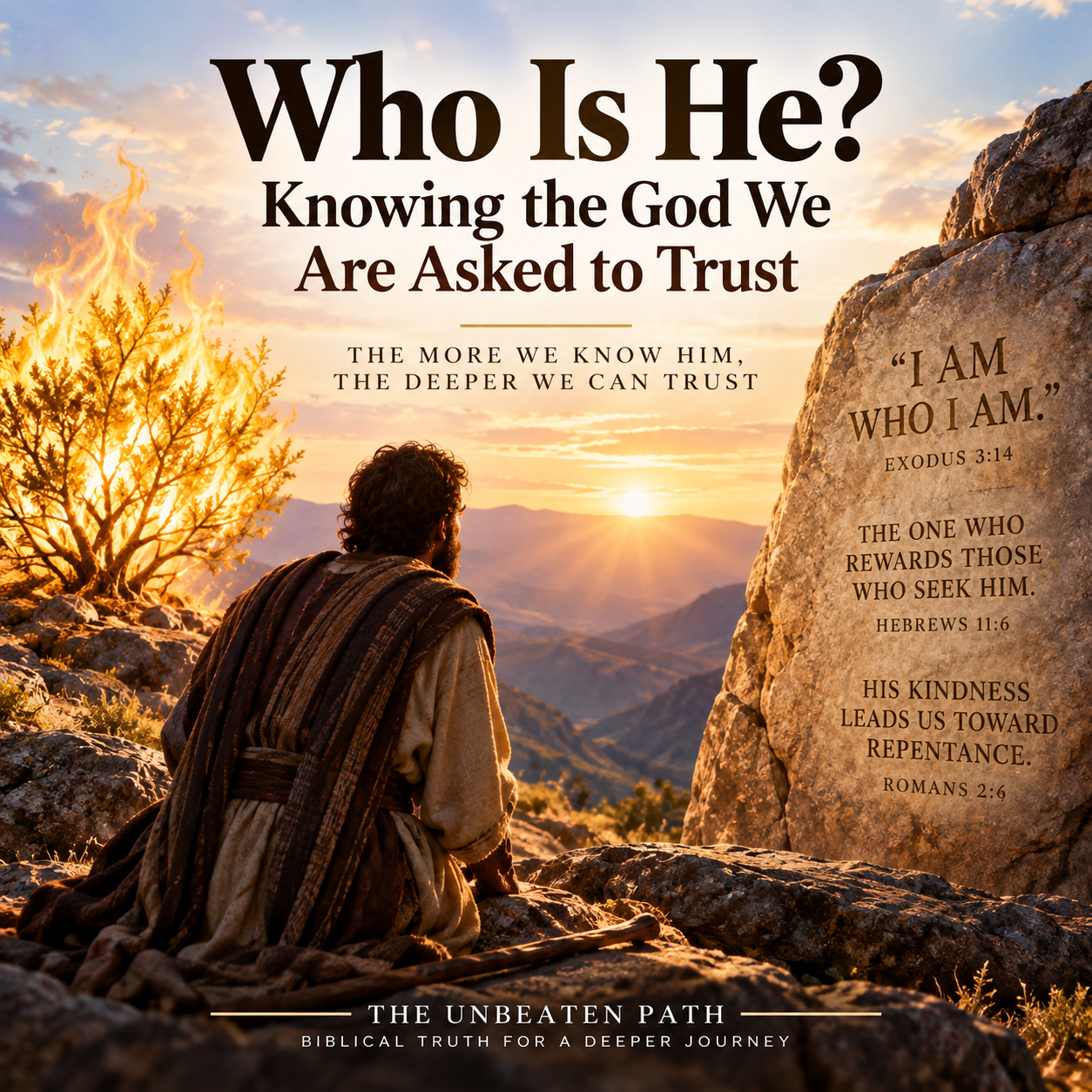
In Exodus 3, Moses encounters God at the burning bush.
God calls Moses to return to Egypt and confront Pharaoh.
Moses understands that the people will want to know who sent him.
So he asks God for His name.
The answer is extraordinary.
“I AM WHO I AM.”
God does not introduce Himself by comparing Himself with something greater.
There is nothing greater.
He does not say, “I became.”
He says, “I AM.”
His existence does not depend upon circumstances, nations, human recognition, or creation itself.
Everything else receives life.
God simply is.
The God We Trust Does Not Depend Upon Us
This matters enormously.
Human beings change.
Our emotions change.
Our circumstances change.
Our strength changes.
Our understanding changes.
People who promise to remain may leave.
Institutions that appear permanent may collapse.
Resources that seem secure may disappear.
But God is not sustained by the unstable world He created.
He is not stronger when circumstances are good and weaker when they are bad.
He does not become more God when we believe Him or less God when we doubt Him.
Our circumstances may change what we see, but they do not change who God is.
Why Knowing Who God Is Changes Trust
Imagine someone telling you:
“Trust me.”
Your natural response is:
“Why should I?”
Trust is not created merely by demanding it.
Trust grows from character.
Is this person truthful?
Faithful?
Wise?
Good?
Capable of doing what he promises?
The same principle lies beneath biblical faith.
God does not merely tell us to trust an undefined power.
He reveals Himself so that trust has an object.
Faith therefore becomes stronger not merely by trying harder to believe, but by knowing God more truthfully.
Faith Is Not Merely Believing Something About God
Hebrews 11:6 teaches that the one who comes to God must believe that He is and that He responds to those who earnestly seek Him.
Notice the movement.
God exists.
Therefore we seek Him.
Faith does not end with an idea.
It moves toward relationship.
A person can affirm correct doctrines about God while keeping Him at a distance.
He may know theological vocabulary without seeking God Himself.
He may know Scripture references without allowing Scripture to expose his heart.
He may know about God while rarely speaking with Him, listening for His truth, obeying Him, or surrendering to Him.
Faith is not merely believing that God exists. It is entrusting yourself to who He is.
Do We Seek God—or Merely What God Can Give?
This distinction exposes something important.
It is possible to seek God’s help without seeking God.
We may want provision.
Healing.
Protection.
Success.
Direction.
Peace.
An open door.
There is nothing wrong with bringing needs to God.
But what happens when the gift is delayed?
What happens when the answer is no?
What happens when the road becomes painful?
Then we discover whether we wanted God—or mainly wanted what we hoped God would provide.
The seeker described in Hebrews is seeking Him.
The God of Scripture Is Not the Servant of Our Expectations
One of the easiest mistakes in faith is to create a picture of God from what we think He should do.
If God loves me, this opportunity must succeed.
If God is with me, this suffering must end quickly.
If I obey, the result must be comfortable.
If I pray sincerely, God must answer in the way I expect.
But then our expectations begin defining God’s character.
When life contradicts the picture we constructed, we conclude that God has changed.
Perhaps He has not.
Perhaps our picture of Him was incomplete.
God is not obligated to become the person our expectations require Him to be.
We must allow revelation to correct expectation—not expectation to rewrite revelation.
God’s Kindness Has a Purpose
Romans 2:4 adds another important part of God’s character.
Paul speaks of God’s kindness, patience, and restraint.
But he also tells us what that kindness is meant to produce.
Repentance.
This prevents us from reducing God’s goodness to indulgence.
God’s kindness is not simply permission for us to remain unchanged.
His goodness invites us home.
His patience gives us space to turn.
His mercy is not evidence that sin does not matter.
It is evidence that the sinner is being given opportunity to repent.
The kindness of God is not merely comfort. It is an invitation to change direction.
Sometimes We Mistake Patience for Approval
Human beings often judge morality by immediate consequence.
If nothing bad happens, we assume everything must be acceptable.
If prosperity continues, we assume God approves.
If judgment does not come quickly, we assume it will never come.
Romans warns against that conclusion.
Delay may be mercy.
Patience may be opportunity.
Kindness may be calling us toward repentance while we mistakenly interpret it as confirmation.
Knowing God therefore requires learning not only what He gives, but what His gifts are meant to accomplish in us.
We Can Create a God Who Never Contradicts Us
A God created by the human imagination is very convenient.
He agrees with our priorities.
He excuses our favourite sins.
He supports our ambitions.
He dislikes the people we dislike.
He rarely asks us to surrender anything costly.
He exists largely to affirm the person we already want to be.
But such a God cannot save us from ourselves because he was created by ourselves.
The living God is different.
He comforts us, but He also corrects us.
He forgives, but He also calls us to repentance.
He loves, but His love does not require Him to approve everything we desire.
He leads, and sometimes His road contradicts ours.
A God Who Never Corrects You May Simply Be Your Reflection
This gives us a useful test.
Has our understanding of God ever forced us to change?
Has Scripture ever corrected an opinion we deeply preferred?
Has knowing God ever required surrender?
Repentance?
Forgiveness?
Humility?
If the God we believe in always agrees with us, we should ask whether we are truly listening to Him.
A God who never contradicts you may be a God created in your own image.
Knowing God Changes the Way We Pray
When God is mainly understood as a provider of outcomes, prayer becomes negotiation.
Give me this.
Remove that.
Open this door.
Prevent this loss.
Again, bringing requests to God is right.
But knowing God changes prayer from merely requesting His hand to seeking His heart.
Prayer begins asking:
“Lord, what are You teaching me?”
“What in me must change?”
“What would faithfulness look like here?”
“Help me want You more than the outcome I am asking for.”
Knowing God Changes Obedience
Obedience becomes extremely difficult when we distrust the One commanding us.
If we secretly believe God wants to deprive us, surrender feels dangerous.
If we believe He is unreliable, waiting feels foolish.
If we believe He does not understand our needs, His commands appear restrictive.
But as His character becomes clearer, obedience begins to rest upon something deeper than immediate understanding.
We may not understand the command completely.
We may not see the outcome.
But we know more about the One who speaks.
This is why knowing God and trusting God cannot finally be separated.
Knowing God Changes Suffering
Suffering raises some of the hardest questions about God.
Where is He?
Why did He allow this?
Why has He not answered?
Those questions should not be mocked.
They arise from real pain.
But suffering also reveals whether our faith rests entirely upon understanding God’s actions or upon knowing something of His character.
There will be seasons when we cannot explain what God permits.
Then Essay #29’s question becomes inseparable from this one.
Can we trust beyond what we understand?
We can only answer that by asking:
Who is He?
Mystery Does Not Mean God Has Revealed Nothing
We will never comprehend God exhaustively.
A finite mind cannot contain the infinite God.
But there is an important difference between saying we cannot know everything about God and saying we cannot know anything about Him.
Scripture exists because God has made Himself known.
He reveals enough for faith.
Enough for obedience.
Enough for repentance.
Enough for worship.
Enough for us to know that the One we seek is not a projection of ourselves.
We do not need to understand everything about God before we can respond faithfully to what He has revealed.
The Question Behind Every Other Question
When life becomes uncertain, we often ask:
What will happen?
Will I be safe?
Will this succeed?
Will God give me what I need?
Will the pain end?
These are understandable questions.
But beneath all of them lies a deeper one:
Who is the God I am trusting while I wait for the answer?
If He is merely the God of our preferred outcome, faith will collapse whenever the outcome changes.
But if He is the living God—the One who is, the One worthy of being sought, the One whose kindness calls us toward repentance—then faith has a deeper foundation.
The Principle
You cannot deeply trust a God you have never sought to know.
Faith is more than agreeing that God exists.
Seek Him.
Listen to how He reveals Himself.
Allow Scripture to correct the God you may have imagined.
Receive His kindness as an invitation toward repentance.
And learn to trust not merely what you hope God will do, but who God has revealed Himself to be.
Because eventually every believer reaches a place where explanations become incomplete.
At that point, the decisive question is no longer merely:
“Do I understand?”
It becomes:
“Do I know enough about Him to keep trusting?”
Questions for Reflection
- When I say I trust God, what do I actually believe He is like?
- Has Scripture shaped my understanding of God more than my circumstances have?
- Do I seek God Himself, or mainly the things I hope He will give me?
- Have I mistaken God’s patience with me for approval of something He is calling me to change?
- Is there anything I believe about God simply because I want it to be true?
- When God’s actions confuse me, does my faith rest upon the outcome—or upon His character?
Related Essays
Trust God Beyond What You Can Understand — trust becomes possible when we understand that God’s sight and wisdom extend beyond the limits of our own understanding.
Trial Is Not Proof of Rejection — hardship should not be allowed to redefine God’s character simply because His purpose is not immediately visible.
The Purpose of Science in God’s Plan — human discovery can explain much about creation without replacing the Creator who gives creation its existence and meaning.
Will We Still Love God When He Takes Back What He Gave? — Job confronts the difference between loving God Himself and loving mainly the gifts received from Him.
Related Ideas
You Cannot Trust the God You Refuse to Know — durable faith grows from knowing God’s revealed character rather than constructing our understanding of Him from circumstances, feelings, and preferred outcomes.
You Do Not Need the Whole Road to Take the Next Faithful Step — knowing the Guide matters when the entire road cannot yet be seen.
Trial Is Not Proof of Rejection — circumstances alone cannot reliably tell us who God is or whether He has abandoned us.
Connected Ideas
God’s Character · I AM · Trust · Faith · Seeking God · Revelation · Repentance · Kindness · Obedience · Mystery · Knowledge of God · Surrender