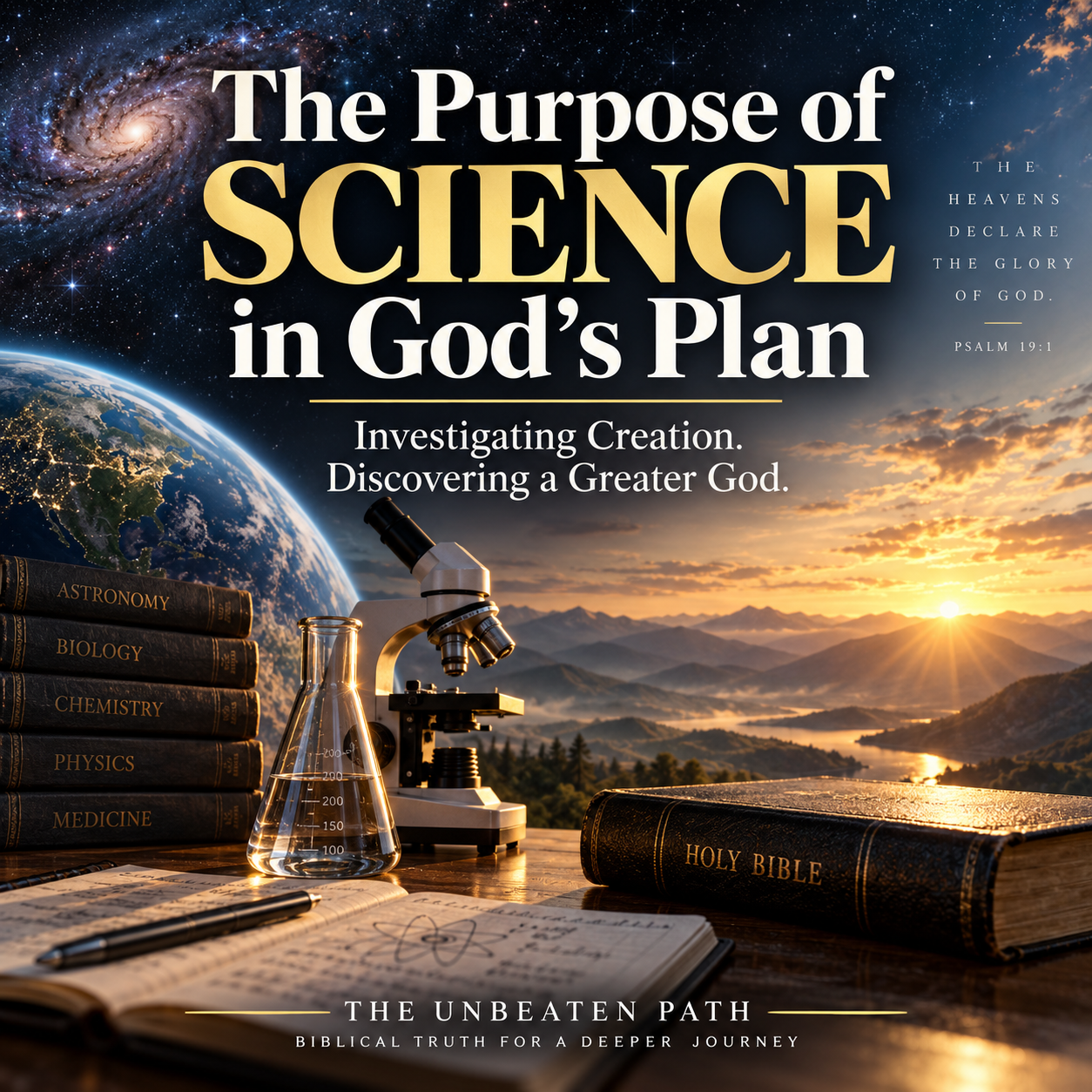
Science has changed the way human beings understand the world.
It has allowed us to observe galaxies billions of light-years away, examine structures smaller than the eye can see, understand disease, harness electricity, study DNA, predict weather, build machines, and uncover patterns in creation that earlier generations could scarcely imagine.
For some, these discoveries appear to make God less necessary.
But that conclusion assumes something science itself cannot establish:
That explaining how something works is the same as explaining why it exists.
Scripture begins somewhere deeper.
John 1:3 declares that all things came into being through the Word, and apart from Him nothing came into being that has come into being.
Science therefore does not investigate a self-created reality.
It investigates creation.
And discovery is not authorship.
Science Begins with a Reality It Did Not Create
Every scientific investigation begins with something already there.
The scientist does not create gravity before studying it.
The biologist does not invent the cell before examining it.
The physicist does not create the laws governing matter before describing them.
The astronomer does not place the stars in the heavens before observing their movement.
Science begins by encountering a world it did not make.
That fact alone should produce humility.
The scientific mind is powerful, but it is always responding to something given.
Scripture identifies the ultimate source of that given reality:
Creation exists because God willed it into being.
Discovery Is Not the Same as Creation
This distinction is easy to lose.
When human beings discover something remarkable, we often speak as though our understanding produced the reality itself.
But discovering a law of nature is not the same as establishing that law.
Understanding a biological process is not the same as originating life.
Describing the formation of a star is not the same as explaining why there is a universe capable of forming stars at all.
Science is extraordinarily good at uncovering patterns within creation.
But the existence of the pattern still raises another question:
Why is reality ordered in a way that human reason can investigate?
Order Makes Science Possible
Science depends upon consistency.
Experiments matter because we expect similar conditions to produce intelligible results.
Mathematics matters because the universe displays relationships that can be expressed numerically.
Observation matters because the human mind is capable, however imperfectly, of recognizing patterns in the world outside itself.
We often take these conditions for granted.
Yet they are remarkable.
A universe that was completely chaotic could not be investigated scientifically.
A human mind utterly incapable of rational thought could not investigate it.
Science therefore operates within an extraordinary correspondence between an ordered creation and a reasoning creature capable of studying it.
The Christian sees no embarrassment in this.
The world is intelligible because it is not ultimate chaos.
It is creation.
The Word Comes Before the World We Study
John 1:1 takes us even deeper.
Before creation, there is the Word.
Christian faith does not begin with matter as the ultimate reality.
It begins with God.
This changes the hierarchy.
Matter does not explain God.
God explains why there is matter to investigate.
Scientific knowledge may increasingly describe the processes through which creation operates, but increasing description does not displace the Creator.
Knowing how a mechanism works does not make its existence self-explanatory.
God Is Not Threatened by Human Discovery
Christians sometimes respond to scientific discovery defensively, as though every new explanation removes a little more territory from God.
But that treats God as though He exists only in the gaps of human knowledge.
That is far too small a view of God.
If God is Creator, then discovering a process within creation does not push Him out of it.
It simply tells us more about the creation He sustains.
The believer therefore need not fear truthful discovery.
Truth cannot ultimately threaten the God of truth.
Searching Can Be an Act of Wonder
Proverbs 25:2 presents a beautiful relationship between concealment and discovery.
There are things hidden within creation that must be searched out.
This is exactly what science does at its best.
It asks questions.
It observes.
It tests.
It revises.
It searches for what is not immediately visible.
From the Christian perspective, the hiddenness of creation need not be viewed as evidence of divine absence.
It can instead become an invitation to exploration.
The deeper we look, the more there is to investigate.
And every genuine discovery reminds us how much remains unknown.
Knowledge Should Produce Humility, Not Arrogance
Scientific progress can easily tempt human beings into intellectual pride.
We discover one layer of reality and begin behaving as though reality itself has been mastered.
But every generation eventually discovers how incomplete the knowledge of the previous generation was.
The more we know, the more clearly we often see the size of what we do not know.
Real knowledge should therefore make us more careful about absolute claims, not less.
Humility is not hostility toward science.
Humility is one of the conditions of good science.
A scientist must be willing to discover that an earlier assumption was wrong.
The Christian should be willing to exercise the same humility in interpreting both Scripture and creation.
Science and Scripture Do Not Ask Exactly the Same Questions
Confusion often arises because people expect science and Scripture to perform identical tasks.
Science commonly asks questions such as:
- What is happening?
- How does this process work?
- What causes this measurable effect?
- Can this result be observed or repeated?
Scripture addresses questions that reach beyond measurement:
- Why do we exist?
- What is good?
- What is evil?
- What is humanity for?
- What do we owe our Creator?
- What has gone wrong with us?
- How can we be reconciled to God?
These categories can overlap, but they are not identical.
A microscope can tell us extraordinary things about a human cell.
It cannot tell us whether a human life should be loved.
A brain scan may reveal patterns associated with moral decisions.
It cannot by itself establish what is morally right.
Science describes much of what is.
It cannot, by scientific measurement alone, tell us what ought to be.
The Material World Is Real, but It Is Not All Scripture Reveals
This is where passages such as Romans 8:13 become important.
Scripture recognizes bodily life, but it refuses to reduce human existence merely to bodily processes.
The human being is morally accountable before God.
We possess desires that must be governed, choices for which we are responsible, and a spiritual relationship with our Creator.
A purely material description of a human being may tell us much about chemistry, biology, and neurological activity.
It cannot exhaust what Scripture means by a person.
Human beings are not merely complicated machines.
We are creatures called to know, love, obey, and answer to God.
Mystery Is Not the Enemy of Knowledge
Mark 4:12 reminds us that spiritual understanding cannot be reduced to the mere possession of information.
A person may see facts without understanding their significance.
This principle extends beyond one passage.
Information and wisdom are not identical.
Data can tell us what is happening while leaving unanswered what it means.
Knowledge can increase without character improving.
Technological capacity can expand while moral wisdom declines.
The ability to do something does not establish that it ought to be done.
Science therefore needs wisdom.
Power without moral direction can become dangerous.
Science Can Become an Idol
The Christian need not reject science, but neither should we worship it.
Science becomes an idol when we ask it to carry an authority it was never designed to possess.
It becomes an idol when human knowledge is treated as the final judge of all reality.
It becomes an idol when technological ability is confused with moral permission.
It becomes an idol when humanity begins believing that enough knowledge can eliminate its need for God.
But knowledge cannot cure pride simply by increasing.
Intelligence cannot reconcile us to God.
Technology cannot forgive sin.
Scientific advancement may transform human circumstances while leaving the human heart fundamentally unchanged.
Faith Must Not Become an Excuse for Ignorance
There is an opposite error.
Christians can misuse faith as an excuse to avoid learning.
But ignorance is not spirituality.
Careful observation is not unbelief.
Asking hard questions is not rebellion against God.
If creation belongs to God, then Christians should have reason to study it carefully, truthfully, and without fear.
We should be willing to distinguish between what Scripture actually teaches and assumptions we have attached to it.
Faithfulness does not require us to defend weak arguments.
It requires us to love truth.
The More We Discover, the Greater the Responsibility
Scientific knowledge gives humanity extraordinary power.
We can heal diseases.
We can alter environments.
We can manipulate biological systems.
We can create technologies whose consequences affect millions of people.
But greater power creates greater moral responsibility.
The central question cannot remain:
“Can we do this?”
We must also ask:
“Should we do this, and toward what end?”
That is where scientific knowledge requires moral wisdom.
The Christian View Is Neither Fear nor Worship
The proper Christian response to science is neither fear nor worship.
We should not fear genuine discovery because creation belongs to God.
We should not worship scientific knowledge because human understanding remains limited and morally dependent upon God.
Instead, science can be received as a form of exploration.
It allows us to investigate the extraordinary complexity, order, and beauty of the world we have been given.
And the deeper we investigate, the less justification we have for intellectual arrogance.
We stand within a reality vastly larger than ourselves.
The Purpose of Science in God’s Plan
Science can relieve suffering.
It can reveal hidden structures.
It can help humanity steward creation more wisely.
It can expose false assumptions.
It can produce wonder.
It can expand our appreciation of how extraordinarily complex the created world really is.
But science must remain a servant of truth rather than becoming a substitute for God.
Its proper place is beneath the Creator, not upon His throne.
Science investigates creation. It does not create the reality it investigates.
The Christian therefore has no reason to choose between honest scientific inquiry and faith in God.
The deeper challenge is to place both knowledge and discovery in their proper order.
Creation is not God.
Science is not God.
Human reason is not God.
All of them find their proper place only when the Creator remains above what He has made.
Questions for Reflection
- Do I treat scientific discovery as though explaining a process eliminates the need for a Creator?
- Am I afraid of genuine discovery because I think truth could threaten God?
- Do I confuse increasing information with increasing wisdom?
- Where might technological capability be advancing faster than moral discernment?
- Do I approach creation with curiosity, humility, and gratitude?
- Has knowledge made me more humble before God—or more confident in human self-sufficiency?
Related Essays
When AI Gives Answers and the Holy Spirit Gives Wisdom — information can be extraordinarily powerful without becoming the same thing as biblical wisdom.

You Set Your Heart; God Shapes Your Mind — knowledge is never morally neutral when the heart determines how that knowledge is interpreted and used.
You Can Predict Your Future! — knowledge, direction, obedience, and what we repeatedly trust all participate in shaping the life we are becoming.
Related Ideas
Discovery Explains Creation Without Replacing the Creator — explaining how creation works does not explain creation away. Scientific discovery reveals mechanisms within a reality that already exists; it does not become the author of that reality.
Connected Ideas
Science · Creation · Knowledge · Wisdom · Discovery · Reason · Mystery · Technology · Truth · Humility · Stewardship · Creator
Scripture index
John 1:3; Proverbs 25:2; Mark 4:12; John 1:1; Romans 8:13