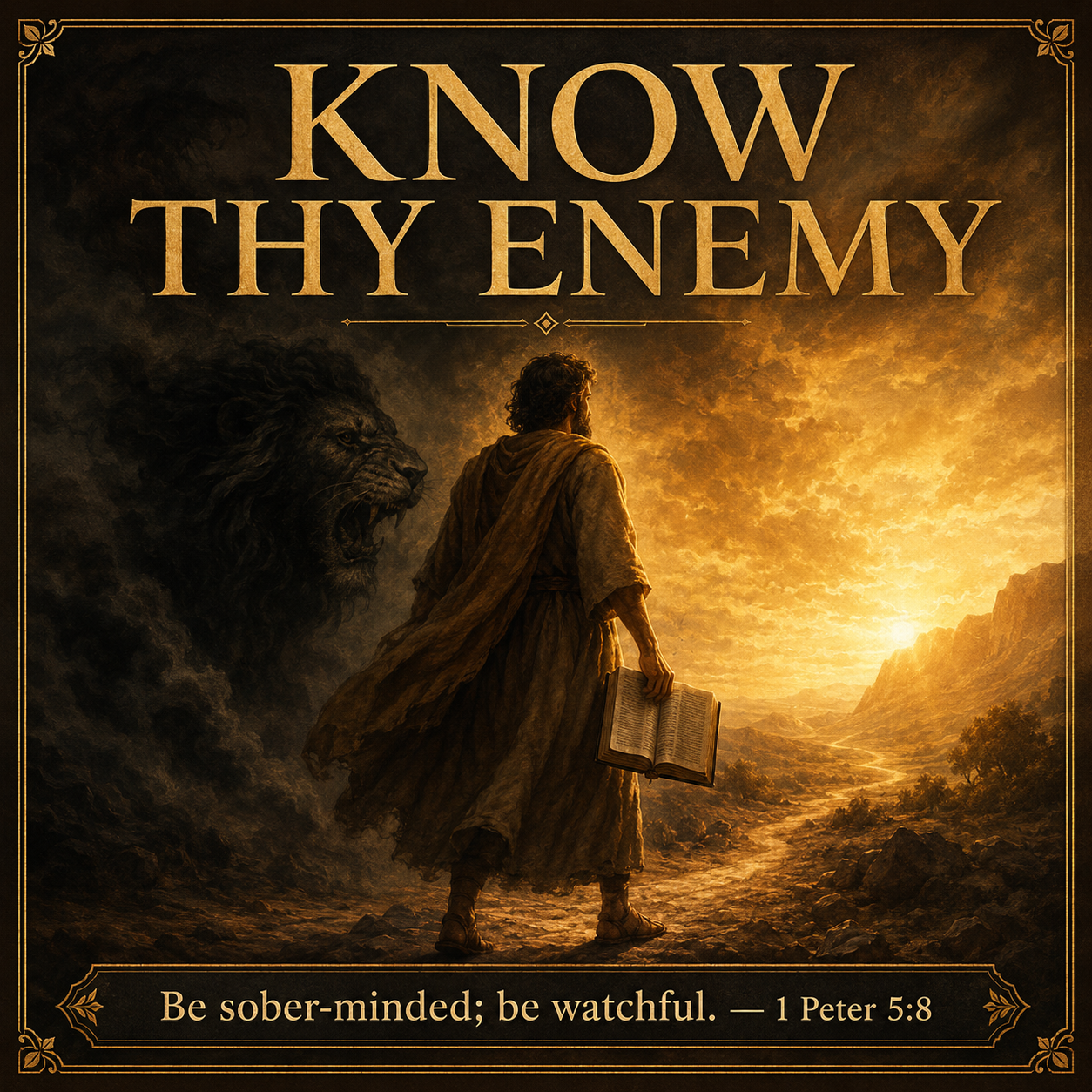
“Be sober-minded and alert. Your adversary the devil prowls around like a roaring lion, seeking someone to devour.” — 1 Peter 5:8
There is an old principle of warfare: if you know your enemy and understand how he works, you are less likely to be surprised by him. The same principle matters spiritually. Scripture does not tell us to become fascinated with Satan, afraid of him, or obsessed with darkness. It tells us to be alert.
Peter calls the devil an adversary. That word matters. An adversary is not neutral. He opposes. He looks for weakness. He studies openings. He seeks an opportunity to destroy what God is building in a human life.
Yet many people try to fight an enemy they do not understand.
The First Danger Is Ignorance
Hosea 4:6 contains a severe warning: God’s people can be destroyed for lack of knowledge.
Ignorance is dangerous because what we do not recognize can influence us while remaining unnamed.
If we imagine the enemy only as something dramatic, frightening, or obviously evil, we may miss the more ordinary ways temptation enters our lives. The enemy does not always arrive looking like an enemy. Sometimes he arrives as a reasonable thought, an attractive desire, wounded pride, fear, resentment, ambition, distraction, or a voice telling us that obedience to God is unnecessary.
The first task, therefore, is not merely to ask, “Who is Satan?” It is to ask, “How does the enemy work?”
Your Enemy Is Whatever Turns You Away from God
We often think of an enemy as a person who attacks us. Biblically, the deeper danger is anything that turns the heart away from God.
A person can become an instrument of temptation. A culture can normalize what God calls destructive. Money can promise security without God. Pride can make correction feel like an insult. Fear can persuade us to disobey because obedience seems too costly. Desire can make a forbidden thing appear necessary for happiness.
The enemy’s goal is not simply to make our circumstances difficult.
His deeper goal is separation: to move the heart away from trust, obedience, truth, and dependence upon God.
This is why spiritual warfare often takes place before any outward act occurs. The battle begins in interpretation. What do we believe about God? What do we believe about ourselves? What do we believe will give us life?
Look at the Serpent in Eden
In Genesis 3:1–6, the serpent does not begin by commanding Eve to rebel.
He begins with a question.
He draws her attention toward God’s command and then quietly changes how she sees it. The garden had been filled with God’s generosity, but the serpent made one restriction appear more important than every gift surrounding her.
Then he attacked God’s credibility.
The temptation was not only about fruit. It was about whether God could be trusted to define what was good.
If Eve could be persuaded that God was withholding something necessary, then disobedience could begin to look like freedom.
That strategy has not disappeared.
Temptation still whispers: “God is limiting you. God is withholding from you. Your desire knows better. You should decide for yourself.”
The serpent’s greatest weapon was not physical strength. It was a competing interpretation of God.
The Enemy Wants Access to the Mind Before the Hand
Sin usually becomes visible only after an invisible process has already taken place.
First a thought is entertained. Then the thought is repeated. Desire grows around it. The conscience begins negotiating. The forbidden action becomes easier to justify. Eventually the hand does what the heart has already permitted.
That is why Proverbs 4:23 tells us to guard the heart carefully. What enters and settles within us matters.
Spiritual vigilance is not paranoia. It is awareness of how direction is formed.
The question is not only, “What am I doing?”
It is also, “What am I repeatedly listening to, imagining, excusing, and desiring?”
Know the Enemy, but Also Know Yourself
An enemy looks for openings.
For one person the opening may be pride. For another, sexual desire. For another, fear of rejection. For another, greed. For another, anger. For another, the craving to be admired. For another, exhaustion and discouragement.
The same temptation does not need to work on everyone.
A wise believer therefore does not merely study evil in the abstract. He learns where his own walls are weak.
Where do I become easiest to deceive?
What desire repeatedly overrules my judgment?
What fear makes obedience difficult?
What wound makes bitterness feel justified?
What success makes me feel that I no longer need God?
Knowing our weakness is not surrender to weakness. It is part of guarding the place where attack is most likely to come.
Jesus Shows Us How the Enemy Is Answered
In Matthew 4:1–11, Jesus enters the wilderness and is tempted by the devil.
The temptations appeal to real pressures: hunger, identity, power, spectacle, and immediate relief.
But Jesus does not negotiate with the devil’s interpretation of reality.
He answers with the Word of God.
This is important. Scripture is not merely information to collect. It gives us a standard by which competing voices can be judged.
Without that standard, the loudest desire can become truth. The strongest emotion can become truth. The culture around us can become truth. Our own reasoning can become truth.
Jesus shows another way: truth is received from God and obeyed even when temptation offers a faster path.
God’s Commands Are Not the Enemy
One of Satan’s oldest strategies is to make God’s command look like the problem.
In Eden, the boundary appeared restrictive. But the serpent did not explain what would follow when that boundary was crossed.
God’s commands often protect what we cannot yet see.
Obedience can feel like limitation when desire is strong, but divine boundaries are not arbitrary walls erected to keep us from life. They are often part of the order through which life is preserved.
When we distrust the command, we become vulnerable to the voice that promises something better outside it.
This is why the battle over obedience is also a battle over God’s character.
Do we believe He is good when He says no?
Do we believe He knows what gives life when our desire disagrees?
The Enemy Studies Isolation
A predator looks for separation.
Peter’s image of a prowling lion should make us think seriously about isolation. A believer who is spiritually tired, ashamed, secretive, bitter, or cut off from correction can become increasingly vulnerable.
The enemy benefits when sin must remain hidden.
He benefits when pride prevents confession.
He benefits when resentment convinces us that everyone else is the problem.
He benefits when we stop praying, stop reading Scripture, stop listening to wise correction, and yet continue believing that we are spiritually safe.
Isolation can turn a small weakness into an open door.
Do Not Be Unaware of His Schemes
2 Corinthians 2:11 warns believers not to be ignorant of Satan’s schemes.
A scheme is not random. It has direction.
Sometimes the enemy accuses after he tempts. First he makes sin attractive; afterward he tells the sinner that restoration is impossible.
Sometimes he uses success instead of suffering. He does not need to destroy a person outwardly if prosperity can make that person forget God.
Sometimes he uses offense. Sometimes comparison. Sometimes hopelessness. Sometimes spiritual pride.
The strategy changes, but the direction is consistent: away from God, away from truth, away from obedience, away from life.
Spiritual Warfare Is Not Won by Fear
The answer to spiritual warfare is not to become frightened by Satan.
James 4:7 gives a simple order: submit to God, resist the devil, and he will flee.
Notice what comes first.
Submission to God.
Resistance is strongest when the believer is already standing under God’s authority.
Ephesians 6:10–18 describes the armour of God: truth, righteousness, readiness, faith, salvation, the Word of God, and prayer.
The armour is not mystical decoration. It describes a life anchored in what God has given.
Truth resists deception.
Righteousness resists corruption.
Faith resists the lie that circumstances have made God untrustworthy.
The Word answers competing voices.
Prayer keeps dependence directed toward God.
The Enemy Cannot Be Stronger Than Christ
To know the enemy correctly is also to know his limits.
Christian vigilance must never become a theology in which Satan appears almost equal to God.
He is not.
1 John 4:4 reminds believers that the One who is in them is greater than the one who is in the world.
The devil is an adversary, but he is not sovereign.
He tempts, deceives, accuses, and seeks openings. Yet the believer’s security is not found in becoming more impressed by the enemy. It is found in remaining nearer to Christ.
The Enemy Can Work Through the World, the Flesh, and the Devil
Not every temptation should be blamed directly on Satan. Scripture also speaks about the world around us and the desires within us.
The world can reward values that oppose God’s kingdom. The flesh can desire what is contrary to the Spirit. The devil can exploit both.
This distinction matters because spiritual warfare is not solved by blaming an invisible enemy for every wrong decision. Sometimes the battlefield is our own appetite. Sometimes it is a habit we refuse to surrender. Sometimes it is a value we absorbed from the culture. Sometimes it is a lie we have believed for so long that it sounds like our own voice.
Knowing the enemy therefore requires honesty. We must identify not only the tempter outside us, but also what inside us responds to the temptation.
The serpent spoke, but Eve desired.
The devil tempted Jesus, but Jesus refused to let hunger, power, or self-display become a reason to disobey the Father.
Victory requires both discernment of the external voice and surrender of the internal desire that wants to agree with it.
The Enemy Can Also Use Good Things
We usually expect temptation to come through obviously bad things. But many of the most effective spiritual distractions begin with something good that is allowed to become ultimate.
Work is good, but work can become identity.
Money is useful, but money can become security.
Family is precious, but even family can become an excuse to disobey God.
Knowledge is valuable, but knowledge can become pride.
Success can become dangerous when it persuades us that we have outgrown dependence upon God.
The enemy does not always need to take something away from us. Sometimes he can accomplish his purpose by giving our attention something else to worship.
That is why discernment asks not merely, “Is this thing bad?” but, “What place is this thing taking in my heart?”
Obedience Keeps Us Inside God’s Order
The Bible repeatedly joins trust with obedience because obedience keeps the believer aligned with God’s wisdom.
This should not be turned into a mechanical promise that obedient people will never suffer. Scripture clearly shows otherwise. But God’s commands still describe the path of life, and rejecting them creates consequences that should not be mistaken for spiritual freedom.
Adam and Eve were provided for in Eden. The command concerning the tree did not contradict God’s provision; it belonged within it.
The serpent separated the command from the character of the Giver. Once Eve saw the boundary as deprivation rather than wisdom, disobedience became easier to rationalize.
We repeat the same mistake whenever we treat God’s instructions as obstacles standing between us and the life we deserve.
The enemy says, “Step outside God’s order and you will gain.”
Faith asks, “What does God know that I cannot yet see?”
Obedience is therefore not mere rule-keeping. It is an act of trust in the wisdom and goodness of God.
The Enemy Wants Us to Misidentify the Battle
Another danger is fighting the wrong enemy.
We may decide that our spouse is the enemy, our colleague is the enemy, our neighbour is the enemy, or the person who corrected us is the enemy.
But Ephesians 6:12 warns that our struggle is not ultimately against flesh and blood.
Human beings can certainly harm us and must sometimes be confronted. Yet spiritual blindness begins when hatred of a person prevents us from seeing the deeper battle over truth, forgiveness, pride, bitterness, fear, and obedience.
If the enemy can make us hate the person in front of us, he may succeed in shaping us into the very thing we believe we are fighting.
Knowing the enemy therefore includes refusing to give him the wrong identity.
The battle is larger than the person who offended us.
Vigilance Must Become a Daily Habit
Peter does not say, “Be alert only when life feels dangerous.”
He calls believers to a sober way of living.
That means spiritual awareness must become ordinary rather than emergency behaviour.
We guard the heart before the crisis.
We learn Scripture before the lie becomes persuasive.
We practise confession before secrecy becomes bondage.
We stay connected to faithful believers before isolation becomes comfortable.
We submit our desires to God before those desires become masters.
Spiritual warfare is often won in quiet decisions long before anyone sees a dramatic battle.
So Know Thy Enemy
Know that he does not always look dangerous.
Know that he often attacks trust before behaviour.
Know that he studies weakness.
Know that he can use both pain and prosperity.
Know that deception becomes easier when God’s Word becomes unfamiliar.
Know that isolation, secrecy, pride, and unguarded desire create openings.
But above all, know your God.
The purpose of knowing the enemy is not to fill the mind with darkness. It is to recognize quickly whatever tries to turn the heart away from the One who gives life.
Be sober.
Be watchful.
Guard the heart.
Stay in the Word.
Submit to God.
Resist the enemy.
And remember that vigilance is not fear. It is faith with its eyes open.
Related Ideas
The Enemy Attacks Trust Before Behavior — outward sin often begins with an earlier battle over trust, interpretation, desire, fear, and attention. The enemy seeks agreement in the heart before disobedience becomes visible.
Temptation Begins by Questioning God’s Goodness — the serpent’s first victory is sought in our interpretation of God before it appears in outward disobedience.
Trial Is Not Proof of Rejection — difficulty can become an arena of testing without becoming evidence that God has abandoned His people.
The Voice You Obey Becomes the Master You Serve — repeated obedience gives authority to the voice, desire, fear, or truth we choose to follow.
Connected Ideas
Enemy · Satan · Temptation · Deception · Serpent · Spiritual Warfare · Vigilance · Discernment · Obedience · Heart · Scripture · Resistance · Armour of God · Truth
Scripture index
1 Peter 5:8; Hosea 4:6; Genesis 3:1–6; Proverbs 4:23; Matthew 4:1–11; 2 Corinthians 2:11; Ephesians 6:10–18; Ephesians 6:12; James 4:7; 1 John 4:4