Core ideaA life should not be measured primarily by size, visibility, wealth or comparison with others. God's deeper measure is faithfulness: what we did with what He entrusted to us, what He formed in us, and how faithfully we use what still remains.
A Biblical Perspective on Frustration, Faithfulness, and Finishing Well
There comes a point in life when many people begin to look backward.
We count the years. We remember the opportunities we missed, the risks we did not take, the plans that never materialised, the money we did not make, the businesses that did not grow, the relationships that did not become what we hoped, and the dreams that somehow remained dreams.
Then a troubling thought enters the heart:
Have I achieved too little with my life?
For some, this question comes quietly. For others, it becomes a deep frustration.
We look at people our age who seem to have accomplished more. They have larger businesses, greater wealth, wider influence, stronger reputations, more impressive titles, or a longer list of achievements.
Comparison begins its work.
We start measuring our life against someone else’s life.
And before long, a dangerous conclusion forms:
Perhaps I have failed.
But Scripture challenges the very measurement behind that conclusion.
A Different Measure of Success
The Bible does not teach that ambition is wrong. It does not encourage laziness, indifference, or passivity. God calls His people to work diligently, use their gifts, multiply what has been entrusted to them, serve others, and make the most of their time.
Yet Scripture repeatedly warns us that God’s measurement of a successful life is very different from ours.
We ask:
How much have I achieved?
God asks:
How faithful have you been with what I gave you?
That difference changes everything.
In the parable of the talents, Jesus describes servants who were entrusted with different amounts. One received five talents, another two, and another one.
Notice something important.
The servants did not receive equal resources.
They were never expected to produce identical outcomes.
The master did not compare the servant with two talents against the servant with five talents. He judged each according to what had been entrusted to him.
And when the faithful servant returned, the master’s commendation was not:
“Well done, highly successful servant.”
It was:
“Well done, good and faithful servant.”
Faithfulness was the standard.
Stop Comparing Your Assignment
That truth should immediately confront one of the greatest sources of human frustration: comparison.
We often evaluate our lives according to someone else’s assignment.
Someone built a large company.
Someone became wealthy.
Someone became famous.
Someone acquired properties.
Someone travelled the world.
Someone built a ministry followed by thousands.
And we quietly ask:
Why not me?
Peter once fell into a similar trap.
After Jesus spoke about Peter’s future, Peter looked toward John and asked, in effect, “What about him?”
Jesus answered:
“What is that to you? You follow Me.”
Those words remain one of the strongest cures for comparison.
What is that to you?
God has not asked you to live another person’s life.
He has not asked you to reproduce another person’s journey.
He has not given everyone the same timing, resources, opportunities, burdens, health, relationships, responsibilities, or calling.
Your responsibility is much simpler and much harder:
You follow Me.
Conviction Is Not Condemnation
This does not mean that frustration is always wrong.
There is such a thing as holy dissatisfaction.
Paul said that he pressed toward the goal. He refused complacency. He disciplined himself. He wanted to finish his race well.
There are moments when we should examine ourselves honestly.
Have I wasted opportunities?
Have I buried gifts because of fear?
Have I allowed laziness to steal years?
Have I avoided difficult assignments?
Have I been careless with money, time, relationships, or influence?
Have I postponed obedience?
Those are legitimate questions.
Scripture does not encourage us to excuse wasted potential.
The servant who buried his talent was rebuked.
Proverbs warns repeatedly against laziness.
Paul urges believers to make the most of every opportunity.
There are times when repentance should sound like this:
I have wasted enough time. From this day forward, I want to live differently.
But there is an enormous difference between conviction and condemnation.
Conviction says:
You can still obey God today.
Condemnation says:
You have already wasted too much. Your opportunity is gone.
The first voice moves us toward God.
The second drives us into despair.
Hidden Years Are Not Wasted Years
Scripture gives us many reasons to reject the belief that usefulness has an expiry date.
Moses was eighty years old when God sent him back to Egypt.
Caleb was eighty-five when he said, “Give me this mountain.”
Abraham waited many years for the fulfilment of God’s promise.
The Bible is filled with men and women whose most significant work occurred after long periods of waiting, obscurity, disappointment, or delay.
We must therefore be careful when we call a season “wasted.”
God may have been doing something that could not easily be measured.
Modern society measures output.
God also measures formation.
We measure money.
God measures character.
We measure visibility.
God measures obedience.
We measure speed.
God measures endurance.
We measure results.
God measures faithfulness.
There are years in which very little appears to be happening outwardly, yet God may be doing profound work inwardly.
Moses spent forty years in Midian.
Joseph spent years in slavery and prison.
David was anointed king long before he sat on the throne.
Jesus Himself spent most of His earthly life outside public ministry.
From the world’s perspective, these might appear to be unproductive years.
But hidden years are not necessarily wasted years.
God often develops the person before expanding the assignment.
He may use disappointment to teach humility.
Delay to develop patience.
Failure to produce wisdom.
Loss to create compassion.
Obscurity to weaken pride.
Weakness to teach dependence.
Therefore the person who feels he has achieved too little should ask a deeper question:
What has God formed in me through the years that did not go according to my plans?
Perhaps some of your greatest preparation took place during seasons you considered failures.
Identity Before Achievement
There is another danger behind the frustration of achievement.
Sometimes the real issue is not accomplishment.
It is identity.
We secretly believe:
If I achieve something significant, then my life will be significant.
This is one of the most exhausting beliefs a person can carry.
Because achievement can never permanently satisfy the need for significance.
Earn one million dollars, and someone has ten million.
Build one company, and someone has built twenty.
Gain ten thousand followers, and someone has ten million.
Acquire one property, and someone owns an empire.
Comparison has no finishing line.
If your identity depends on achievement, there will never be enough achievement.
The gospel offers something radically different.
Before Jesus had performed His public miracles, before He had preached to crowds, before He had gathered the disciples, the Father declared His love for Him.
Identity came before public accomplishment.
The Christian therefore works from acceptance, not for acceptance.
This is one of the deepest forms of freedom available to us.
You can still work intensely.
You can build.
Invest.
Create.
Lead.
Serve.
Give.
Teach.
Mentor.
Take risks.
Pursue excellence.
But you no longer need these accomplishments to prove that your life matters.
Your work becomes stewardship rather than self-validation.
And when that change occurs, frustration loses much of its power.
What Remains in Your Hand?
Perhaps one of the most important biblical questions for the person who thinks he has achieved too little is the question God asked Moses:
“What is that in your hand?”
Moses had a staff.
It looked ordinary.
But surrendered to God, that ordinary staff became associated with extraordinary acts of deliverance.
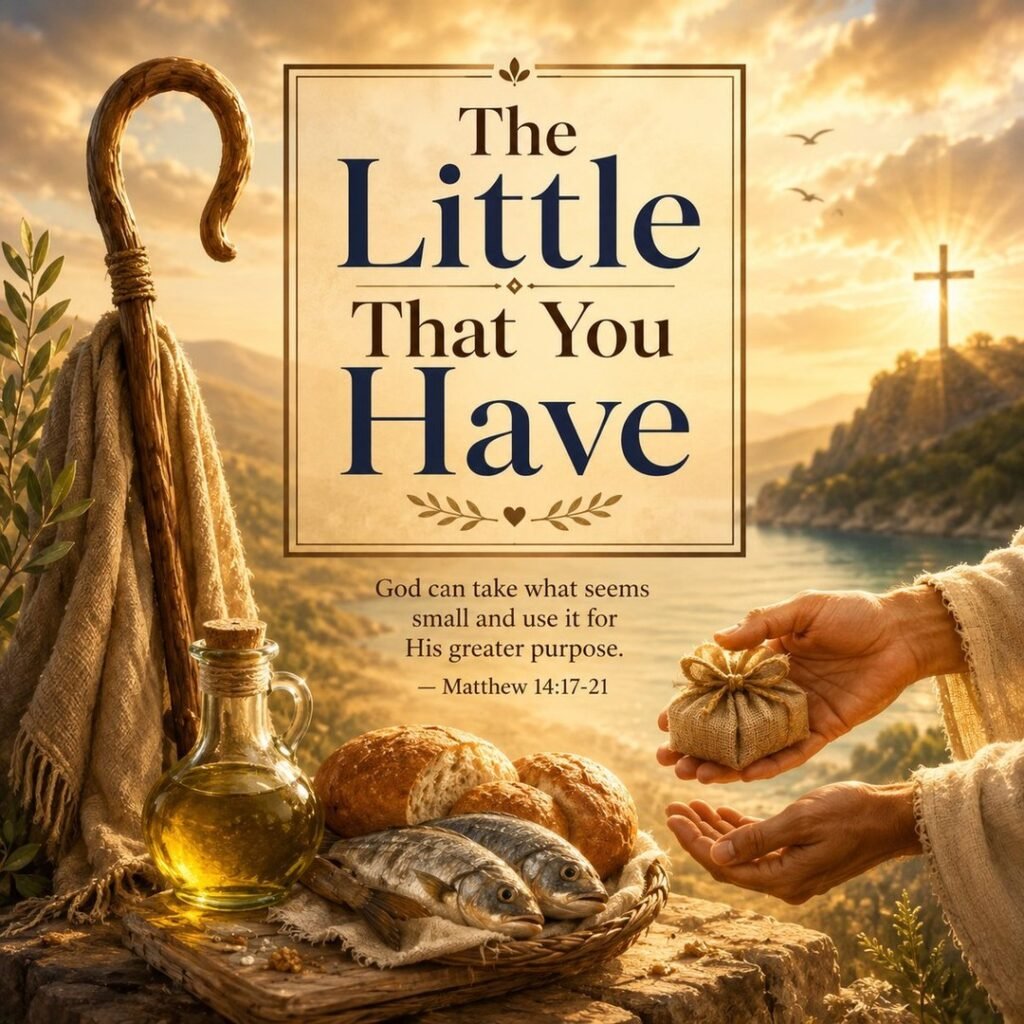
The disciples faced thousands of hungry people and saw insufficiency.
They had five loaves and two fish.
Their language was essentially:
This is too little.
But Jesus began with the little that was available.
That is often how God works.
We look at our remaining years and say:
Too little time.
Too little money.
Too little influence.
Too little energy.
Too little opportunity.
Too little success.
God may be asking:
What remains in your hand?
Perhaps you still have experience.
Perhaps wisdom.
Perhaps relationships.
Perhaps some capital.
Perhaps a business.
Perhaps a skill.
Perhaps knowledge others need.
Perhaps lessons learned through painful mistakes.
Perhaps the ability to encourage someone who is walking through something you survived.
Perhaps time.
Perhaps faith.
Perhaps only a small opportunity.
Smallness Does Not Prevent Usefulness
Never despise what remains merely because it looks small.
Zechariah asks:
“Who dares despise the day of small things?”
The kingdom of God itself is compared to a mustard seed.
A widow places two small coins into the offering, and Jesus notices her.
A young boy offers five loaves and two fish, and thousands are fed.
David walks toward Goliath carrying weapons that looked inadequate.
Again and again, God demonstrates that smallness does not prevent usefulness.
The little thing surrendered to God may accomplish more than the great thing possessed only for ourselves.
Rich Toward God
That brings us to one of the most sobering teachings of Jesus.
In Luke 12, a rich man’s land produces abundantly.
He builds larger barns.
His wealth increases.
By every ordinary economic measure, he is successful.
Yet God calls him a fool.
Why?
Not because wealth is inherently evil.
Not because business expansion is evil.
Not because possessing assets is evil.
His tragedy was that he confused accumulation with the meaning of life.
He was rich toward himself but poor toward God.
That means it is entirely possible to achieve much and still waste one’s life.
And it is equally possible to appear to achieve little while living a life of tremendous eternal significance.
That is why the question:
“Have I achieved enough?”
may be the wrong question.
A better question is:
“Have I been faithful?”
And another:
“What can I still faithfully do?”
Finish Your Race
Paul understood this.
Near the end of his life, he did not summarise his existence by wealth, recognition, possessions, or worldly status.
He said:
“I have fought the good fight, I have finished the race, I have kept the faith.”
What a definition of success.
He finished his race.
Not someone else’s race.
His.
This may therefore be the proper biblical response to the frustration of having achieved too little:
Do not spend the rest of your life mourning the life you wish you had lived.
Learn from it.
Repent where repentance is necessary.
Correct what can still be corrected.
Reconcile where reconciliation is possible.
Use what remains.
Give what you can.
Serve whom you can.
Build what God places before you.
And stop asking whether your life looks impressive enough compared with another person’s.
Use What Remains
One day, the deepest question will not be how large our achievements became.
The question will be whether we faithfully completed the assignment placed before us.
God is not asking whether your life became famous.
He is not asking whether your name became great.
He is not asking whether you accumulated more than everyone around you.
He is asking whether you were faithful with what came into your hands.
So if you feel that you have achieved too little, perhaps you do not need to spend your remaining years looking backward with regret.
Look instead at what is still in your hands.
Look at the years that remain.
Look at the people still around you.
Look at the wisdom you have gained.
Look at the opportunities still appearing.
Then place all of it before God.
The final chapter has not yet been written.
And in the kingdom of God, a small beginning surrendered in faith can still produce a harvest far greater than you imagined.
The greatest tragedy is not that we achieved too little.
It is that we might spend so much time grieving what we did not achieve that we fail to faithfully use what still remains.
Do not despise the little.
Do not worship the large.
Do not compare your race.
Do not bury what remains.
Instead, pray:
Lord, whatever is left in my hands, whatever is left in my years, and whatever strength You have given me—teach me to use it faithfully.
Because in the end, the greatest achievement may not be that the world looked at your life and called it successful.
It may simply be that God looked at your life and said:
“Well done, good and faithful servant.”
Related Idea
Faithfulness Before Success — why Scripture measures a life by faithful stewardship before visibility, scale, wealth, or applause.
Connected Ideas
Faithfulness · Calling · Comparison · Stewardship · Identity · Hidden Years · Finishing Well · Surrender
Originally published on X on 2026-08-09. This website edition preserves the original essay while adding structural headings and knowledge links.