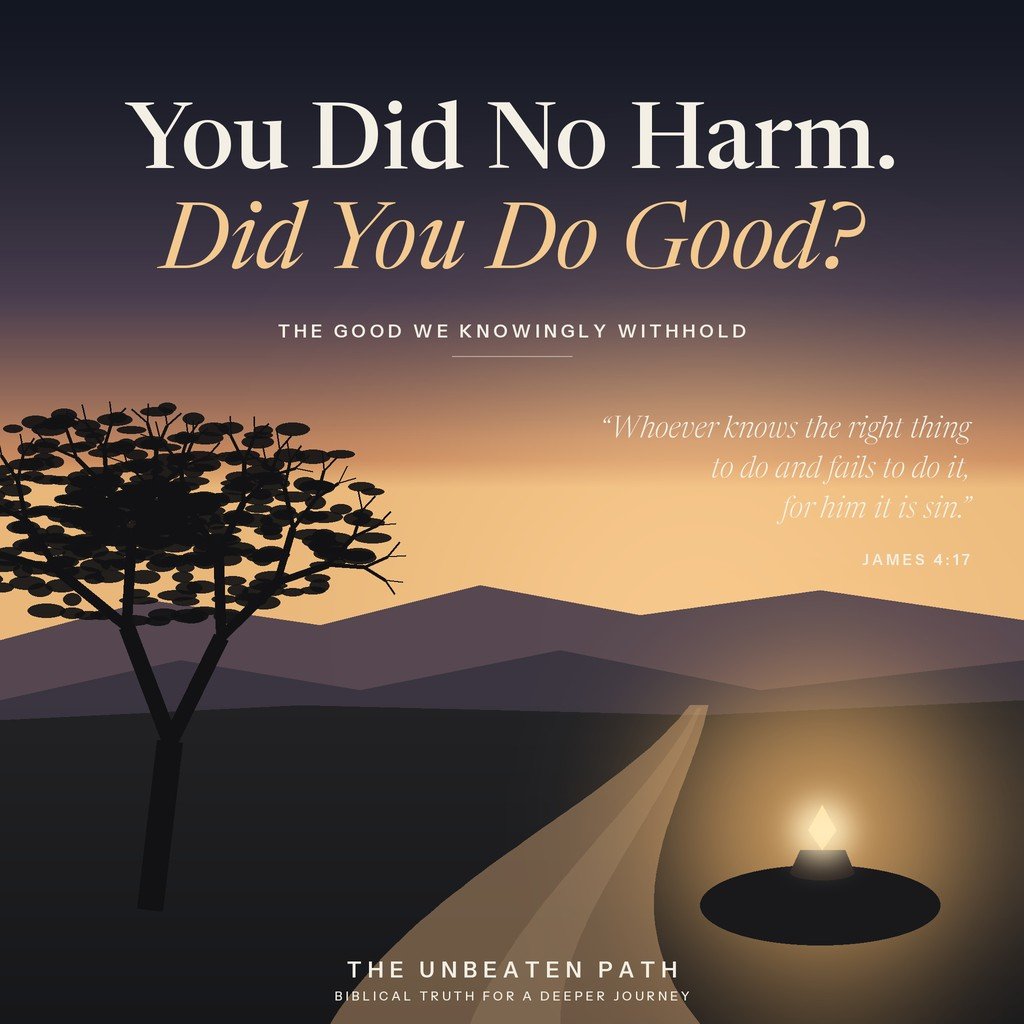
Core ideaKnowingly withholding the good we can do is sin. “I did not hurt him” does not answer “Why did you leave him without help?”
We can let someone suffer and still believe we did nothing wrong. We did not cause the wound. We did not take their money or betray their trust. We merely saw what had happened and decided that getting involved would cost us too much.
But Scripture reaches beyond the evil we commit to the good we knowingly withhold:
So whoever knows the right thing to do and fails to do it, for him it is sin.
James 4:17, ESV
Consider how carefully we protect ourselves from that responsibility. We know someone has been treated unjustly, but speaking up might damage a relationship we value. We see a brother struggling, but asking what he needs might oblige us to share what we have. We recognise the burden, calculate the inconvenience, and call it “none of our business.”
If we were the ones suffering, we would want someone to stand beside us. We would find it painful to watch people who could help turn away. Yet the help we would plead for becomes the help we excuse ourselves from giving.
The priest and Levite did not rob the wounded man. They saw him and passed by. Their innocence in the attack did not fulfil their responsibility to the victim.
“I did not hurt him” does not answer “Why did you leave him without help?”
When we know the good we ought to do and choose to withhold it, we have more to confess than we think.
The Good We Owe
Love places a responsibility upon us before we decide whether we feel generous.
Paul describes love as a continuing debt (Romans 13:8). Proverbs tells us not to withhold good from those to whom it is due when we have the power to act (Proverbs 3:27). Here, what we owe is the love God commands us to show. When another person needs the good we can provide, helping is more than an optional favour.
We understand this when we are the ones in need. If someone could speak the truth that would clear our name, we would not regard their silence as an innocent personal preference. If someone entrusted with our care ignored our suffering, we would recognise that they had failed in their responsibility towards us.
The command to love our neighbour as ourselves requires us to recognise our responsibility as readily as we recognise theirs.
Duty names the responsibility. Love explains why we willingly embrace it. Jesus joined His obedience to His love for the Father (John 14:31). In Him, the Father’s command was fulfilled by a willing heart. We, too, are called to care about the people God asks us to serve.
The good we owe does not become optional because we would rather not give it.
Love at Our Convenience
We can worship God and still refuse to help the person before us.
Jesus told the parable in a conversation about inheriting eternal life and the command to love God and neighbour. The questioner asked who qualified as his neighbour. Jesus placed a wounded man beside the road (Luke 10:25–37).
The robbers had stripped him, beaten him, and left him half dead. A priest saw him and passed by on the other side. A Levite saw him and did the same.
These men were associated with God’s worship and service. Yet the man before them received no mercy from either. Their religious standing could not dress his wounds. Their innocence of the robbery could not carry him to safety. He needed someone to stop.
Jesus does not give their reasons. Their passing by is enough to make us examine ours.
We leave a message unanswered because we suspect the person needs more than a greeting. We avoid the friend whose troubles have become exhausting. We know that someone has been mistreated, but the person responsible can advance our interests. We feel sorry for the injured person and remain useful to the one who injured them.
Sometimes we even pray that God will send help while guarding the help we could give.
Love at our convenience lets our comfort decide how far our concern will go.
The priest and Levite continued their journeys. The wounded man remained without their help. We do the same when we see another person’s suffering, recognise the help we ought to give, and walk away because we do not want our lives disturbed.
When we knowingly withhold the help we ought to give, we are choosing our comfort over our neighbour’s need. That choice is sin.
Love That Indulges
Love can also stop at the displeasure of someone we cherish. We recognise the danger of their conduct, yet withhold the action that might bring their anger upon us.
Eli’s case exposes the seriousness of that retreat. His sons abused their priestly position and treated the Lord’s offering with contempt. Eli knew of their wickedness and rebuked them. He warned them about sinning against God (1 Samuel 2:12–25).
But God did not accept his warning as fulfilling his responsibility. Eli had honoured his sons above Him and shared in the benefit of the misused offerings (1 Samuel 2:29). God later declared judgment upon his house because he knew of his sons’ wrongdoing and failed to restrain them (1 Samuel 3:13).
Eli’s words opposed the sin; his failure to restrain it allowed it to continue.
Eli held an entrusted office. The wrongdoing concerned the worship he was responsible for overseeing. He had authority to act and shared in the benefits of the misconduct.
We warn someone we love, but when they refuse to change, we shield them from the consequences. They keep their position. Those they hurt remain exposed. We have spoken against the wrong while protecting their freedom to continue it.
Scripture names the injustice:
It is not good to be partial to the wicked and so deprive the innocent of justice.
Proverbs 18:5, NIV
The person we favour receives our protection. The person they harm is denied it. We may call our choice loyalty, but those left exposed experience it as abandonment.
Our affection for the wrongdoer does not excuse our injustice towards the wronged.
Nor does shielding the wrongdoer secure their good. Eli’s sons died on the same day. The ark was captured. When Eli heard about the ark, he fell backwards, broke his neck, and died (1 Samuel 4:11–18). His rebuke had not become restraint, and the wrongdoing continued until judgment came.
Love must sometimes accept the anger of the person it seeks to help. When responsibility has been entrusted to us, it may require restraint, removal from a position, or an honest report to those who can intervene. The purpose is to stop the harm and call the wrongdoer to repentance.
Love that shields wrongdoing leaves the innocent unprotected and the person we cherish vulnerable to judgment.
Love in Deed and Truth
The Samaritan’s mercy shows love willing to bear the cost of another person’s good.
He saw the same wounded man. Moved with compassion, he approached him, treated his wounds, placed him on his own animal, and brought him to an inn. He cared for him, paid for continued care, and promised to meet further expense (Luke 10:33–35).
His compassion became treatment, transport, shelter, and continued care.
The Samaritan did not cause the wound, but he accepted the cost of caring for the wounded.
Jesus directed His questioner to do likewise. Mercy became a command.
John brings the same demand into the lives of believers. Christ laid down His life for us; we ought to lay down our lives for one another. John then asks how God’s love can remain in someone who possesses material resources, sees a brother in need, and closes his heart against him. He calls us to love in deed and truth (1 John 3:16–18).
We ask Christ to forgive the sins we cannot undo, bear the guilt we cannot remove, and save us when we cannot save ourselves. Then a brother needs food, time, or help that we can provide—and we close our hearts. We understand our own need for mercy. Why does his need become too much to ask?
The unforgiving servant received release from an immense debt, then refused mercy to a fellow servant who owed him far less. His master condemned that refusal (Matthew 18:23–35). The parable concerns forgiveness; John exposes the same contradiction in withholding material help: we receive mercy, then refuse to show it.
We plead for a mercy that cost Christ His life, then withhold a kindness that would cost us far less.
Jesus commands us to love one another as He has loved us, even to laying down our lives (John 15:12–13). These people matter to the Father. As we love Him, their good becomes our concern, and we willingly bear the cost of serving them.
Paul recognises that we should give according to what we have (2 Corinthians 8:12). The Samaritan involved an innkeeper; we too can seek help and share responsibility. Genuine limitations remain, but reluctance must not disguise itself as inability.
Love in deed and truth gives the help we would otherwise withhold to spare ourselves the cost.
Neglect Faces Judgment
The good we knowingly withhold is sin, and we are accountable to God for it.
James 4:17 follows a rebuke of those who boast about their plans without acknowledging their dependence upon God. His conclusion is plain: knowing the right thing to do makes our failure to do it sin.
Jesus’ account of judgment gives withheld care terrible weight. Those at His left are confronted with the food, drink, welcome, clothing, and care they failed to provide. He identifies their neglect of the least of His brothers as neglect of Him. The passage ends in eternal punishment (Matthew 25:41–46).
The charge includes what they left undone. Jesus does not present their refusal as a missed opportunity to be unusually generous. He pronounces judgment.
We cannot answer that charge by listing the wrongs we never committed. God calls us to account for the good He required, and we withheld.
The good we knowingly withheld is part of the sin we must confess.
That confession must name what our excuses concealed: the person we abandoned, the truth we suppressed, the responsibility we allowed affection to weaken. Repentance turns us towards the action we avoided. Where repair remains possible, sorrow must move our hands.
Knowing the good does not excuse leaving it undone. It makes our refusal answerable to God.
God Does Not Forget
God also remembers those who bear the cost of doing good. His justice includes the love that human gratitude fails to repay.
The Samaritan paid for damage the robbers caused. We may likewise lose money, time, opportunity, or affection because we respond to a wrong we did not commit. We may help faithfully and receive no thanks. The burden can feel unfair because the cost has fallen upon the person willing to care.
Scripture does not leave that person forgotten. Proverbs 19:17 describes kindness to the poor as lending to the Lord and promises His repayment. Galatians 6:7–9 connects sowing and reaping with perseverance in doing good: the harvest comes at the proper time if we do not give up. Hebrews 6:10 grounds assurance in God’s justice. He will not forget the work and love we express toward Him by serving His people.
The person we help may never repay us; the God we serve will not forget us.
His promises do not set repayment to our timetable or make every reward financial. They assure us that faithful love is neither unseen nor wasted. We can entrust Him with the cost of obedience.
We act because we love Him. We persevere because we trust Him. What faithful love gives, God remembers and rewards.
Where Will Our Love Stop?
The person we avoided still needs help. The person we protected may still be harming others. Our explanations may have quietened our conscience without relieving anyone’s suffering.
We have examined love that stops at inconvenience, love that retreats from necessary correction, and love that willingly accepts the cost of another person’s good. Now we must name our own response. Whose need have we dismissed? Whose wrongdoing have we shielded? What have we refused to give?
Confess the refusal. Give the help. Speak the truth. Exercise the responsibility we have neglected. God warns us against knowingly withholding the good He requires, and promises to remember the love we show in serving His people. We can entrust Him with the cost of obedience.
“I did not hurt him” does not answer “Why did you leave him without help?”
Related Essays
The Sin of What We Leave Undone — Matthew 25:45 and the quieter disobedience of the good we fail to do.
You May Have Forgotten What You Sowed—God Has Not — Galatians 6 and why faithful good is never wasted.