Human beings can hide many things from one another.
We can hide motives behind polite words.
We can hide resentment behind silence.
We can hide fear behind confidence.
We can hide selfish ambition behind apparently noble actions.
We can even hide pain so well that the people closest to us do not know what we are carrying.
But Scripture presents a radically different reality before God.
What is hidden from people is never hidden from God.
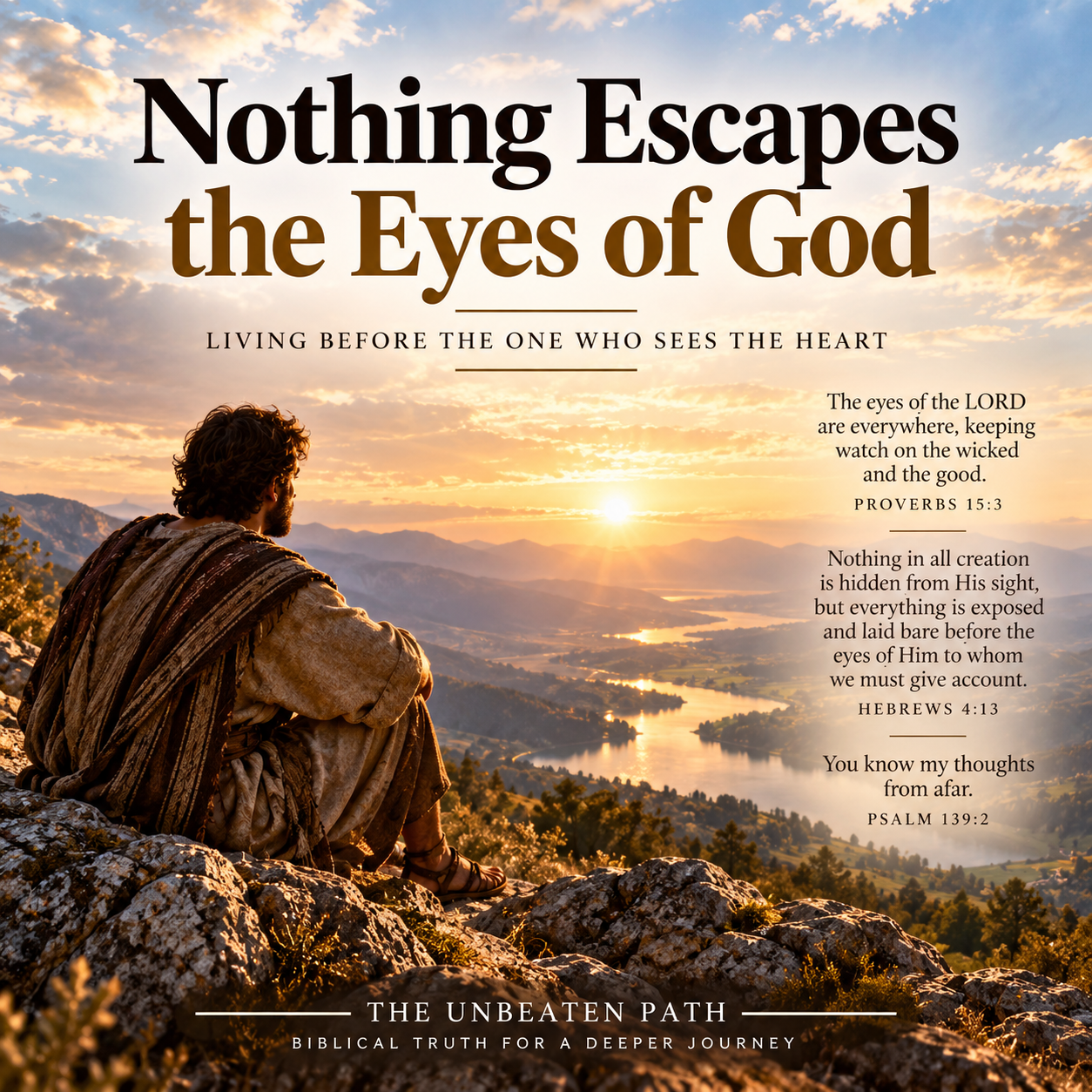
Proverbs 15:3 declares that the eyes of the LORD are everywhere.
That truth is both frightening and comforting.
It means secret sin is never truly secret.
But it also means unseen faithfulness is never truly unseen.
God Sees More Than Behaviour
Human judgment begins with what is visible.
We hear words.
We observe actions.
We see success or failure.
We form conclusions from the small amount of evidence available to us.
But God is not limited to appearances.
1 Samuel 16:7 reminds us that human beings look at outward appearance while the LORD looks at the heart.
God sees the action.
But He also sees why it was done.
He sees generosity—and whether it came from love or from the desire to be admired.
He sees silence—and whether it came from wisdom or cowardice.
He sees religious activity—and whether the heart beneath it is surrendered or merely performing.
God does not merely see what we do. He sees the heart from which we do it.
Nothing Is Truly Hidden
Hebrews 4:13 gives one of Scripture’s clearest statements about this reality.
Nothing in creation is concealed from God’s sight.
Everything lies open before Him.
This destroys one of sin’s favourite illusions:
“No one knows.”
Perhaps no other person knows.
Perhaps the behaviour remains private.
Perhaps reputation remains untouched.
Perhaps consequences have not yet appeared.
But secrecy from people is not secrecy from God.
The hidden room is still open before Him.
The private conversation is still heard.
The concealed motive is still known.
The thought never spoken aloud is still visible to the One who searches the heart.
The Heart Has No Locked Room Before God
Psalm 139 presents God’s knowledge in deeply personal terms.
David recognizes that God knows when he sits and when he rises.
God knows his thoughts.
His movements.
His words before they are spoken.
David imagines travelling to the farthest possible place.
Still God is there.
He imagines darkness covering him.
But darkness is not dark to God.
Human beings may create private spaces.
God does not experience them as private.
The heart has no locked room to which God does not already have access.
Why We Manage Appearances
Much human behaviour is shaped by the fact that we are being watched by other people.
We want approval.
We fear rejection.
We protect reputation.
We carefully present the parts of ourselves that support the image we want others to believe.
This creates a dangerous possibility.
We can become more concerned with appearing righteous than becoming righteous.
We can learn the language of faith while concealing an unsurrendered heart.
We can become skilled at managing what people see.
But God is not an audience that can be managed.
If we live mainly to be seen by people, we will manage appearances. If we live knowing we are seen by God, we must confront the heart.
God Sees Motives We May Not Fully Understand Ourselves
Jeremiah 17:10 describes the LORD as searching the heart and examining the mind.
This goes deeper than God simply possessing information about us.
His knowledge penetrates places where even our self-knowledge is incomplete.
Sometimes we sincerely believe our motives are pure.
Later we discover pride was mixed with service.
Fear was mixed with prudence.
Self-interest was mixed with generosity.
Resentment was hiding beneath righteous indignation.
We are capable not only of deceiving others but of misunderstanding ourselves.
God is not confused about us.
He sees the mixture clearly.
That is why genuine spiritual growth requires humility.
We must be willing to ask God to expose what we cannot yet see.
God’s Sight Makes Hypocrisy Unsustainable
Hypocrisy depends upon a separation between appearance and reality.
The outside says one thing.
The inside says another.
Before people, that separation may survive for years.
Before God, it never exists.
He sees both simultaneously.
This should make us less interested in protecting an image and more interested in becoming whole.
Integrity means the hidden person and the visible person are increasingly becoming the same person.
There is less need to perform because there is less to conceal.
Spiritual maturity is not becoming better at appearing righteous. It is becoming more truthful before the God who already sees everything.
But God’s Sight Is Also Deeply Comforting
The doctrine that God sees everything can sound threatening.
But consider the other side.
People may misunderstand you.
God does not.
People may overlook your sacrifice.
God does not.
People may never know how much something cost you.
God knows.
People may judge an action without knowing the burden beneath it.
God sees the whole story.
The same divine sight that exposes hidden sin also recognizes hidden faithfulness.
The same eyes that make secret sin impossible also make unseen faithfulness impossible to overlook.
God Sees the Obedience Nobody Applauds
Some of the most important obedience in a Christian life will never receive public recognition.
The temptation resisted when nobody would have known.
The money quietly given.
The forgiveness offered without announcement.
The prayer spoken when no one was listening.
The truthful decision that cost an opportunity.
The private repentance that changed direction.
The years of faithful service that attracted little attention.
None of it is invisible to God.
We do not have to make every act of faithfulness visible in order for it to matter.
God’s sight releases us from the exhausting need to make sure everyone notices.
God Sees the Injustice Others Miss
There are also wrongs that human justice never fully uncovers.
Lies remain believable.
Victims remain misunderstood.
Manipulation occurs privately.
Power protects wrongdoing.
Evidence disappears.
People may conclude that because justice did not happen immediately, nothing will ever be answered.
But Ecclesiastes 12:14 reminds us that God will bring every deed into judgment, including hidden things.
This does not give us permission for personal vengeance.
It gives us reason to believe reality is larger than what human courts, opinions, or memories can presently establish.
Nothing ultimately disappears from the knowledge of God.
What Is Concealed Will Not Remain Concealed Forever
Luke 12:2–3 warns that what is concealed will ultimately be disclosed.
Jesus’ warning should disturb the assumption that secrecy makes something safe.
Sin often survives by persuading us to think only about immediate visibility.
Will someone find out?
Will this damage my reputation?
Will there be consequences today?
But those are not the deepest questions.
The more important question is:
What does this look like before the God who already sees it?
Living Before God Changes the Question
When we live primarily before human eyes, we ask:
What will people think?
Will they approve?
Will I look successful?
Can I hide this?
Can I explain myself convincingly?
But life before God asks:
Is this true?
Is this faithful?
Is my heart clean before Him?
What motive is actually driving me?
Would I still do this if nobody ever knew?
Those questions move faith from performance toward integrity.
The Fear of God Is Different From the Fear of People
Fear of people makes us manage perception.
Fear of God calls us toward truth.
Fear of people says:
“Do not get caught.”
Life before God says:
“Do not become comfortable with what God sees is wrong.”
Fear of people is concerned with exposure.
Reverence for God is concerned with reality.
The goal is not merely to maintain a clean reputation.
It is to become clean in the places where reputation cannot reach.
God’s Knowledge Invites Confession, Not Hiding
If God already knows, pretending before Him accomplishes nothing.
We do not inform God when we confess.
We agree with Him about what He already sees.
This is one of the freeing truths of repentance.
We do not have to construct a defence.
We do not have to minimise.
We do not have to impress Him with explanations.
The One before whom we confess already knows the entire truth.
Confession therefore becomes an act of coming into the light.
God’s complete knowledge means there is nothing left to protect through pretending.
God Also Sees the Pain You Cannot Explain
There are experiences we struggle to communicate even to people who love us.
Grief can be difficult to explain.
Fear can be hidden beneath ordinary routines.
Loneliness can exist in crowded rooms.
A person may appear strong while privately feeling exhausted.
People see fragments.
God sees the whole burden.
Psalm 139 does not merely say God observes David.
It portrays a God intimately acquainted with him.
That means there may be moments when you cannot make another person fully understand what you are carrying.
Yet you are still completely known.
We Are Never Unseen
This may be one of the most important consequences of God’s omniscience.
You are never truly unseen.
Not in obedience.
Not in suffering.
Not in temptation.
Not in injustice.
Not in repentance.
Not in the quiet work nobody applauds.
Not in the secret battle nobody knows you are fighting.
The eyes of God do more than expose.
They witness.
The Principle
What is hidden from people is never hidden from God.
This truth should make secret sin harder to excuse.
But it should also make unnoticed faithfulness easier to continue.
You do not need every person to understand your heart.
You do not need every sacrifice to be recognized.
You do not need every injustice to be immediately exposed.
You do not need every act of obedience to receive applause.
God sees.
And because God sees, the most important question becomes not merely how life appears before people, but what it truly is before Him.
Questions for Reflection
- Is there any part of my life I treat as though it were hidden from God?
- Am I more concerned with maintaining a good appearance than cultivating a truthful heart?
- Would I still make the same choices if no human being ever knew about them?
- Is there an unseen act of faithfulness I have become discouraged about because nobody notices?
- Have I allowed misunderstanding by others to make me forget that God knows the whole story?
- What might change if I consciously lived today before the eyes of God rather than primarily before the opinions of people?
Related Essays
Who Is He? Knowing the God We Are Asked to Trust — knowing God’s character includes recognizing that His knowledge reaches far beyond what human beings can see.
The Sin of What We Leave Undone — God sees not only visible wrongdoing but also the faithful action, mercy, and obedience knowingly withheld.
The Temptation — temptation often gains strength by persuading us that hidden choices are safer or less significant than they truly are.
You Set Your Heart; God Shapes Your Mind — what happens within the heart matters because God sees and forms the inner person, not merely outward behaviour.
Related Ideas
God Sees What People Cannot See — living before God’s eyes frees us from both the deception of hidden sin and the discouragement of unnoticed faithfulness, because He sees motives, suffering, obedience, and the whole heart.
You Cannot Trust the God You Refuse to Know — God’s complete knowledge is part of the character of the One believers are learning to trust.
The Enemy Attacks Trust Before Behavior — hidden sin often begins before visible behaviour, when interpretation, desire, and trust are first redirected.
Obedience Includes the Good You Refuse to Do — God’s sight includes not only what the hand does, but also what it knowingly refuses to do.
Connected Ideas
God’s Sight · Omniscience · Heart · Motives · Integrity · Hypocrisy · Hidden Sin · Faithfulness · Justice · Confession · Reverence · Unseen Obedience
Scripture index
Proverbs 15:3; Hebrews 4:13; Psalm 139:1–12; Jeremiah 17:10; 1 Samuel 16:7; Ecclesiastes 12:14; Luke 12:2–3