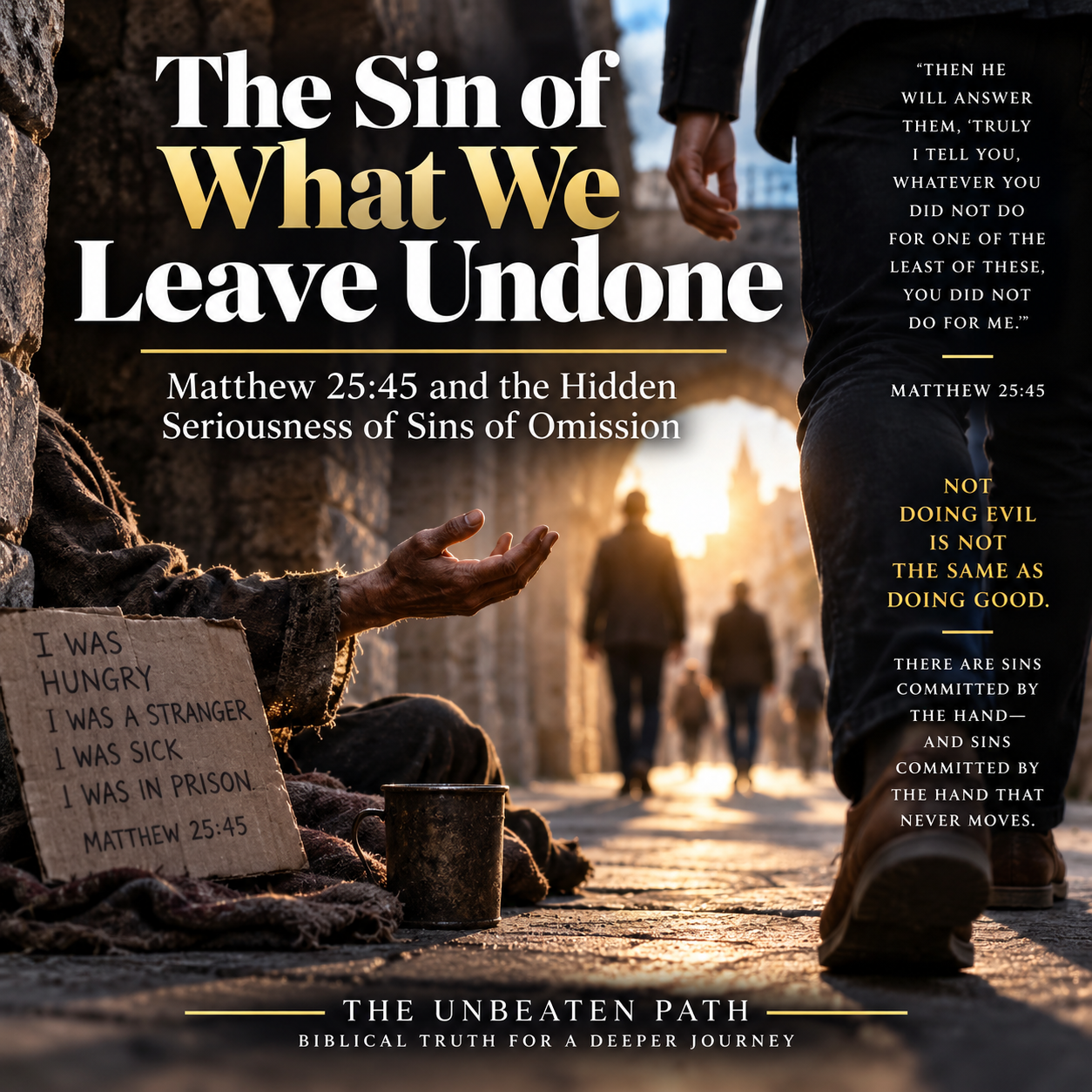
We usually recognize sin by what someone does.
A lie is spoken.
A command is broken.
A person deliberately chooses what God has forbidden.
But Jesus reveals another kind of disobedience—one that can leave very little visible evidence.
It is the sin of what we leave undone.
In Matthew 25:45, the King does not condemn people because they actively harmed the hungry, the stranger, the sick, or the imprisoned.
His words are more unsettling:
What you did not do mattered.
They saw need.
They had opportunity.
And they did nothing.
Scripture therefore forces us to confront a truth that is easy to avoid:
Not doing evil is not the same as doing good.
Sin Can Be an Absence
We often measure ourselves by the wrong standard.
I did not steal.
I did not cheat.
I did not betray anyone.
I did not commit some obvious act of rebellion.
All of that may be true.
But obedience cannot always be measured by the absence of wrongdoing.
Sometimes God asks:
- Did you love?
- Did you forgive?
- Did you speak when truth required it?
- Did you help when mercy was within reach?
- Did you repent when conviction came?
- Did you obey when God made the next step clear?
A life can appear respectable while remaining deeply disobedient through what it continually refuses to do.
Matthew 25 Makes Omission Visible
In Matthew 25:45–46, Jesus presents a final accounting.
The people being addressed are surprised.
That surprise matters.
They apparently did not understand the seriousness of what had been neglected.
Different Christian traditions debate precisely how “the least of these” should be identified—whether Jesus is referring particularly to His disciples and messengers, to suffering believers, or more broadly to people in need.
But the warning remains unmistakable:
A failure to respond faithfully is not morally empty simply because no dramatic act of evil occurred.
There are moments when inaction itself becomes a decision.
The Hand That Never Moves Can Still Disobey
There are sins committed by the hand.
And there are sins committed by the hand that never moves.
Someone is wounded, but pride refuses to apologize.
Someone is in need, but comfort refuses to be interrupted.
God exposes something, but repentance is postponed.
Truth should be spoken, but fear remains silent.
A gift should be used, but insecurity buries it.
A relationship should be reconciled, but resentment waits for the other person to move first.
Nothing dramatic happens.
Yet the heart is still choosing.
Delay Can Become Disobedience
One of the easiest ways to avoid obedience is not to reject it openly.
It is simply to postpone it.
Later.
When I am ready.
When circumstances improve.
When I feel more confident.
When somebody else changes first.
But delayed obedience can eventually become settled refusal.
The longer the heart resists what it already knows, the easier resistance becomes.
Then what once troubled the conscience begins to feel normal.
What We Refuse to Do Also Forms Us
Galatians 6:7–8 teaches that we reap according to what we sow.
We normally apply this to active behavior.
But omission also shapes the heart.
Every time we refuse forgiveness, resentment is strengthened.
Every time we refuse generosity, self-protection becomes easier.
Every time we refuse truth because it is costly, fear gains authority.
Every time we ignore conviction, spiritual sensitivity can weaken.
What we repeatedly refuse begins forming us just as surely as what we repeatedly practise.
There is no spiritually neutral ground.
Light Creates Responsibility
John 3:19 describes people loving darkness rather than light.
Why?
Because light exposes.
Once something becomes visible, we can no longer honestly behave as though we do not know.
That is why spiritual conviction can feel uncomfortable.
God may show us something not merely so that we understand it, but so that we respond.
Knowledge creates responsibility.
The more clearly obedience is seen, the more significant refusal becomes.
Conviction ignored does not remain merely information received. It becomes obedience withheld.
Sin Cannot Be Repaired With a Patch
Mark 2:22 uses the picture of new wine and old wineskins.
Jesus was speaking in a particular context, but the image reveals a broader truth about transformation.
God does not merely offer cosmetic repairs to an unchanged heart.
We often want to keep the old structure while making small religious adjustments.
Add prayer without surrender.
Add church without repentance.
Add biblical language without actual obedience.
But discipleship is not simply attaching good behavior to a self-governed life.
Christ calls for renewal from within.
Repentance Must Eventually Become Action
In Daniel 4:27, Daniel urges the king to turn from sin and practise righteousness and mercy.
Notice that repentance is not described merely as an internal feeling.
Direction must change.
It is possible to regret wrongdoing while continuing the same life.
It is possible to feel convicted without becoming obedient.
It is possible to agree with God’s standard while repeatedly refusing the action His standard requires.
Biblical repentance ultimately moves.
It turns.
It leaves something.
And it begins walking another way.
The Gospel Does Not Leave Us Trapped in Failure
Once omission is taken seriously, an uncomfortable realization follows.
Who among us has done every good thing we should have done?
Who has loved perfectly?
Who has responded faithfully to every opportunity?
Who has never postponed obedience?
No one.
This is why the gospel is essential.
1 John 1:9 teaches that if we confess our sins, God is faithful and just to forgive and cleanse.
The answer to exposed failure is not pretending it is insignificant.
It is confession.
Forgiveness.
Cleansing.
And renewed obedience.
Grace Is Not Permission to Remain Unchanged
1 John 3:6 speaks very strongly about continuing in sin.
John is not teaching that Christians never stumble.
His concern is the direction and settled practice of the life.
Grace forgives.
But grace also confronts.
Grace does not merely tell us that failure no longer matters.
Grace brings us back under the transforming rule of Christ.
The forgiven person is not called to remain comfortably where forgiveness found them.
We are called to walk in the light.
Do Not Merely Avoid Evil—Overcome It With Good
Romans 12:21 gives us a remarkable command:
Do not be overcome by evil, but overcome evil with good.
Christian obedience is therefore active.
The goal is not merely:
“I did nothing wrong.”
The deeper question is:
“Did I respond to evil with the good God placed within my power to do?”
This changes discipleship.
Faithfulness is no longer merely defensive.
It becomes constructive.
Love moves.
Mercy moves.
Truth moves.
Forgiveness moves.
Obedience moves.
There Are Moments That Do Not Return
Some opportunities can be recovered later.
Others cannot.
The person may no longer be there.
The season may close.
The conversation may never return.
The opportunity to encourage, reconcile, give, speak, or serve may disappear.
This does not mean we should live anxiously, terrified that every missed moment has destroyed God’s purpose.
God is merciful.
But mercy should not become an excuse for perpetual delay.
There are moments when obedience belongs to today.
What Are You Waiting to Do?
Perhaps there is someone you need to forgive.
Perhaps there is something you need to confess.
Perhaps God has repeatedly pressed a particular act of obedience upon your conscience.
Perhaps someone needs encouragement you keep assuming another person will provide.
Perhaps there is generosity you intend to practise eventually.
Perhaps you already know what faithfulness requires, but you are waiting to feel ready.
The danger of omission is that nothing appears to happen.
No obvious scandal.
No dramatic fall.
Just another day of not obeying.
But days become patterns.
Patterns form character.
And eventually the heart becomes comfortable with what once convicted it.
The Seriousness of Refusing the Light
Matthew 12:31 contains Jesus’ severe warning concerning blasphemy against the Holy Spirit.
This passage should not be casually equated with every delayed act of obedience.
But it reminds us that persistent resistance to God’s truth is spiritually serious.
The heart is not infinitely unaffected by what it repeatedly rejects.
Resistance can harden.
Excuses can become convictions.
And eventually a person may begin defending what they once knew they should surrender.
This is why we should respond to conviction while the heart is still listening.
The Principle
The absence of visible wrongdoing is not necessarily the presence of obedience.
Christian faithfulness is more than avoiding forbidden things.
It is becoming the kind of person who responds when God calls.
Who loves when love costs something.
Who forgives before resentment settles.
Who gives while something is still in the hand.
Who speaks when truth requires courage.
Who repents when light exposes darkness.
Who does the good that God has placed within reach.
Do not judge your obedience merely by asking what evil you avoided.
Also ask what good you knowingly left undone.
Questions for Reflection
- Is there something I know God is asking me to do that I continue postponing?
- Do I measure righteousness mainly by the sins I avoid rather than by the obedience I practise?
- Where has fear, comfort, pride, or resentment kept me from doing good?
- Is there a person I should forgive, encourage, help, or reconcile with?
- What conviction have I repeatedly received but not acted upon?
- If I knew an opportunity would disappear tomorrow, what act of obedience would I stop postponing today?
Related Essays
The Temptation — temptation is not only an invitation to commit obvious evil; it can also persuade us to postpone or rationalize obedience.
The Voice You Obey Becomes the Master You Serve — repeated obedience and repeated refusal both shape which voice gains authority within the heart.
You Can Predict Your Future! — what we repeatedly practise or refuse gradually forms direction, character, and fruit.
Related Ideas
Obedience Includes the Good You Refuse to Do — avoiding obvious wrongdoing is not the whole of obedience; Scripture also confronts the love, mercy, repentance, courage, and faithful action we knowingly withhold.
Connected Ideas
Omission · Obedience · Sin · Repentance · Mercy · Love · Conviction · Delay · Good Works · Discipleship · Responsibility · Faithfulness
Scripture index
Matthew 25:45; Mark 2:22; Daniel 4:27; Galatians 6:7–8; Matthew 12:31; 1 John 1:9; 1 John 3:6; John 3:19; Romans 12:21; Matthew 25:45–46