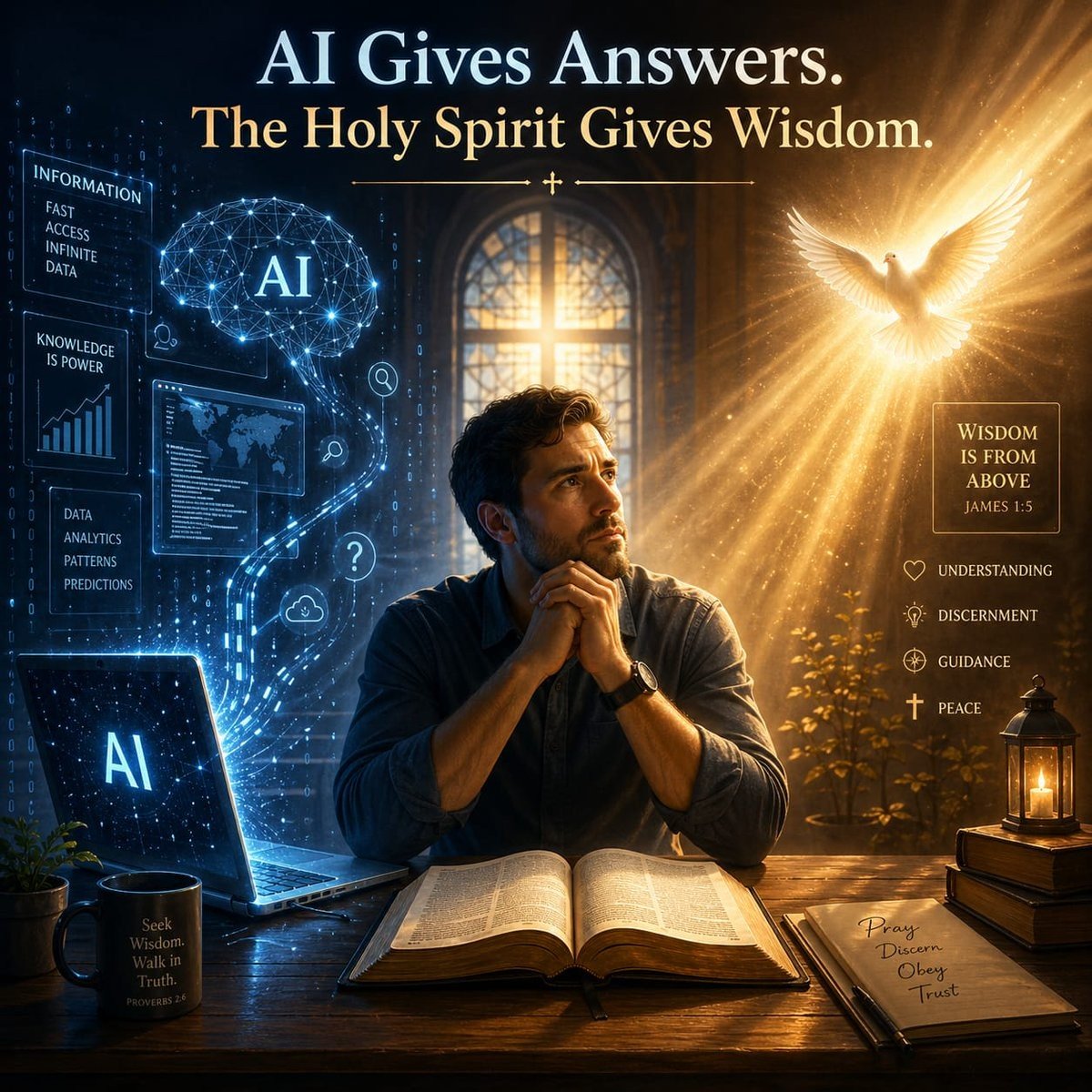
Core ideaArtificial intelligence can provide information quickly, but biblical wisdom is more than information. Wisdom begins with the fear of the Lord and is formed through prayer, Scripture, obedience, waiting, discernment, and the work of the Holy Spirit. AI can assist Christian learning, but it must remain a servant rather than becoming a source of spiritual authority or a substitute for dependence on God.
Answers Are Faster Than Ever
We are living in an age where answers come faster than ever before. A person can ask a question about history, science, medicine, law, business, theology, philosophy, or Scripture, and within seconds artificial intelligence can produce a detailed response. It can compare ideas, summarize books, explain difficult concepts, translate languages, write essays, generate sermons, draft prayers, and even imitate the tone of a spiritual teacher. To many people, AI feels almost miraculous because of the speed and depth of knowledge it appears to provide.
The Spiritual Question Beneath the Technology
For Christians, this raises an important spiritual question. If believers have long trusted that the Holy Spirit guides them into truth and gives wisdom, what happens when AI also appears to provide knowledge, answers, and guidance? Will Christians become more informed but less prayerful? Will they become better equipped intellectually but weaker spiritually? Will they begin to seek answers from machines before they seek God?
This is not a small question. It touches the heart of Christian discipleship in the modern age. The issue is not simply whether Christians should use AI. The deeper issue is whether Christians can use AI without replacing spiritual dependence with technological dependence. In other words, can AI serve Christian learning without becoming a substitute for the Holy Spirit?
Information Is Not the Same as Wisdom
The first thing Christians must understand is the difference between information, knowledge, wisdom, and revelation. AI is extremely powerful in handling information. It can process huge amounts of data, organize facts, identify patterns, and produce structured explanations. It can help a person understand world history, compare Bible translations, study church history, explore theological positions, and prepare teaching materials. In this sense, AI can be a useful tool.
But biblical wisdom is not the same as information. Wisdom is not merely knowing many things. Wisdom is knowing what is true, what is right, what is pleasing to God, and how to live in obedience. Scripture says, “The fear of the Lord is the beginning of wisdom.” This means that true wisdom begins not with intelligence, but with reverence. A person may be highly educated and still be spiritually foolish. A person may know many facts and yet lack humility, holiness, patience, love, and obedience.
AI may provide information, but it does not fear the Lord. It does not worship. It does not pray. It does not repent. It does not obey God. It does not have a conscience awakened by the Spirit. It can describe Christian love, but it cannot love God. It can explain repentance, but it cannot repent. It can write about holiness, but it cannot be holy. This distinction is very important.
The Holy Spirit Does More Than Inform
The Holy Spirit is not merely a supplier of facts. The Holy Spirit is the Spirit of God who dwells in believers, reveals Christ, convicts of sin, guides into truth, strengthens faith, produces spiritual fruit, and forms the character of Christ within God’s people. The Spirit does not merely inform the mind; He transforms the soul.
AI Creates Both Opportunity and Danger
This is where the AI age creates both an opportunity and a danger. The opportunity is that Christians can now access learning tools that previous generations could not imagine. A young believer can ask AI to explain difficult Bible passages. A pastor can use AI to organize sermon notes. A missionary can translate teaching materials into different languages. A Christian businessperson can use AI to think through ethical decisions. A Bible study leader can prepare discussion questions more efficiently. Used properly, AI can support study, teaching, communication, and ministry.
But the danger is equally real. Christians may begin to confuse quick answers with spiritual guidance. They may mistake polished language for truth. They may replace slow meditation with instant summaries. They may ask AI questions they should first bring before God. They may become comfortable receiving religious-sounding answers without testing them through Scripture, prayer, and spiritual discernment.
The Loss of Waiting
Before the AI era, seeking answers often required patience. A Christian facing a difficult decision might pray, read Scripture, speak with a pastor, ask mature believers for counsel, fast, wait, and listen for the inner conviction of the Holy Spirit. This process was not always quick. Sometimes God’s answer came through time, silence, correction, or closed doors. The waiting itself became part of spiritual formation.
In the AI era, however, a believer can receive an answer almost instantly. This changes the rhythm of seeking. Instead of waiting on God, one may simply prompt a machine. Instead of wrestling with Scripture, one may ask for a summary. Instead of asking the Spirit for discernment, one may trust a confident explanation. Instead of seeking counsel in Christian community, one may privately depend on a chatbot.
The danger is not that AI gives answers. The danger is that Christians may stop seeking God with the same seriousness because answers now feel easily available.
This can create a spiritual disconnect between the pre-AI era and the AI era. In earlier times, the search for truth often involved humility, effort, and dependence. People had to open their Bibles, sit under teaching, discuss with others, pray through confusion, and grow slowly. In the AI age, knowledge can feel immediate and effortless. But spiritual maturity has never been immediate or effortless. Formation takes time. Wisdom grows through obedience, testing, suffering, repentance, and communion with God.
AI Cannot See the Condition of the Heart
A Christian can ask AI, “What should I do?” and receive a reasonable answer. But AI does not know the full condition of the person’s heart. It does not see hidden pride, fear, greed, bitterness, lust, or ambition. It does not know whether the decision is connected to a divine calling or a dangerous temptation. It cannot convict the person of sin. It cannot give the peace of God. It cannot say, in the deepest spiritual sense, “This is the way; walk in it.”
Do Not Turn AI Into an Oracle
This is why Christians must be careful not to treat AI as an oracle. An oracle is something people go to for hidden knowledge, direction, and certainty. If Christians begin to ask AI for ultimate guidance without prayer, Scripture, and discernment, they may unknowingly give technology a spiritual authority it should never have.
AI should be a servant, not a master. It should be a tool, not a temple. It may help organize thoughts, but it must not rule the conscience. It may provide explanations, but it must not replace the voice of God. It may assist learning, but it must not become the believer’s source of spiritual authority.
Intelligence Is Not Anointing
One of the greatest risks in the AI era is that Christians may mistake intelligence for anointing. AI can write a sermon that sounds powerful. It can produce a prayer that sounds beautiful. It can generate a devotional that sounds emotional. It can create a theological essay that sounds scholarly. But spiritual power does not come from polished words alone. A sermon may be well-written but not prayer-born. A prayer may be elegant but not sincere. A devotional may be moving but not Spirit-led. A theological answer may be technically correct but spiritually lifeless.
The anointing of the Holy Spirit cannot be manufactured by language. It comes from God. It comes through surrender, holiness, prayer, obedience, and intimacy with Him.
AI Can Still Be a Useful Tool
This does not mean Christians should reject AI completely. Rejecting every modern tool is not necessarily spiritual wisdom. Christians have used writing, printing presses, radio, television, the internet, translation software, and digital Bible apps for the spread of knowledge and the gospel. AI may become another tool that can be used for good when placed under God’s authority.
The question is not, “Can Christians use AI?” The better question is, “Can Christians use AI without losing spiritual dependence?”
A Christian Rule for Using AI
A healthy Christian approach to AI should begin with prayer. Before asking AI for answers to serious matters, a believer should first ask God for wisdom, humility, and discernment. Prayer reminds the soul that God is the source of truth. It places technology in its proper position.
Second, Christians must test all AI-generated content against Scripture. AI can make mistakes. It can mix truth with error. It can sound confident while being wrong. It can reflect cultural assumptions, biased sources, or shallow interpretations. The Bible remains the final authority for Christian faith and conduct.
Third, Christians should involve spiritual community in important decisions. AI may provide useful perspectives, but it cannot replace pastors, elders, mentors, family, and mature believers who know the person’s life and can speak with spiritual care.
Fourth, Christians must learn to wait. The AI age trains people to expect instant answers. But God often forms people through waiting. Waiting exposes motives. Waiting develops patience. Waiting teaches dependence. Waiting reminds believers that God is not a machine to be prompted but a Father to be trusted.
Fifth, Christians must obey the truth they already know. Sometimes people seek more answers not because they lack information, but because they are avoiding obedience. AI can provide endless explanations, but obedience remains personal. A believer does not become wise by collecting answers. A believer becomes wise by walking faithfully with God.
The AI Age Should Sober, Not Frighten, Christians
Therefore, the rise of AI should not frighten Christians, but it should sober them. AI may become one of the greatest tools for learning in human history. But it may also become one of the greatest distractions from spiritual dependence. It can make people feel wise without making them holy. It can make people feel informed without making them obedient. It can make people feel guided without truly seeking God.
The Christian response must be balanced. We should not worship technology, and we should not fear it as though God has lost control of history. Instead, Christians should place AI under the lordship of Christ. Use it carefully. Test it constantly. Refuse to let it replace prayer. Refuse to let it replace Scripture. Refuse to let it replace the Holy Spirit.
Only the Holy Spirit Transforms the Soul
In the end, AI can answer many questions, but it cannot give eternal life. It can explain the gospel, but it cannot save the soul. It can describe the fruit of the Spirit, but it cannot produce that fruit in us. It can imitate religious language, but it cannot create genuine worship. It can inform the mind, but only the Holy Spirit can transform the heart.
Will Believers Remain Spiritually Awake?
The true challenge for Christians in the AI age is not whether machines will become intelligent. The deeper challenge is whether believers will remain spiritually awake.
AI may give us more knowledge than any previous generation. But Christians must remember: more knowledge does not automatically mean more wisdom. More answers do not automatically mean more obedience. More information does not automatically mean more intimacy with God.
The Better Question
So the Christian question in this new age is not merely, “What can AI tell me?”
The better question is:
“After AI has answered me, have I still sought God?”
That question may determine whether the AI age becomes a tool for deeper Christian learning or a temptation toward spiritual laziness.
AI can give answers.
But the Holy Spirit gives wisdom.
AI can inform the mind.
But the Holy Spirit transforms the soul.
#Faith #ChristianLiving #Revelation
Related Ideas
AI Can Inform the Mind; Only God Can Transform the Soul — AI can explain, summarize, and generate answers, but it cannot convict the conscience, produce holiness, create worship, or transform the soul. Technology can inform; spiritual transformation belongs to God.
What Rules the Heart Shapes the Mind — tools can inform the mind, but what the heart trusts and depends upon determines whether knowledge becomes wisdom or merely another source of self-reliance.
The Voice We Obey — the decisive issue is not merely what voices are available to us, but which voice we trust enough to obey.
Surrender — technology remains a servant only when the heart refuses to give it the authority that belongs to God.
Connected Ideas
Artificial Intelligence · Information · Wisdom · Discernment · Prayer · Scripture · Holy Spirit · Spiritual Dependence · Obedience · Christian Community · Waiting · Anointing
Originally published on X on 2026-04-29. This website edition preserves the original essay while adding structural headings and knowledge links.