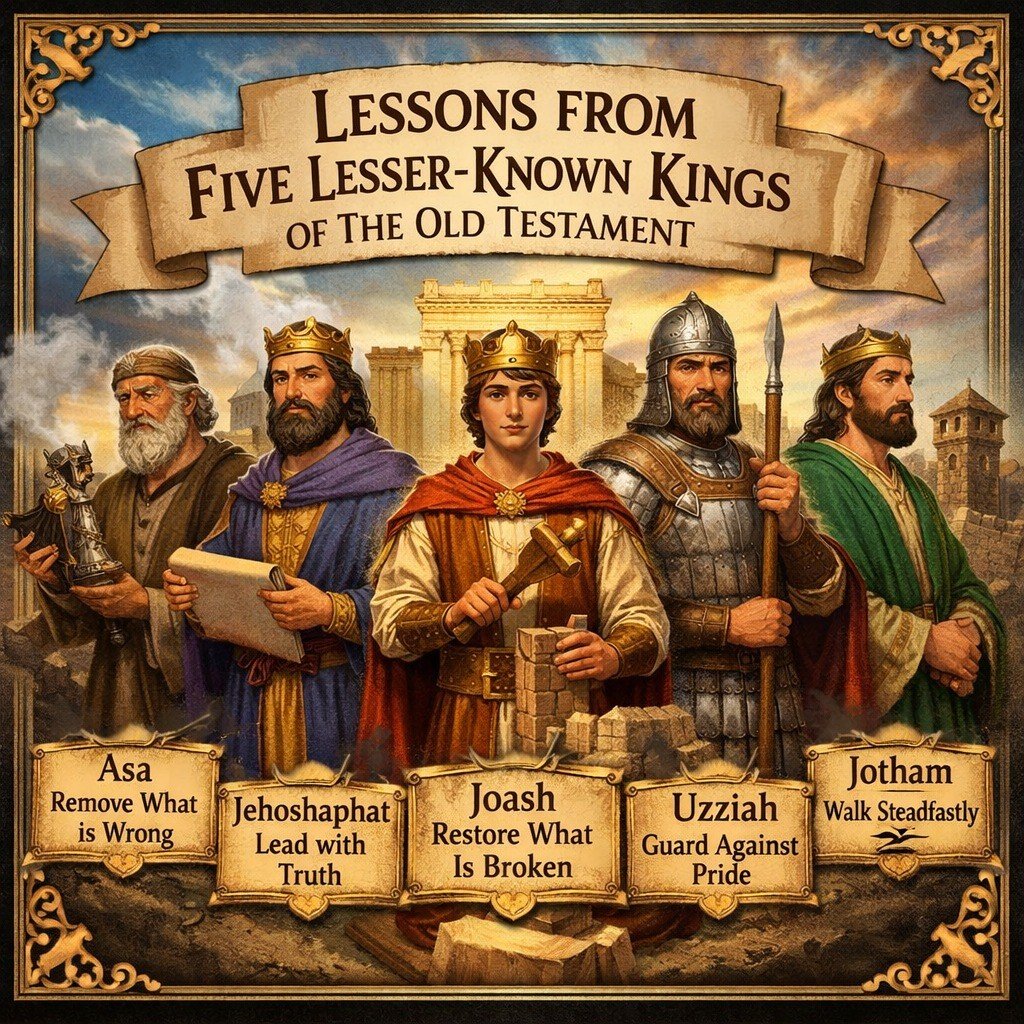
When people think about great kings in the Old Testament, the names that usually come to mind are David and Solomon. David is remembered as the shepherd king who defeated Goliath and loved God deeply. Solomon is known for his wisdom, wealth, and the building of the temple. Yet the Old Testament also records the lives of other kings who are less famous but still accomplished great and mighty things. Some strengthened the nation, some restored true worship, some built cities and defenses, and some showed how powerful quiet faithfulness can be.
Among these lesser-known kings, Asa, Jehoshaphat, Joash, Uzziah, and Jotham stand out. Their stories teach us that greatness is not always loud, famous, or celebrated by the world. Often, true greatness is seen in obedience, courage, humility, reform, and steadfastness before God. Their lives offer rich lessons for anyone who wants to serve God faithfully in their own generation.
Asa: The Courage to Remove What Is Wrong
King Asa teaches us that real strength often begins with spiritual cleansing. One of his greatest accomplishments was that he removed idols and false worship from the land. He understood that the nation could not expect God’s blessing while allowing corruption and compromise to remain. Asa did not merely focus on building an army or securing cities. He first dealt with the spiritual condition of the people.
This teaches us an important lesson: sometimes the first step toward victory is not adding something new, but removing what is wrong. In life, many people want peace, growth, and blessing, but they do not want to let go of habits, attitudes, or sins that weaken their walk with God. Asa shows that courage is needed not only in battle, but also in cleansing one’s heart and life.
He also used peaceful seasons wisely. During times of rest, Asa strengthened cities and prepared the nation. This teaches us that peace is not meant to be wasted. Quiet seasons are opportunities to build character, deepen faith, and prepare for future challenges. Asa’s life reminds us that when God gives us calm days, we should not become lazy. We should use those days to grow stronger.
Jehoshaphat: The Power of Godly Leadership
Jehoshaphat is another king who accomplished much, though he is often less remembered. He strengthened the kingdom and set up fortified cities, but one of his greatest works was spiritual and educational. He sent leaders, Levites, and priests throughout the land to teach the people the Law of God. This shows that Jehoshaphat understood something very important: a nation is strongest when it knows the truth of God.
From Jehoshaphat we learn that leadership is not just about authority. It is also about guiding people into truth. A good leader does not merely command others. He helps them understand what is right. He builds not only structures, but also people.
Jehoshaphat also teaches us how to respond in times of fear. When enemies came against Judah, he did not immediately rely on military strength alone. He called the people to seek the Lord in prayer and fasting. This is a powerful lesson for believers today. When trouble comes, panic is not the answer. Prayer is. Before action must come surrender. Before strategy must come dependence on God.
His life teaches that spiritual leadership matters deeply. People need leaders who not only organize and plan, but who also point them back to God.
Joash: The Importance of Restoring What Has Been Neglected
Joash became king at a very young age, and one of the great things he accomplished was the repair of the temple. The house of God had fallen into neglect, and Joash helped restore it. This was not a small matter. By repairing the temple, he was helping to restore honour to God among the people.
Joash teaches us that restoration is a noble work. It is easy to admire those who build something new, but it also takes wisdom and commitment to restore what has been broken or neglected. In our own lives, this may mean restoring prayer, restoring family relationships, restoring integrity, or restoring devotion to God.
Yet Joash’s story also carries a warning. He began well, but later in life he did not remain as faithful as he should have been. This shows us that starting well is important, but finishing well is even more important. Some people begin their spiritual journey with passion and zeal, but over time they drift. Joash reminds us that outward accomplishments are not enough if the heart does not remain anchored in God.
His life teaches both encouragement and caution. God can use even the young to do great things. But each person must also cultivate a faith that endures beyond early success.
Uzziah: Success Must Be Guarded by Humility
Uzziah was a remarkably capable king. He achieved much in warfare, building, agriculture, and national defense. He fortified Jerusalem, built towers, strengthened the military, and developed the land. He was skilled, organized, and effective. His reign shows what can happen when a person applies discipline, wisdom, and diligence under God’s blessing.
From Uzziah we learn that ability and excellence are gifts that can be used for great good. God is not against strong leadership, careful planning, or practical achievement. In fact, Uzziah’s life shows that these things can be part of godly stewardship.
However, his story also gives a serious warning. After he became strong, his heart was lifted up with pride. That pride led to his downfall. This is one of the clearest lessons in the Bible: success can be more dangerous than struggle. Many people know how to cry out to God when they are weak. Fewer know how to stay humble when they are strong.
Uzziah teaches us that achievements, influence, and power must always remain under the rule of humility. The higher a person rises, the more carefully he must guard his heart. Skill without humility is dangerous. Success without reverence can destroy a person.
Jotham: The Strength of Quiet Faithfulness
Jotham may be the least known of these kings, yet his life carries one of the most beautiful lessons. He built gates, towns, forts, and towers. He grew strong and accomplished much, yet he is not among the most celebrated names in Scripture. This is exactly why his example is so valuable.
Jotham teaches us that quiet faithfulness matters. Not every great life is dramatic. Not every godly person becomes famous. Some people simply walk steadily before God, fulfill their duties, build wisely, and remain faithful over time. In God’s eyes, that is greatness.
We live in a world that often celebrates noise, fame, and outward recognition. But Jotham reminds us that there is power in consistency. A person does not need to be widely known to be deeply useful. Quiet obedience, practiced day after day, can produce lasting fruit.
His life teaches us that stability is a form of strength. There is something mighty about a person who remains steadfast, disciplined, and faithful even without applause.
Conclusion
Taken together, these five lesser-known kings teach us rich and enduring lessons. Asa teaches us to remove what is wrong. Jehoshaphat teaches us to lead people into truth and seek God in crisis. Joash teaches us the value of restoration and the need to finish well. Uzziah teaches us to guard against pride in times of success. Jotham teaches us the beauty of quiet and steady faithfulness.
Their lives remind us that greatness in God’s sight is not measured only by fame or power. It is measured by obedience, humility, courage, and perseverance. These kings may not be the most celebrated names in the Old Testament, but they accomplished much because, in different ways, they aligned themselves with God’s purposes.
In the end, their stories teach us that God can use those who cleanse what is corrupt, teach what is true, restore what is broken, build with wisdom, and walk faithfully over time. That kind of life may not always seem impressive to the world, but in the eyes of God, it is both great and mighty.
Related Ideas
Quiet Faithfulness Is Greatness Before God — God does not measure greatness mainly by fame, visibility, or scale. A life marked by steady obedience, humility, stewardship, perseverance, and faithfulness can be deeply significant before Him even when it remains largely unseen.
Faithfulness Before Success — greatness before God is measured by faithful stewardship and obedience rather than visibility, power, or applause.
Strength Can Hide Spiritual Drift — Joash and Uzziah warn that early success and growing strength do not guarantee a heart will remain dependent on God.
What Rules the Heart Shapes the Mind — leadership, achievement, and wisdom remain safe only when the heart stays ordered under God.
Connected Ideas
Faithfulness · Leadership · Courage · Reform · Restoration · Humility · Pride · Perseverance · Quiet Obedience · Stewardship · Finishing Well
Originally published on X on 2026-03-31. This website edition preserves the original essay while adding structural headings and knowledge links.
Scripture index
2 Chronicles 14:2–7; 2 Chronicles 15:8–15; 2 Chronicles 17:7–9; 2 Chronicles 20:3–12; 2 Chronicles 24:4–14; 2 Chronicles 24:17–22; 2 Chronicles 26:3–21; 2 Chronicles 27:1–6