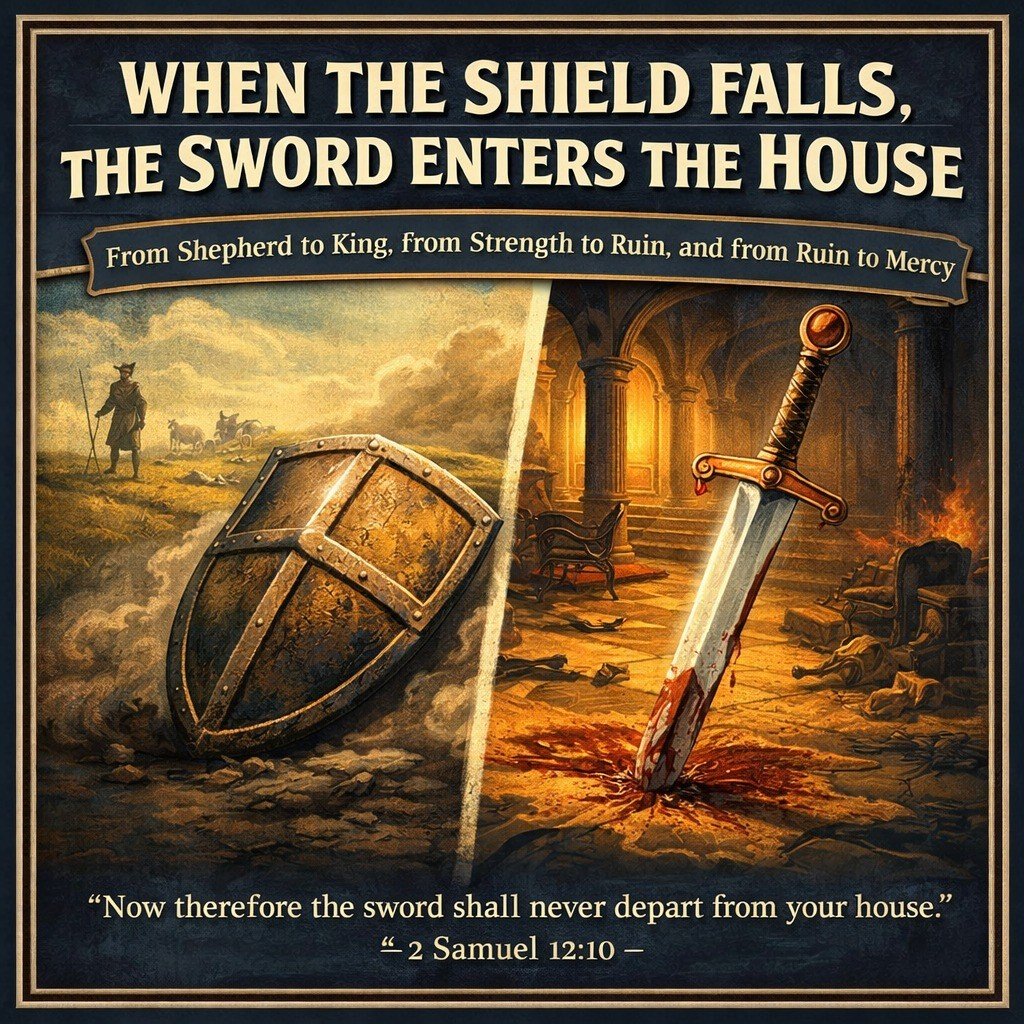
From Shepherd to King, from Strength to Ruin, and from Ruin to Mercy
Now therefore the sword shall never depart from your house.
— 2 Samuel 12:10
From Shepherd to King
David is presented to us not just as a heroic figure, but as a mirror reflecting the human soul’s journey before God. His life illustrates the complexities of the heart: moments of hiddenness and dependence, strength and confidence, and drift and ruin, culminating in a broken path back to mercy. His story is not preserved in Scripture solely for admiration; rather, it is meant to show how the condition of the heart influences a person’s actions and how those actions determine whether one lives under God’s protection or steps outside of it.
Through David, we see how a person can reside within the shield of God’s protection; how one can venture beyond it; and how, once that shield is lost, destruction can enter their life. His kingship did not render him immune to failure, nor did his divine calling protect him from falling into chaos when he abandoned righteousness. His story serves as both a warning and a hope for life.
However, David’s narrative does not end in despair; instead, it concludes with mercy extended to someone who can no longer rely on his own righteousness. In reading about David, we are encouraged to recognise how one’s heart can gradually move toward dependence on God, yet can also slip into self-confidence, leading to a significant drift that opens the door to ruin. David himself barely noticed how far he had strayed until Nathan confronted him with the truth of what he had become.
Before David stood in the strength of a king, he lived as a lowly shepherd, overlooked and drawing little attention from men. It was in that smallness that his faith in God as his shield began to take root. He was not the obvious choice among his brothers, nor was he the one called forward immediately when Samuel looked for the new king. While others stood in line to meet human expectations, David remained with the sheep, out of the spotlight and far from where people would naturally look for a king. His early life was characterised not by prominence but by obscurity. It was in that obscurity that his reliance on God grew.
For David, obscurity became not a place of abandonment by men but a lesson in trust in God. In the fields, he learned to live before God without seeking recognition, and that quiet life fostered a closeness to GOD. His lack of visible status may have actually increased his reliance on God. The shepherd’s life provided him with solitude, vulnerability, and unseen responsibility—conditions that trained his heart to look upward. Long before David carried a sling into battle or wore the garments of a king, he had already learned in secret where his safety lay. The shield was not first formed in victory, but in hidden dependence.
Strength Under the Shield
What began as a hidden dependence in David did not remain a weakness; over time, it transformed into strength, though his faith in God still sheltered this strength as his shield. This is most clearly observed in the years when his courage, restraint, and leadership grew under pressure while remaining grounded in God. Before Goliath, David displayed a boldness that stemmed not from self-confidence, but from a deep conviction in the living God. His strength was not merely the power of a man relying on himself; it came from his belief that God Himself would stand between him and any threats he faced.
David’s greatness was evident not only in what he dared to confront but also in what he chose not to seize. Although Saul stood in the way of the throne promised to him, David refused to seize it by force, believing it must come by God’s hand. The same man who could face a giant also knew how to restrain himself in the presence of a king. This exemplified strength under control, with courage still governed by reverence.
Even in the face of pressure, uncertainty, and waiting, David’s leadership was defined by dependence rather than entitlement. He became strong, but his strength did not turn inward upon itself. At his best, David’s strength did not replace his dependence on God; it expressed it. In this season of his life, strength and submission coexisted, and because of this, he remained within the protective shield of his faith.
When Confidence Forgets Dependence
Strength can carry its own dangers. Once a person has it for a long time, they may begin to believe it originates with them rather than being sustained by God. When a person’s dependence on God weakens in their heart, they may unknowingly step outside of their protective shield.
By the time David reached the pinnacle of his kingship, he was no longer the hidden shepherd or the hunted fugitive. At that point, David was established, secure, and able to stay in Jerusalem while others went out to fight. What had initially been a strength rooted in dependence on God had become his normal state, and what is considered ordinary is often no longer felt as reliance on God.
David did not stumble while hiding in a cave; rather, he fell in the palace. He did not collapse under the pressure that forced him to rely on God; rather, it was when strength, security, and comfort made him less vigilant in guarding his heart against sin. The cave taught him dependence, while the palace revealed how easily strength, once enjoyed for a long time, could lead to a subtle shift away from God.
David’s staying behind was not yet the fall itself, but it revealed a changed posture: the man who had once lived closely before God now lived in a security that made him less careful to guard his heart against sin. In this environment of ease and untested desires, the heart that had once been shaped by dependence began to drift quietly. Bathsheba did not create the breach in David’s heart; she revealed it was already there.
David’s fall didn’t happen in just a single moment of weakness; it was the result of a series of deliberate choices. He saw her, inquired about her, sent for her, took her, and then tried to conceal his actions. When his attempts at concealment failed, he turned to manipulation, and his desire escalated to bloodshed. The man who had once trusted God to act now began to act as if he could secure, manage, and cover his own desires. This was the deeper collapse beneath the visible sin: confidence had turned inward, strength was no longer protected by dependence, and David had begun to live beyond his protective shield.
When the Shield Falls
The fall of David’s moral shield became evident when he stopped guarding his heart against sin. He allowed his desires to dictate his actions, then used his power to protect what they had taken. His sin began with lustful sight, but it didn’t end there. David inquired about Bathsheba, sent for her, and took her, thereby crossing the line from merely entertaining temptation to forsaking righteousness. However, this was not the extent of his downfall. Once he had taken what he desired, he no longer walked in truth; instead, he chose concealment, seeking not repentance but cover for his actions.
David attempted to manage the consequences of his sin through deception, bringing Uriah back in the hope that what he had done in secret would remain hidden. When concealment failed, his sin became even harder. Rather than humbling himself before God, David orchestrated the death of a faithful man to keep his wrongdoing from being exposed. What had started as a desire escalated to bloodshed. This marked David’s deepest departure from God’s heart. The man who once trusted in God’s ways now acted against His holiness, truth, and justice. He took instead of receiving, concealed instead of confessing, and destroyed instead of protecting. Before the sword entered David’s house, his moral shield had already fallen.
The Sword Enters the House
When Nathan spoke the word of the Lord, the judgment fell not only on David’s hidden act but also on the disorder that act had unleashed: “the sword shall never depart from your house.” David was forgiven, yet the sword remained, highlighting that mercy toward the sinner does not always erase the damage sin has already inflicted.
What had been allowed in secret now returned in multiplied sorrow within his household. The child died. Tamar was violated. Amnon was killed. Absalom rose in rebellion and fell in death. The family began to reflect, in horrifying ways, the disorder David had initially allowed to fester within himself. This aspect of the story is especially difficult and revealing; it forces us to look not only at David, the forgiven sinner, but also at the wounded individuals who had to live with the consequences of his sin.
The sword did not strike David alone; it passed through his household, wounding lives that could not be reduced to David’s private failure. In this way, Scripture illustrates that sin, particularly in the life of someone entrusted with power and influence, does not remain confined to the individual who commits it. Instead, it becomes an atmosphere of dysfunction, an inheritance of pain, and a source of injury.
What David initiated in the secrecy of his desires evolved into disorder in the lives of those who were entrusted to him. Righteousness, then, is not merely a shield for the individual; it is also a shelter for those who live under his influence. When that shield falls, the entire household becomes vulnerable to the sword.
From Ruin to Mercy
If David’s earlier strength had once rested on his confidence in God, his return came in a very different way: not through regained self-assurance, but through brokenness, chastisement, and mercy. The man who had once stood boldly in faith now returned as one wounded by the awareness of what he had become. He could no longer stand as he did before; the sword had entered his house, and his own sin had stripped him of the right to rest in himself. Yet this was also the place where his journey back began.
David’s return began when he stopped hiding and stopped resisting the truth. Once exposed by the word of God, he no longer tried to cover up his shortcomings but yielded himself to mercy. This is why the latter David is so poignant: he does not return as a man reclaiming his former strength, but as one who has learned that he cannot survive except by God’s mercy.
In Psalm 3, he still calls God his shield; however, he does so not as a man asserting his own righteousness, but as one who casts himself upon God’s compassion, even while the sword is already at his door. Mercy did not remove the sword from David’s life, but it kept the sword from having the final say over his soul. That is the hope within the sorrow. David’s story does not suggest that ruin is trivial or that repentance erases every wound. Instead, it teaches that a man may stray far from the truth, and yet, when he is broken enough to stop defending himself, he can still find that God’s mercy remains available. David’s hope lay not in becoming the man he once was, but in discovering that God’s mercy could still embrace the man he had become.
Conclusion
David is not merely a figure in Scripture whose story illustrates the rise, fall, and return of a king. Instead, he serves as both a warning and a lesson in mercy for all who can recognise the subtle changes in their own hearts. His life, which transitioned from shepherd to king, from strength to downfall, and from despair to mercy, maps out the complex journey of the human soul before God.
In the early days of his obscurity, David’s faith in God gave him a sense of protection. As he grew stronger, he maintained a balance between courage and dependence on God. However, David’s downfall did not happen in the cave; it occurred in the palace. He did not collapse under pressure, but rather when strength, security, and comfort made him careless in guarding his heart against sin. Bathsheba did not create the rupture in David’s heart; she merely revealed that the fracture was already there.
Once David’s shield of righteousness fell, the consequences quickly followed. What he allowed in secret transformed into overwhelming sorrow within his household. This narrative is more than a record of one man’s personal failure; it unveils a painful truth about human existence: righteousness not only protects the individual but also serves as a refuge for those influenced by that person. When David’s shield faltered, his entire household became vulnerable. Though David received forgiveness, the repercussions of his sin lingered, illustrating that mercy does not always erase the damage sin has already inflicted. This story forces us to examine not only David, the forgiven sinner, but also the wounds suffered by those living amid the ruins his sin created. Within this, Scripture instructs us to be cautious. Sin is never private, especially for someone whose strength, calling, or position provides shelter for others. It permeates the atmosphere, becomes an inheritance, and inflicts injuries.
However, David’s story does not conclude with ruin alone. Its ultimate message is not the restoration of innocence but the embrace of mercy. David’s return began when he stopped concealing his sins and faced the truth. He could no longer stand proudly as he once did. The man who had confidently relied on his faith became one humbled by the realisation of his own failings. In Psalm 3, he still refers to God as his shield, but now he does so not from a position of self-righteousness, but as someone seeking refuge in God’s compassion amid the consequences of his actions. Mercy did not eliminate the sword from David’s life, but it prevented the sword from having the final say over his soul. This is the glimmer of hope amid sorrow. David’s hope did not lie in regaining his former self, but in discovering that God’s mercy could still welcome the man he had become.
Thus, David’s story serves as a mirror for us. We are meant to recognise how one’s heart can initially rise in dependence on God and, just as subtly, shift toward self-confidence until the drift becomes significant enough to lead to ruin. We learn that there is no immunity in strength, status, calling, or blessing once righteousness is forsaken. Additionally, when a person has strayed far from the shield of righteousness, the path back remains open for anyone willing to abandon their self-defence before God. David’s life warns us to protect our hearts against sin before it wreaks havoc. Yet it also teaches us that, even in the aftermath of ruin, when one can no longer rely on personal righteousness, they can still turn to mercy—and therein find that God remains the lifter of the bowed head. #GodForgives #Mercy #Repentance
Related Ideas
Strength Can Hide Spiritual Drift — Success, strength, experience and position can quietly reduce dependence on God. Spiritual collapse often begins long before visible failure, when confidence in self starts replacing reliance on Him.
The Voice We Obey — spiritual drift becomes dangerous when repeated choices give desire, pride, fear, or self-protection increasing authority over the heart.
Surrender — David’s return begins when concealment ends and the heart stops defending itself before God.
Faithfulness Before Success — strength, visibility, position, and achievement are not reliable measures of spiritual safety; faithfulness must remain rooted in dependence on God.
Connected Ideas
Dependence · Strength · Spiritual Drift · Temptation · Power · Concealment · Consequences · Repentance · Mercy · Leadership
Originally published on X on 2026-03-31. This website edition preserves the original essay while adding structural headings and knowledge links.