Core ideaThe first sin in heaven began with “I will.” The two greatest commandments turn us from self to God and neighbour, and they change the heart, not only behaviour.
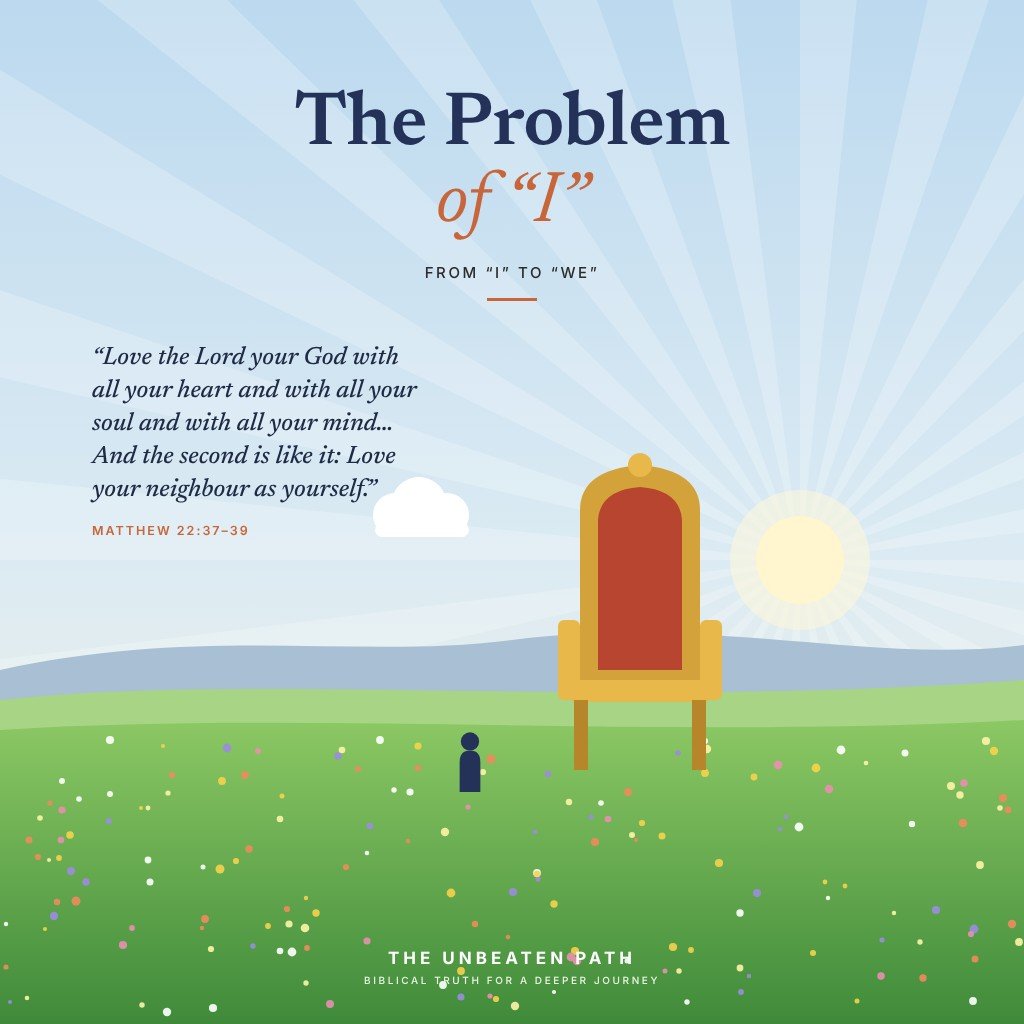
Jesus declared, "'Love the Lord your God with all your heart and with all your soul and with all your mind.' This is the first and greatest commandment. And the second is like it: 'Love your neighbour as yourself.' All the Law and the Prophets hang on these two commandments.
Matthew 22:37–40
GOD has a spiritual roadmap for us to achieve eternal life. Many are unaware of it or do not understand its seriousness, so they do not faithfully obey and carefully abide by it; therefore, they miss the way. Many may assume that once they say their sinner's prayer, they earn the right to heaven. As in the parable of the Ten Virgins, once we say our sinner's prayer, we are like the ten virgins awaiting the bridegroom for the wedding feast. As the parable unfolds, the unfortunate truth is that not all virgins who waited entered the feast. Not only were they denied entrance, but they were brushed off heartlessly with 'Truly I tell you, I do not know you.' All their waiting was for nothing but an empty hope of eternity in heaven. When the gate was shut, their fate was sealed, and there was no trying again. We do not want that to happen to us, so we must not be like the foolish virgins. We must know what it takes to be the bride of Jesus and be fully prepared for it. We must not be hoodwinked by pseudo-pastors, preaching palatable messages that are easy to swallow but are, as Jesus describes, the wide gate and broad way which leads to destruction. Regrettably, many will enter through it.
Being a Christian is more than saying the sinner's prayer and, from then on, attending church, worshipping GOD, saying some prayers and doing some good deeds, as in all other religious practices. Many are mistaken to think that their eternal future is assured once they say the sinner's prayer. If it is that simple, like walking through the wide gate and an easy path, then it is likely. Jesus said, "Small is the gate and narrow the way that leads to life, and only a few find it". If one and one do not add up to two, then we should check the numbers. We cannot follow blindly like lost sheep, ending up as lost souls. Forgiveness of sin is essential, but it is not enough. When we seek GOD for forgiveness, we become conscious of our sins and regret them. If we are not, then it is illogical to seek forgiveness for seemingly doing nothing wrong. And if we ever seek forgiveness without being repentant, we are being hypocrites. We are confessing with our mouths, but our hearts do not mean it. GOD will not be fooled. Only when we are aware that we have done wrong and seek forgiveness will we strive to change from our wrongdoings.
However, many ask for forgiveness for procedure's sake, not knowing where they have done wrong. Without this realisation, they have no conviction to change. They remain status quo on the inside. They attend church like attending a meeting and call themselves Christians because they have said the sinner's prayer. In Jesus's time, these people were typified as Pharisees and scribes. Jesus did not accept the Pharisees and scribes then, and will not tolerate anyone who is a replica of them now. Therefore, without changing on the inside, the sinner's prayer is not enough to allow anyone access to heaven. If we are truly repentant of our sins, we will change. However, change is not the appropriate word because we need more than physical changes; we need a spiritual overhaul from the inside out. We need spiritual transformation as a butterfly transforms from a caterpillar physically. If there is no transformation, GOD will not accept us as His children.
Without transformation, we can only be Christians in name and not GOD's children of spiritual birth. In other words, to be a Christian, according to the apostle Paul, we need a change that eliminates all of our old selves and transforms us into a new creation. To Jesus, this process is called to be born again. What does it mean? It means we no longer hold on to the genetic code of our fallen selves. With our determination to deny ourselves, we crucified our fallen selves and put to death our evil desires, and it is 'I no longer live, but Christ lives in me'. That is, we hold on to the spiritual genetic code of Christ and live a life with Him in us. Therefore, just as Christ, who did not sin, and no deceit was found in His mouth, so will we be likewise.
The apostle Paul explains the mystery of dying to ourselves this way: 'When our old self was crucified with Him so that the body of sin might be rendered powerless, that we should no longer be slaves to sin. For anyone who has died has been freed from sin. Therefore, the primary purpose of being 'born again' by putting to death our fallen nature is that we are no longer slaves to sin, will not have the desire to sin and will sin no more. Therefore, Jesus said, "Truly, truly, I tell you, no one can see the kingdom of God unless he is born again." The message is clear: GOD loves sinners, but He cannot accept sin. If we want to see the kingdom of GOD, we must be free from sin. We need to be clean from the inside out. Hence, taking comfort in GOD's forgiveness will not get us nearer to GOD nor further from hell. When we continue to sin, we are proclaiming that we are children of sin and refuse to be clean.
The broad way is to say the sinner's prayer and the narrow way is to deny ourselves, take up our cross, and follow Jesus. This act is synonymous with being born again. Jesus mentioned in the next verse, "For whoever wants to save his life will lose it, but whoever loses his life for My sake will find it", implying that the consequence of following Jesus is that we will lose our eminence in the world. Many might think it is no big deal, not knowing that our fallen nature will forbid that. By nature, we are not only competitive but also comparative. Consequently, we are envious and greedy of the things we do not have and boastful, conceited and arrogant of the things we have. To get what we do not have, we become senseless, faithless, heartless, merciless. Why? Because we are fallen creatures, holding on to the nature of Satan. Just as Satan is, so are we. And Satan's motto, "I will ascend above the tops of the clouds; I will make myself like the Most High." That is, Satan is full of self-indulgence, and we are the apples that do not fall far from the tree.
This selfish ambition is not limited to Satan but also to Jesus's disciples. There was an incident when a mother requested of Jesus: "Declare that in Your kingdom one of these two sons of mine may sit at Your right hand, and the other at Your left." When the ten heard about this, they were indignant with the two brothers. Amazingly, the apostle Matthew counted and recorded that ten were indignant about the two brothers. Perhaps the Bible want us to add the numbers together; ten plus two is equal to twelve, the number of Jesus's disciples. What can we tell from this incident? All were coveting the prized seats of being left and right of Jesus. Two of them voiced it out through their mother, while the ten just felt indignant. If they were not coveting, then they would be happy and bless the request and not feel resentful.
Therefore, it is within reason to say that inside everyone's heart is the self-indulgence, 'I,' which controls the heart, mind, and soul. From the 'I', possibly radiate the evil in all of us. 'I', perhaps, is the sin that separates GOD from us. It is the 'I' who will do it according to my way, which is the sin against GOD. In retrospect, if Satan, without the thought of "I would make myself like the Most High, had not fallen from grace. Jesus promises in Revelation: "To the one who overcomes, I will grant the right to sit with Me on My throne, just as I overcame and sat down with My Father on His throne." What does Jesus want us to overcome? Perhaps it is the 'I', the mastermind of sins.
As much as many hope, they cannot walk out of the 'I' to be an overcomer. If they can, then there would not be so many conflicts in the family, community and country. When we put 'I' first, we have issues with others because 'I' is a solitary word which has no room for others. When 'I' think this way is correct, the other ways will be wrong. When 'I' want it, there can be no compromise unless the 'I' gives way. Therefore, with 'I', there is only competition and never collaboration. But GOD is collaborative and not competitive. Consequently, He exists as the Trinity. Collaboration can only happen if 'I' is replaced with 'We'.
To treat our 'I' problem, GOD gave us the greatest commandments in the New Testament. The first is to 'Love the Lord your God with all your heart and with all your soul and with all your mind', and the second is to 'Love your neighbour as yourself'. To replace our selfish love for ourselves, GOD commands us first to love Him, and second to love our neighbour as ourselves. GOD has no commandment for man to love himself. The remedy for a man to walk out of 'I' is to die to himself and stop being self-occupied. Jesus's advice is for us to deny ourselves, while the apostle Paul's suggestion is for us to be a living sacrifice. All points to the same thing that the 'I' must die by putting GOD as the centre of our lives, and second, we must treat our neighbours with as much love as ourselves. If we could do that, we would no longer be the centre of our universe, where everything revolves around us. We will not be like Satan, where 'I' dominated all. He said in his heart, "I will ascend to the heavens; I will raise my throne above the stars of God. I will sit on the mount of assembly in the far reaches of the north. I will ascend above the tops of the clouds; I will make myself like the Most High." In his eyes, there was no one except himself. And that was the beginning of his downfall.
The book of Ezekiel writes: "From the day you were created, you were blameless in your ways—until wickedness was found in you." Satan was created sinless, yet in a holy place like heaven, how did Satan get contaminated with wickedness? A good reason could be that Satan turned his eyes away from GOD to himself. Instead of adoring GOD, he adored himself, which became wickedness. GOD is the light, and when Satan turned away from the spiritual light, he faced spiritual darkness. Without GOD's light, Satan turned cold and evil. Satan can be compared to a plant. When a plant does not grow towards the light but towards the shadow, it will surely die. Therefore, the 'I' that turns away from GOD will turn into sin and self-destruction.
GOD gave us the Ten Commandments of the Old Testament before He gave us the two Greatest Commandments of the New Testament. What is the difference, and what is GOD's purpose? The Ten Commandments aim to correct a man from the outside by restraining him without changing the inner man. In contrast, the greatest commandments aim to make good the inner man so that what a man does is acceptable to GOD. Therefore, being able to fulfil the Ten Commandments is good, but it is not enough. We will be nothing more than the scribes and Pharisees – hypocrites.
The scribes and Pharisees are the specialists of the Ten Commandments, and yet Jesus did not have a good word for them when He said, "Woe to you, scribes and Pharisees, you hypocrites! You clean the outside of the cup and the dish, but inside, they are full of greed and self-indulgence. For you are like whitewashed tombs, which outwardly appear beautiful, but within are full of dead people's bones and all uncleanness." It is not that the Ten Commandments are inferior to the greatest commandments, but the Ten Commandments are a prelude to better things to come. First, we learn to clean the cup on the outside and then the cup on the inside so the cup can be completely clean. Then, our good deeds are out of a pure heart, unlike the scribes and Pharisees, whose good deeds were laced with personal agendas of 'I' for self-glorification.
Unless we have a change of heart from 'I' to 'we', whatever good deeds or works of GOD we do are a waste of time, amounting to nothing. GOD will not look upon them with pleasure. Instead, He will reject them. Jesus says, "Not everyone who says to Me, 'Lord, Lord,' will enter the kingdom of heaven, but only he who does the will of My Father in heaven. Many will say to Me on that day, 'Lord, Lord, did we not prophesy in Your name, and in Your name drive out demons and perform many miracles?' Then I will tell them plainly, 'I never knew you; depart from Me, you workers of lawlessness!'" It is incomprehensible how there can be lawlessness in prophecy in Jesus's name, and in His name, drive out demons and perform many miracles.
GOD does not look at the intent of the deed but the heart behind it. If the deed channels glory to 'I' and not to GOD, then the motive is impure. It becomes self-glorification and self-seeking, like the mentality of Satan. We are stealing GOD's glory from Him, and He will not condone it. GOD will not reward us for it because we are not doing it for Him but for ourselves. Therefore, Jesus said, "So when you give to the needy, do not sound a trumpet before you, as the hypocrites do in the synagogues and on the streets, to be honoured by men. Truly I tell you, they already have their full reward. But when you give to the needy, do not let your left hand know what your right hand is doing, so that your giving may be in secret. And your Father, who sees what is done in secret, will reward you."
GOD wants us to walk out of 'I' in our hearts, minds, and souls in whatever we do. If 'I' is the reason Satan sinned, it is ours too. It is with good reason that GOD gave us the greatest commandments. It is to help us to walk out of 'I' and not for it, sin against GOD. Only when we walk out of 'I' will the veil of 'I' be removed for us to see GOD and all His goodness. Jesus says, "Behold, I stand at the door and knock. If anyone hears My voice and opens the door, I will come in and dine with him, and he with Me." Jesus wants us to open the prison door that 'I' captured us in so that we are no longer 'I' but 'we'. With Christ in us, we will never sin against GOD.
“Love the Lord your God with all your heart and with all your soul and with all your mind… And the second is like it: Love your neighbour as yourself.”
Matthew 22:37–39 · KJV
Questions to carry with you
Take one question into your prayer time, or work through them together in a small group or Bible study.
- Where is “I will” ruling my decisions?
- Do my good deeds secretly seek an audience?
- Who is my neighbour this week, and how can I put them before myself?