Core ideaThe soul cannot be satisfied by mastering, possessing or gaining more of the world. The ancient deception of Eden is that life, greatness and completeness can be found independently of God. Because the soul was created for communion with its Creator, only remaining connected to God can satisfy its deepest hunger.
“What will it profit a man if he gains the whole world, yet forfeits his soul? Or what can a man give in exchange for his soul? ” Matthew 16:26
The Fruit That Looked Like a Better Life
We live in a world filled with voices that constantly tell us who we are, who we should be, and how to measure our worth. Many spend their lives pursuing these expectations, mastering the necessary skills, believing that once they acquire them, they have what it takes to be successful, to be in the right job, have the right look, or have the right social status. They will finally feel accomplished, complete and fulfilled. Unknown to them, the voice whispering to Eve in the Garden of Eden still echoes throughout every generation, telling many that their current life could be better like the Joneses, if only they could do a bit more. Its advice is never evil, but of good intent, of the promise of greatness, progress, enlightenment, advancement and the possibility of becoming more than what they could be. “You will be like God,” he said —the Serpent told Eve — and it appealed to the deepest desire of the human heart—to rise higher, know more, possess greater power, and transcend its limitations.
For Eve, who suffered no lack in the Garden of Eden, eating from the forbidden fruit represented a step toward a more complete existence of being independent and not dependent on God to be like Him. The fruit promised understanding in her ignorance, power within her limitations, and godlikeness despite her humanity. Besides, being “desirable for gaining wisdom, it was “good for food,” “pleasant to the eyes.” Everything about it was beneficial with no apparent harm. To her, eating it was not a choice of death over life; it was a choice of a better life over a lesser one.
The same fruit that tempted Adam and Eve in the garden still hangs before us today, although in different forms. It manifests as knowledge, achievement, wealth, influence, technology, status, and power. Like Eve, we often fail to see these things as temptations. Instead, we perceive them as opportunities, advancements, and necessary steps toward fulfilment. The voice we hear does not say, “Turn away from God,” but rather, “Move forward. Become more. Rise higher. Seize what is possible.”
The forbidden fruit is appealing precisely because it seems to promise us more of life than what God has chosen to give in His own way and timing. If God is unwilling, we can achieve it by ourselves, by mastering the world. We stand independent of God, and that is the key to human flourishing. However, hidden beneath this promise lies the same ancient deception: that humanity can achieve completeness by increasing its power over the world, rather than by self-mastery in obedience to God.
The Ancient Promise of More
Eve fell blindly into the Serpent’s deception, unaware of the consequences—a mistake many people continue to make. They often reach for fruits that promise enlightenment, success, and power, believing these will make them complete. Time and again, they find themselves disappointed, and soon they are left hungry once more, searching for fulfilment again. Each new pursuit is seen as the next stage in their evolution, the next peak to conquer, and the next achievement that will finally satisfy them.
They fail to learn, thinking that fulfilment lies in the continuous pursuit of more: more power, more knowledge, more influence, more achievement, more status. The soul mistakenly believes in the principle that more is better. However, the more they strive to master the world without first mastering themselves, the more they realise that these fruits do not provide the fulfilling life they envisioned. Like Eve, they confuse the appearance of life with life itself. The Serpent’s greatest deception was not merely to persuade humanity to choose evil but to convince us that life could be found apart from the One who is Life.
Solomon: The World in His Hands, Hunger in His Soul
Jesus said, “I am the vine, and you are the branches. The one who remains in Me, and I in him, will bear much fruit. For apart from Me, you can do nothing.” This verse breaks the deception that we can be complete or find accomplishment on our own, without Christ. However, the belief that humanity can exist independently of God has led many to become self-sufficient instead of God-reliant. As a result, they tend to place more importance on themselves than on God, making them self-centred rather than God-centred. When their priorities shift, their hearts follow suit. Because of this focus on self, many struggle to follow the greatest commandment: to love the Lord our God with all our heart, soul, and mind. Consequently, the Bible states, “These people honour Me with their lips, but their hearts are far from Me.”
What Is the Soul?
When our hearts drift further away from God, we also lose sight of the purpose behind our actions. Ultimately, we might resonate with Solomon’s words: “Meaningless! Meaningless!” says the Teacher. “Utterly meaningless! Everything is meaningless.” God gave Solomon riches, honour, wisdom, influence, and power beyond that of any king in his generation. If fulfilment could be found through mastering the world, Solomon should have been the most fulfilled man who ever lived. Yet after possessing everything that men spend their lives pursuing, he concluded, “Meaningless! Meaningless! Everything is meaningless.” His body lacked nothing, yet his soul remained unsatisfied. Solomon became living proof that the soul can possess the world and remain hungry.
To understand our soul, we must first understand who we are. We are not merely physical beings like animals, nor solely spiritual beings like God. It is written: “Then the LORD God formed man from the dust of the ground and breathed into his nostrils the breath of life, and man became a living soul.” We are created from the dust of the earth, which gives us a physical form, and the breath of God, which imparts spirituality. Therefore, we are neither just dust nor just breath; we are a living soul that emerges from the union of both, existing in both realms.
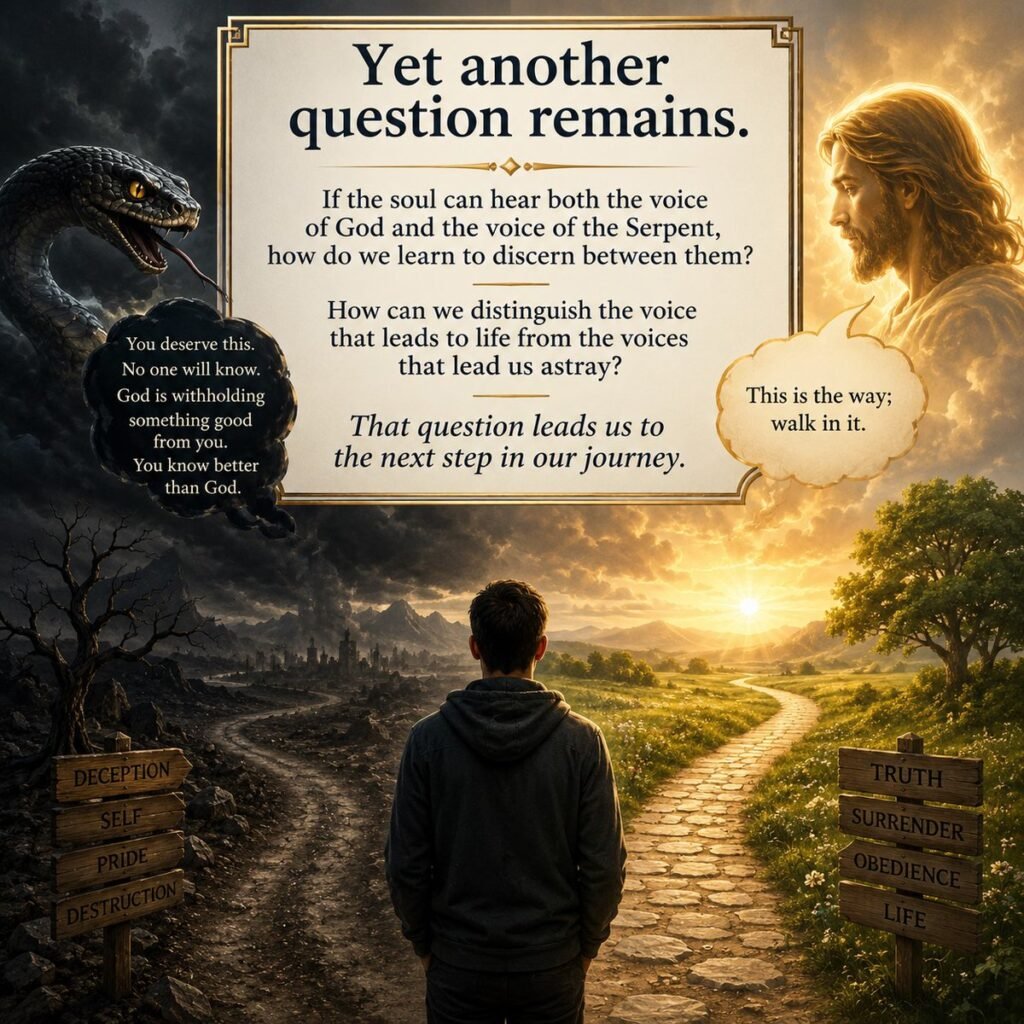
Through our bodies, we experience hunger, pleasure, pain, beauty, and the physical essence of existence. Through our spirits, we engage in worship, develop our conscience, seek transcendence, long for God, and become aware of eternity. The soul is where these realities converge, forming a single self that defines who we are. Because of this, we can hear voices beyond the physical realm that influence our choices. The book of Isaiah states, “And whether you turn to the right or to the left, your ears will hear this command behind you: ‘This is the way; walk in it.'” Just as Adam and Eve could hear both God’s voice and the Serpent’s voice, we too can discern voices from both Light and darkness.
The Battleground of the Soul
Consequently, the soul, where the body and spirit unite, becomes the battleground and the crossroads where we choose our allegiance. Similar to the Garden of Eden, we must decide whose voice we want to follow. If we choose God, we will remain with Him; if not, we will need to leave to respond to the voice we choose. Ultimately, the voice we follow will depend on the condition of our hearts.
With the understanding that we are living souls, let us return to the Garden of Eden and analyse Eve’s temptation and recognise the Serpent’s clever deception. This deception does not simply make evil appear good; rather, it presents disobedience as a pathway to a new stage of life. The temptation is not only about the physical attractiveness of the fruit, which was appealing to the eye and good for food, but it also possesses a spiritual allure aimed at her soul. The promise, “You will be like God,” suggests a potential for flourishing in Eve’s existence. This temptation targets not only her physical desires but also her spiritual being.
What the Soul Was Made For
In today’s world, wealth, achievement, knowledge, and influence appeal not only to the body but also to the soul’s desire for significance, greatness, and fulfilment. However, physical satisfaction will never truly meet our spiritual hunger, and the soul can possess everything and still feel empty. The soul keeps reaching for more because it was made for something infinitely greater than the world can offer. That “something” is not merely heaven, wisdom, or blessing, but God Himself.
Jesus said, “I am the bread of life. Whoever comes to Me will never hunger, and whoever believes in Me will never thirst.” Only God can truly satisfy our spiritual hunger and fill the emptiness that worldly achievements cannot. Only when we find our fulfilment in Him, will we be content in whatever we do and will no longer thirst for more. The tragedy of Eden was not that Eve chose what appeared to be death, but that she mistook a grasping for greatness as a movement toward life that only comes from God.
We can be like Joseph, who, despite his hardships as a slave, did not complain about his meaningless life because God was with him. With God with him, what little he had was enough. In contrast, Solomon, despite possessing status, power, fame, and wisdom, felt discontented. He remarked, “I have seen all the things that are done under the sun, and have found them to be futile, a pursuit of the wind.” As Augustine of Hippo famously wrote: “You have made us for Yourself, and our hearts are restless until they rest in You.” Therefore, the Palmist wrote, ” As the deer pants for streams of water, so my soul pants for You, my God. My soul thirsts for God, for the living God.”
More Is Not the Same as Fullness
Many mistakenly think that having more leads to greater fulfilment and satisfaction, while having less leads to less fulfilment and satisfaction. This is contrary to God. With God, the little we have can become much, but without God, the abundance we possess amounts to nothing. The key condition is that we must master the self in obedience to God. As Jesus said, “If you keep My commandments, you will remain in My love, just as I have kept My Father’s commandments and remain in His love. I have told you these things so that My joy may be in you and your joy may be complete.”
The completeness we seek is not found in material possessions, but in following the commandments and nothing else. Our souls must be connected to the Spirit of God so that we do not feel empty or in need of anything else. The Serpent, in the form of Satan, understood this and, through his deception, led to disobedience, which severed our connection to life by diminishing our dependence on God. Instead of encouraging reliance on God, he promoted self-sufficiency as a means of achieving godlike status.
The Serpent persuaded Eve that life could be found apart from God and that independence would lead to flourishing. Yet the history of humanity has proven the opposite. The soul continues to hunger because it was never created to live apart from its Creator. Wealth, achievement, knowledge, power, and influence may satisfy the body and impress the world, but they cannot satisfy the soul. Only God can do that. As Augustine observed, “You have made us for Yourself, and our hearts are restless until they rest in You.” Therefore, the mastery we seek is not first the mastery of the world, but the mastery of self in obedience to God. For only when the soul remains connected to its source of life will it find the completeness it has been searching for all along.
The Soul Must Remain Connected to Life
The story of Eden is not just about humanity’s first act of disobedience; it is about a soul searching for life in the wrong places. Eve reached for the forbidden fruit because it seemed to offer wisdom, fulfilment, greatness, and a deeper existence. It promised life but ultimately led her away from the true source of life. Since that day, humanity has continued to seek the same fruit in various forms. Some pursue it through wealth, while others seek it through achievement, influence, knowledge, status, or power. Each of these pursuits promises fulfilment, yet none can truly satisfy the deepest hunger of the soul.
The reason is clear: the soul was not created to seek its fulfilment in the world. Instead, it was designed to find its life in God. While wealth may fill our hands, knowledge may occupy our minds, and achievements may enhance our resumes, only God can satisfy the emptiness within our souls. Therefore, the most important question in life is not how much of the world we can acquire, but whether our souls remain connected to the One who gave them life. When the soul finds its rest in God, it no longer needs to strive for the fruits that promised fulfilment, because it has already discovered Life Himself.
Related Ideas
The Soul’s Hunger for God — the soul was created for communion with God; created things can be received as gifts, but they cannot satisfy the hunger that belongs to the Creator alone.
The Voice We Obey — Eden shows that desire is often awakened by a voice that redefines what life, wisdom and fulfilment mean.
Surrender — the serpent’s promise of self-sufficiency is answered by a soul willing to remain dependent on God rather than grasp for life apart from Him.
Faithfulness Before Success — abundance, achievement and visibility cannot become the measure of a life whose deepest good is communion with God.
Connected Ideas
Desire · Contentment · Self-Sufficiency · Temptation · Worldly Success · Communion with God · Obedience · Spiritual Hunger
Originally published on X on 2026-06-09. This website edition preserves the original essay while adding structural headings and knowledge links.