Core ideaScripture asks a deeper question than whether existence continues after death: do we possess the life of God before we die? Death exposes the limits of earthly achievement and leads to judgment, but Jesus Christ entered death, conquered it, and gives eternal life. In Christ, the believer dies to sin and the old self now, walks in newness of life, and can ultimately face physical death not as the final terror but as the doorway into God’s presence.
Is There Life After Death?
The question, “Is there life after death?” has followed humanity from the beginning of time. It is not a question only for the old, the sick, or the dying. It is a question for every man and woman, because death stands at the end of every human road. A man may build wealth, raise a family, establish a name, gain influence, accumulate knowledge, and enjoy success, but one day he must still face the grave. Death is the great interruption. It breaks plans, silences ambition, separates families, and strips away every earthly title.
Death Is Real, but Not Final
Yet the Bible does not treat death as a mystery that cannot be understood. Scripture speaks plainly. Death is real. Death is painful. Death is an enemy. But death is not final for those who belong to God. The Bible’s answer to the question of life after death is not vague, sentimental, or merely comforting. It is deeply serious. It tells us that there is life after death, but also judgment after death. It tells us that man does not simply pass into a peaceful unknown. He passes into the presence of God.
The Question Beneath the Question
This is where biblical thinking challenges human thinking.
Human thinking usually asks, “Will I continue after I die?”
Biblical thinking asks, “Do I have the life of God before I die?”
Human thinking asks, “Is there existence beyond the grave?”
Biblical thinking asks, “Am I reconciled to the One who holds eternity?”
Human thinking wants life without surrender.
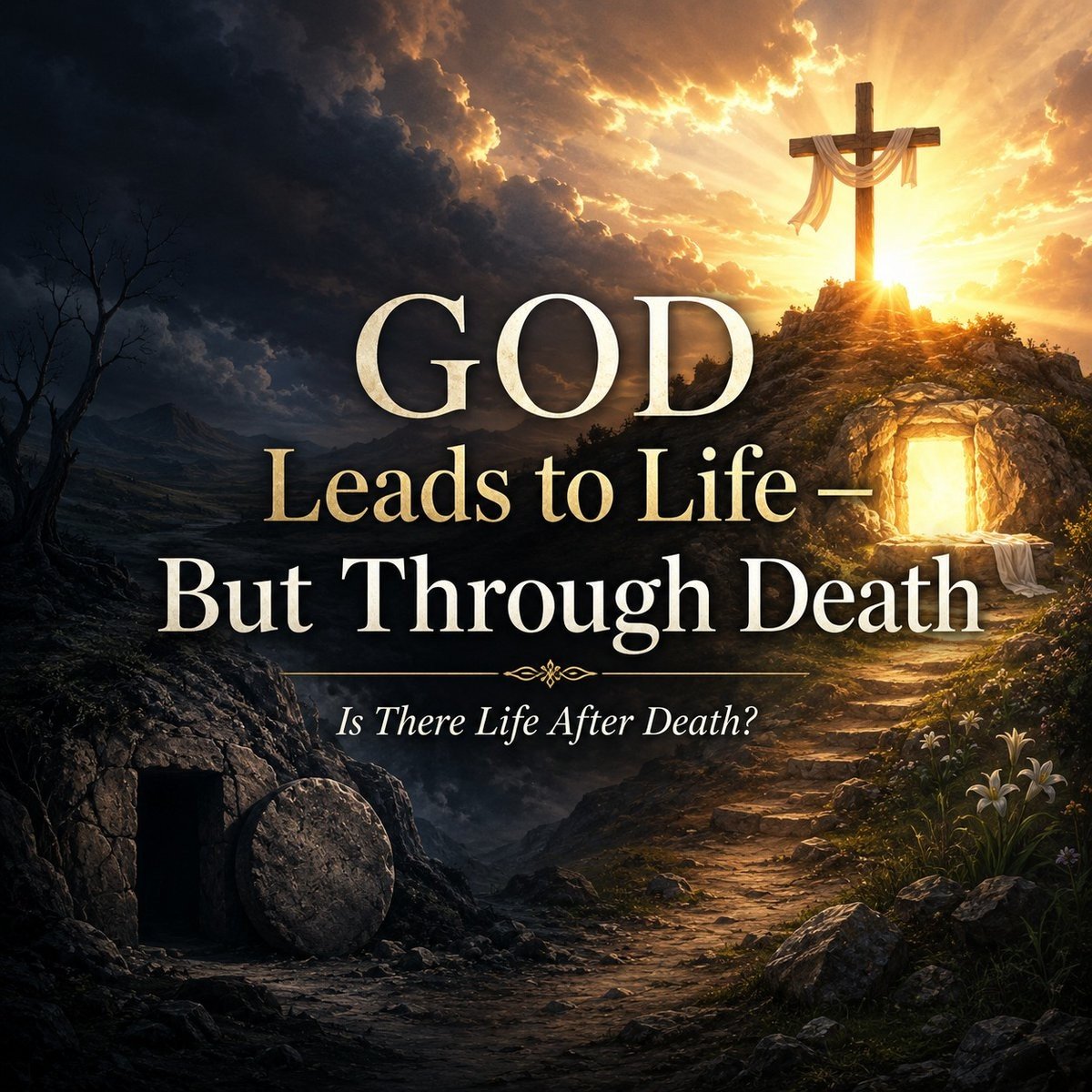
God gives life through death. This is the central truth: God leads to life—but through death.
Not only physical death, but death to sin, death to pride, death to the old self, death to rebellion, death to the illusion that this present world is ultimate. The Bible does not merely promise that something exists after death. It declares that true life is found only in God, and that eternal life comes through Jesus Christ, who entered death and conquered it.
Romans 6:23 says, “For the wages of sin is death, but the gift of God is eternal life in Christ Jesus our Lord.”
This verse gives us the whole framework. Death is wages. Eternal life is gift. Death is earned through sin. Life is received through Christ. Therefore, the real question is not only whether there is life after death. The deeper question is: Who possesses the life that death cannot destroy?
The Bible gives us many characters who wrestled with death, suffering, eternity, judgment, and resurrection. Through them, we see different angles of this great question. Solomon shows us the emptiness of life when death is viewed without God. Job shows us hope beyond bodily decay. David shows us the comfort of God’s presence in the valley of death. Lazarus and Martha reveal that resurrection is not merely a doctrine but a Person. The thief on the cross shows that eternal life is received by faith, not earned by religious achievement. Paul shows that death becomes gain when Christ becomes life. And Jesus Christ Himself reveals the final truth: death is conquered only through the cross and resurrection.
Solomon: Death Exposes Life Without God
Solomon is one of the clearest biblical characters who confronts death honestly. He had wisdom, wealth, pleasure, power, and opportunity. If anyone could test the meaning of life under the sun, it was Solomon. Yet in Ecclesiastes, he looks at human life and sees a painful reality: the wise man dies, the fool dies, the rich man dies, the poor man dies. Man builds, but another inherits. Man labours, but cannot keep his gain forever. Man enjoys, but pleasure fades. Man seeks knowledge, but knowledge cannot stop death.
Ecclesiastes 3:20 says, “All go to one place. All are from the dust, and to dust all return.”
Solomon does not speak like a shallow pessimist. He speaks like a man who has looked honestly at the world without pretending. Death exposes the vanity of earthly life when life is disconnected from God. It shows that achievement alone cannot save a person. It shows that pleasure alone cannot satisfy the soul. It shows that human wisdom, though useful, cannot defeat the grave.
This is important for our generation. Modern man often believes that progress will eventually solve everything. Education, medicine, technology, wealth, and artificial intelligence may improve life, extend life, and make life more convenient. But none of them can remove death. Death still stands beyond every advancement.
The most powerful man and the weakest man both return to dust.
Solomon’s conclusion is therefore not that life is meaningless in an absolute sense. His conclusion is that life becomes meaningless when it is lived without reference to God. At the end of Ecclesiastes, he says, “Fear God and keep his commandments, for this is the whole duty of man. For God will bring every deed into judgment.”
This is a serious truth. Death does not erase accountability. Death leads to judgment. Therefore, the wise man does not live only for what he can gain before death. He lives in the fear of God, knowing that every life will be weighed before Him.
Job: My Redeemer Lives
But if Solomon shows the emptiness of earthly life without God, Job shows hope in God even when earthly life collapses.
Job was a man who came face to face with suffering and death. He lost his wealth, his children, his health, and his honour. His body was wasting away. His friends accused him. His wife told him to curse God and die. Job sat in ashes, covered in pain, wrestling with questions too heavy for ordinary speech.
Yet in the middle of his suffering, Job declared one of the most powerful statements of hope in the Old Testament:
“I know that my Redeemer lives, and at the last he will stand upon the earth. And after my skin has been destroyed, yet in my flesh I shall see God.”
This is remarkable. Job does not merely hope that his pain will end. He hopes in a living Redeemer. He believes that even if his body is destroyed, he will see God. His hope reaches beyond sickness, beyond loss, beyond the grave.
Job teaches us that biblical hope is not optimism. Optimism says, “Things may get better.” Biblical hope says, “My Redeemer lives.” Optimism depends on circumstances changing. Biblical hope depends on God remaining faithful.
This is why Job is so important to the question of life after death. He shows us that the believer’s hope is not rooted in the preservation of the body in this present age. The body may decay. Health may fail. Strength may disappear. But if the Redeemer lives, then death does not have the final word.
David: God Is Present in the Valley
David also explores death deeply, but from another angle. David knew danger, betrayal, war, guilt, grief, and loss. He saw death on battlefields. He saw death in his own family. He knew what it meant to walk near the edge of the grave. Yet in Psalm 23, David says:
“Even though I walk through the valley of the shadow of death, I will fear no evil, for you are with me.”
David does not say that God prevents him from entering the valley. He says God is with him in the valley. This is one of the deepest comforts in Scripture. The believer does not always avoid danger, suffering, or death. But the believer is not abandoned in them.
The valley of the shadow of death is frightening because it reminds man of his weakness. But David’s confidence is not in himself. His confidence is in the presence of the Shepherd. God’s presence changes the meaning of the valley. Death is still a shadow, but it is not sovereign. Darkness is real, but God is nearer than the darkness.
David also says in Psalm 16, “You will not abandon my soul to Sheol, or let your holy one see corruption.” In the New Testament, Peter applies this to Christ’s resurrection. David’s words point beyond David himself to the greater Son of David, Jesus Christ, who would enter death and rise again.
Lazarus and Martha: Resurrection Is a Person
This brings us to Lazarus and Martha.
The story of Lazarus in John 11 is one of the clearest biblical revelations of life after death. Lazarus was sick. His sisters, Mary and Martha, sent word to Jesus. But Jesus delayed. By the time He arrived, Lazarus had already been dead four days.
Martha came to Jesus grieving. She said, “Lord, if you had been here, my brother would not have died.” Her words are full of sorrow, but also faith. She believed Jesus could have healed Lazarus. She believed in the resurrection on the last day. But Jesus brought her understanding deeper.
He said, “I am the resurrection and the life. Whoever believes in me, though he die, yet shall he live.”
This is one of the most important statements Jesus ever made. He did not merely say, “I teach resurrection.” He did not merely say, “I can perform resurrection.” He said, “I am the resurrection and the life.”
This means eternal life is not first a concept. It is not merely a future event. It is not simply a religious belief. Eternal life is found in a Person. Jesus Himself is the resurrection. Jesus Himself is life.
Martha believed in a future doctrine. Jesus revealed that the doctrine stood before her in human flesh.
Then Jesus went to the tomb and called, “Lazarus, come out.” And the dead man came out.
Lazarus’ resurrection was a sign. It showed that death must obey the voice of Christ. But Lazarus would eventually die again physically. His resurrection pointed to something greater: the resurrection of Jesus, who would rise never to die again.
Through Lazarus, we learn that death is not stronger than Christ. Through Martha, we learn that correct doctrine must become personal faith in Jesus Himself. It is possible to believe in life after death as an idea, yet not fully grasp that life is found only in Christ.
The Thief: Grace at the Edge of Death
The thief on the cross gives us another powerful picture. Unlike Solomon, he had no lifetime of wisdom to reflect on. Unlike Job, he had no long testimony of endurance. Unlike David, he had no psalms of worship. Unlike Paul, he had no ministry. He was a condemned man dying beside Jesus.
Yet in his final moments, he turned to Christ and said, “Jesus, remember me when you come into your kingdom.”
That prayer was simple, but full of faith. He saw a kingdom when others saw only a dying man. He saw innocence in Jesus while others mocked Him. He saw hope when his own life was ending.
Jesus replied, “Today you will be with me in paradise.”
This is one of the clearest statements about life after death in Scripture. The thief had no time to perform religious works. He could not repair his past. He could not build a record of obedience. He could only trust Christ. And Christ promised him paradise.
This destroys human pride. Eternal life is not earned by achievement. It is not purchased by good works. It is not secured by reputation. It is received by grace through faith.
The thief on the cross shows us that salvation is possible even at the edge of death. But his story should not make us careless. It should make us humble. He was saved at the last hour not because the last hour is safe to delay until, but because Christ is mighty to save.
Then we come to Paul, who gives perhaps the most mature Christian view of death. Paul had suffered beatings, imprisonment, danger, rejection, hunger, and persecution. He lived with death near him. Yet he wrote:
Paul: To Live Is Christ, to Die Is Gain
“For to me to live is Christ, and to die is gain.”
This sentence is impossible for the natural man to say honestly. Most people believe to live is gain and to die is loss. But Paul reverses it. Why? Because Christ had become his life. If Christ is life, then death cannot take life away. Death can only bring the believer nearer to Christ.
Paul also writes that to be away from the body is to be at home with the Lord. He does not view death as extinction. He views it as departure into the presence of Christ. This does not mean Paul despised earthly life. He continued serving, preaching, suffering, and loving the church. But he no longer clung to earthly life as ultimate.
This is the freedom of the Christian. The believer can live faithfully without worshipping this life. He can work, build, love, serve, and endure, but he knows his true treasure is beyond the grave.
Paul also teaches that believers are united with Christ in His death and resurrection. In Romans 6, he explains that those who belong to Christ have died to sin and now walk in newness of life. This means the Christian experience of eternal life begins before physical death. The believer has already passed from spiritual death into life.
This is crucial. Christianity does not only answer what happens after the body dies. It addresses the deeper problem that man is spiritually dead even while physically alive.
Life Before Death: Dying to Sin
A person may breathe, eat, work, speak, trade, study, marry, and succeed, yet remain dead in sin. This is why Jesus told Nicodemus, “You must be born again.” Man does not merely need improvement. He needs resurrection of the soul.
Therefore, God leads to life through death in two ways. First, Christ physically died and rose again so that believers may have eternal life. Second, the believer must spiritually die to the old self in order to live a new life in God.
This brings us to the centre of everything: Jesus Christ.
All biblical reflection on death and eternal life must end with Him. Jesus did not merely discuss death. He entered it. He did not merely comfort mourners. He conquered the grave. He did not merely promise resurrection. He rose bodily from the dead.
Jesus Christ: The One Who Holds the Keys
At the cross, Jesus carried sin. He entered judgment. He bore the curse. He tasted death. But on the third day, He rose. The resurrection is God’s declaration that death has been defeated, sin has been answered, and eternal life has been opened to all who believe.
Revelation 1:18 records Jesus saying, “I died, and behold I am alive forevermore, and I have the keys of Death and Hades.”
This is the final authority. Jesus does not merely survive death. He rules over it. He holds the keys. Death is not king. Christ is King.
Therefore, the Christian answer to “Is there life after death?” is not a weak yes. It is a victorious yes—but a serious one.
Yes, there is life after death.
But there is also judgment after death.
Yes, there is resurrection.
But resurrection unto life belongs to those who are in Christ.
Yes, death is real.
But Christ has defeated death.
Yes, the grave receives the body.
But it cannot imprison those who belong to Jesus.
This truth should change the way we live now.
If death is not the end, then earthly success is not ultimate.
If judgment is real, then hidden sin is not hidden forever.
If resurrection is promised, then suffering is not meaningless.
If Christ is life, then living without Him is the greatest tragedy.
If eternal life is a gift, then pride must die.
If God leads to life through death, then the old self must be crucified.
The world teaches us to preserve ourselves, promote ourselves, protect ourselves, and build our own name. Jesus teaches us to deny ourselves, take up our cross, and follow Him. The world says life is found in gaining more. Jesus says life is found in losing ourselves for His sake.
What This Means for the Way We Live
This is why Christianity is not merely a religion of comfort. It is a religion of resurrection. And resurrection always passes through death. The seed must fall into the ground and die before it bears fruit.
The old self must die before the new life appears.
Christ had to go to the cross before the empty tomb.
The believer must die to sin before walking in holiness.
The body may die, but the believer will rise.
So the question is no longer only, “Is there life after death?”
The greater question is:
Have you received the life that death cannot destroy?
Solomon tells us that life without God is vanity.
Job tells us that the Redeemer lives beyond bodily decay.
David tells us that God walks with His people through the valley of death.
Martha tells us that resurrection is more than doctrine.
Lazarus tells us that death must obey the voice of Christ.
The thief tells us that grace can save even at the edge of the grave.
Paul tells us that to live is Christ and to die is gain.
Jesus tells us, finally and fully, that He is the resurrection and the life.
Therefore, we do not place our hope in human memory, reputation, wealth, health, or legacy. These things may have value, but they cannot defeat death.
Our hope is in Christ.
Have You Received the Life Death Cannot Destroy?
He entered death.
He conquered death.
He rose from death.
He holds the keys of death.
And He gives eternal life to all who believe in Him.
So yes, there is life after death.
But more than that, there is life before death for the one who dies to self and lives in Christ.
And for that person, death is no longer the final terror. It becomes the final doorway. Not into darkness, but into the presence of the Lord.
God leads to life—but through death.
And only in Christ does death become the road to eternal life.
#GodLeadsToLife
Related Ideas
The Life Death Cannot Destroy — The deepest biblical question is not merely whether existence continues after death, but whether we possess the life of God before we die. In Christ, eternal life begins now and physical death cannot finally destroy it.
The Final Word Is Resurrection — Christ does not merely promise survival after death; His resurrection establishes that death itself will not have the final word.
Live Ready, Not Merely Long — the reality of death turns the question from how many years we can secure to whether we are reconciled to God and ready to meet Him.
Surrender — the life of God is not found by preserving the old self at all costs, but by yielding pride, rebellion, control, and self-rule to Christ.
Connected Ideas
Death · Eternal Life · Resurrection · Judgment · Surrender · New Birth · Dying to Self · Christ · Grace · Hope
Originally published on X on 2026-05-12. This website edition preserves the original essay while adding structural headings and knowledge links.